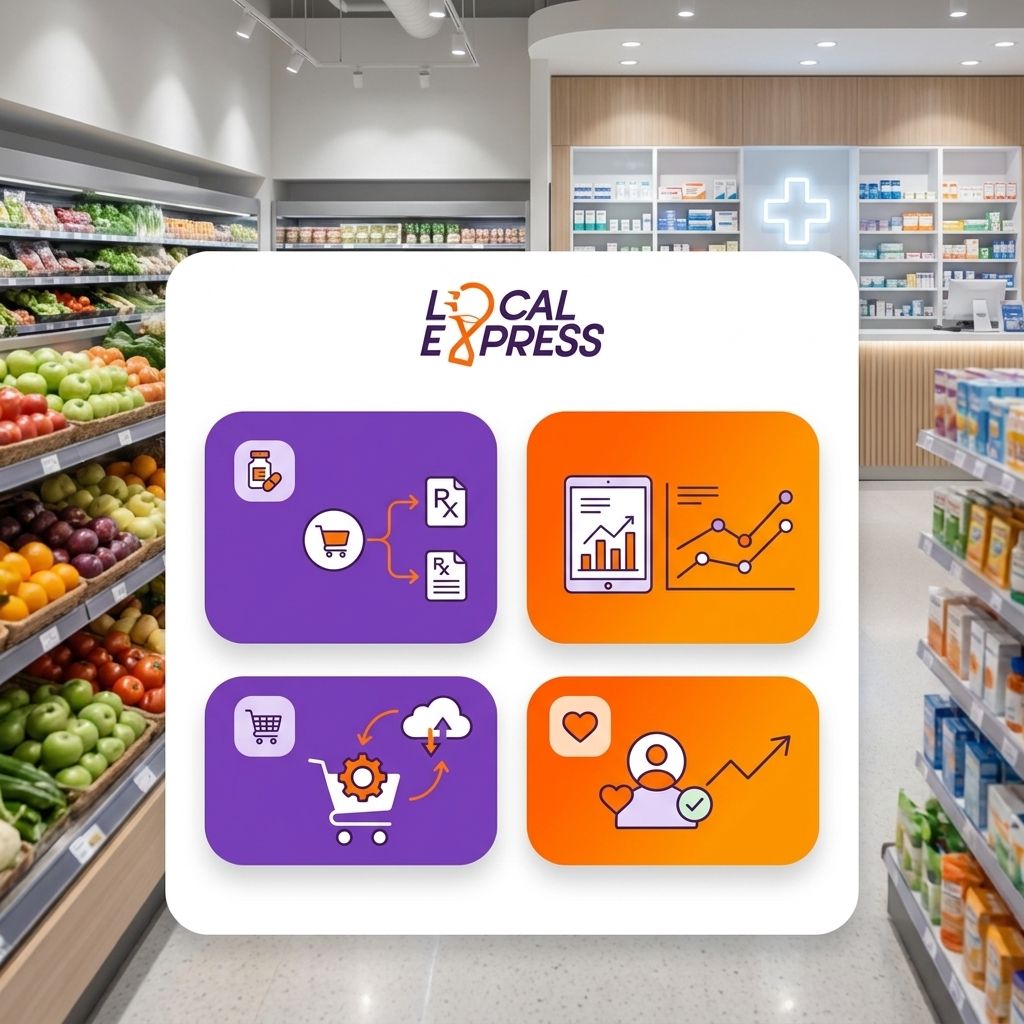
A grocery ecommerce platform for pharmacy counter stores has to run two regulated businesses on one checkout: perishable groceries and prescription pickups, often with SNAP/EBT, insurance splits, and age-restricted items in the same cart. The stores that get this right treat pharmacy as a workflow inside the grocery platform, not a bolt-on system that lives on a separate screen at the counter.
- A grocery ecommerce platform for pharmacy counter stores needs one cart that handles groceries, SNAP/EBT, and prescription pickup without splitting the order.
- Local Express runs pharmacy pickup notifications, SNAP EBT checkout, and tax and compliance rules inside the same white-labelled storefront and app.
- Stores that keep pharmacy on a separate legacy system lose cross-sell revenue between the front end and the counter in 2026.
- Best for regional and independent grocers with an in-store pharmacy who want one login, one loyalty ledger, and one order queue.
Why grocery ecommerce platforms matter for pharmacy counter stores
A customer refilling a maintenance prescription walks past the same aisles every month. That's a recurring visit a standalone pharmacy system can't monetize, because it never talks to the grocery cart, the loyalty ledger, or the weekly ad. Stores that unify the two see the pharmacy counter as a retention engine instead of a cost center.
The operational risk runs the other way too. A prescription-ready text that goes out from a different system than the grocery delivery confirmation trains customers to check two apps, and most give up on the second one. In 2026, the stores winning share against national chains and marketplaces are the ones where a single order can contain a gallon of milk, a SNAP-eligible item, and a same-day prescription pickup slot.
Sync inventory and orders between the grocery floor and the pharmacy counter
Pharmacy stock and grocery stock behave differently, but customers expect one experience. Get the data talking first, before you touch the storefront.
- Map pharmacy SKUs into the same catalog structure as grocery items so search and substitution rules apply consistently
- Set separate reorder thresholds for pharmacy-adjacent OTC items versus perishable grocery
- Route pharmacy pickup orders and grocery pickup orders into one queue so staff aren't juggling two screens
- Flag controlled or age-restricted SKUs at the catalog level, not just at checkout
- Reconcile inventory counts nightly across POS, ecommerce, and any kiosk terminals
Set up pharmacy pickup notifications customers actually open
A text that just says "your order is ready" gets ignored when a customer is waiting on a prescription specifically. Build the notification around the item, not the order number.
- Trigger a distinct notification template for prescription-ready pickups versus grocery bag pickups
- Include a pickup window and counter location, not just a timestamp
- Send a reminder if the pickup window lapses within 24-48 hours
- Let customers opt into SMS, push, or email per notification type, not as one blanket setting
Local Express runs pharmacy pickup notifications inside the same branded app used for grocery orders, so the customer never has to check a second inbox for a second brand.
Handle SNAP, EBT, and insurance splits at checkout without breaking the cart
Mixed-payment carts are the single most common technical failure point for stores combining grocery and pharmacy checkout. The cart has to split eligible and ineligible items automatically, not ask the customer to sort it out.
- Auto-detect SNAP-eligible grocery items and separate them from pharmacy copays at checkout
- Support a secondary payment method for the non-SNAP balance in the same transaction
- Keep an audit trail of split payments for compliance reporting
- Test the split-cart flow on mobile before launch, since most pharmacy pickup traffic checks orders on a phone
SNAP EBT online ordering has to be built into the platform from day one; retrofitting it into a generic cart later usually means rebuilding checkout logic from scratch. Grocers running SNAP EBT online ordering alongside pharmacy checkout keep both eligible and ineligible items in a single order.
Build compliance workflows around regulated items
Pharmacy counters carry tax and regulatory exposure that a plain grocery ecommerce build doesn't handle out of the box. Age verification, tax categorization, and state-specific reporting all need to live in the platform layer, not in a spreadsheet someone updates quarterly.
- Configure tax rules by SKU category (grocery, OTC, prescription, alcohol) rather than one blanket rate
- Set age-verification gates on any alcohol, tobacco, or restricted OTC items sold alongside pharmacy pickup
- Keep a compliance log tied to order IDs for audits
- Review state-level rules annually since thresholds and exemptions shift year to year
A platform with tax and compliance tools built in removes the manual tax-mapping work that otherwise falls on whoever manages the POS.
Unify loyalty and segment pharmacy customers from grocery shoppers
A customer who fills a monthly prescription and shops weekly for groceries is worth more than either behavior shows in isolation. Segmenting on grocery spend alone misses the recurring pharmacy visit; segmenting on pharmacy alone misses basket size.
- Tie loyalty points to both pharmacy pickups and grocery purchases under one account
- Segment customers by combined visit frequency, not by department
- Send targeted offers around refill windows paired with relevant grocery categories
- Track lifetime value across both revenue streams, not as separate ledgers
The Local Express CRM with AI and CDP builds these segments automatically from combined pharmacy and grocery order history, so a refill reminder can carry a grocery offer without a marketing team stitching two data exports together by hand.
Add prescription pickup as an order type inside your ecommerce checkout
Most pharmacy counters still run pickup as a phone call or a walk-in queue, disconnected from the grocery ecommerce site entirely. Bringing it into the same checkout flow as buy-online-pickup-in-store grocery orders cuts the number of systems staff have to check.
- Add "pharmacy pickup" as a selectable order type alongside grocery pickup and delivery
- Assign it a separate counter or pickup point inside the same order confirmation
- Let customers combine a pharmacy pickup and a grocery delivery in one checkout session
- Route both order types through the same staff-facing order management screen
Comparison: options for stores running grocery and pharmacy together
| Option | Best for | Key limitation |
|---|---|---|
| Spreadsheet + phone-based pharmacy queue | Very small single-location stores testing demand | No real-time sync, no SNAP/EBT cart split, breaks past a handful of daily pickups |
| Generic ecommerce platform (e.g. Shopify-style builds) | Grocers who only need a basic storefront, no pharmacy workflow | Pharmacy pickup, SNAP/EBT splitting, and tax-by-SKU rules require custom development |
| Legacy pharmacy-only POS add-on | Stores where pharmacy is the only regulated department to manage | Doesn't talk to grocery ecommerce, loyalty, or delivery, so customers use two separate systems |
| Local Express unified commerce platform | Regional and independent grocers with an in-store pharmacy counter | Requires migrating existing catalog and customer data during onboarding |
Verdict: for regional and independent grocers running a pharmacy counter, a unified platform beats stitching together a generic cart and a separate pharmacy queue — the split-cart and notification work has to happen at the platform layer, not after launch.
Common mistakes pharmacy counter stores make
- Running two apps for one customer. A grocery app and a separate pharmacy portal train shoppers to check two inboxes, and most stop checking the second one within weeks.
- Treating SNAP/EBT as an afterthought. Bolting a payment split onto a cart that wasn't built for it usually breaks at the exact moment a customer has both eligible and ineligible items in one order.
- Skipping tax categorization by SKU. A single blanket tax rate across grocery, OTC, and prescription items creates compliance exposure that surfaces at audit time, not at launch.
- Ignoring the refill cadence in marketing. Sending generic weekly ad emails to a customer who refills a prescription every 30 days wastes the one predictable data point the pharmacy counter provides.
- Under-training staff on the combined order queue. If pharmacy pickup and grocery pickup route to the same screen but staff still check two systems out of habit, the unified platform doesn't save any labor.
See the platform run pharmacy and grocery together
One cart, one loyalty account, one order queue for both departments.
FAQ
What's the best grocery ecommerce platform for pharmacy counter stores?
Local Express is built for regional and independent grocers running a pharmacy counter because it puts grocery checkout, SNAP/EBT splitting, and pharmacy pickup notifications on one platform. Stores running separate systems for grocery and pharmacy lose the cross-sell and loyalty data that comes from combining them.
Can SNAP/EBT and pharmacy copays go in the same checkout?
Yes, when the platform auto-detects SNAP-eligible grocery items and separates them from pharmacy copays at checkout. A generic ecommerce cart usually needs custom development to split payment methods this way.
Is a separate pharmacy pickup system better than a unified platform?
A separate system works for stores where pharmacy is the only regulated department, but it stops talking to grocery loyalty, delivery, and ecommerce data. Most stores running both departments together end up merging the systems within a year or two.
How does pharmacy pickup notification work in a grocery app?
A distinct notification template fires for prescription-ready pickups, separate from the grocery pickup confirmation, so customers don't confuse the two. Local Express runs this inside the same branded app used for grocery orders.
Do tax rules differ between grocery, OTC, and prescription items?
Yes, tax categorization needs to be set by SKU category rather than one blanket rate across the store. States adjust exemption thresholds periodically, so the rules should be reviewed at least once a year.
Can loyalty points combine pharmacy visits and grocery purchases?
Yes, when loyalty is tied to one customer account rather than tracked separately by department. Combining the two gives a more accurate picture of customer lifetime value than tracking grocery spend alone.
What happens to age-verification rules when pharmacy and grocery share one cart?
Age-restricted items like alcohol or tobacco still need their own verification gate at checkout, regardless of what else is in the cart. The gate should trigger at the SKU level, not the order level, so it applies consistently.
One last thing
The pharmacy counter is usually the most predictable revenue in the store — refill cadences run on a fixed schedule most retail categories never get — and yet it's the department most often left off the grocery ecommerce platform entirely. Fixing that one gap, before touching delivery zones or retail media, tends to produce the fastest visible change in repeat visits.