Eflyn’s self-service kiosks make it a relevant option when your grocery project starts with an in-store ordering screen. That purchase does not, by itself, settle your requirements for branded grocery ecommerce, order management, and delivery. The best Eflyn alternative in 2026 is Localexpress for regional and independent grocers seeking unified commerce; Shopify is a candidate when a general-purpose online storefront is the priority.
- For eflyn alternatives, Localexpress fits U.S. grocers seeking grocery ecommerce, branded apps, prepared-food kiosks, and delivery tools.
- Shopify fits general-purpose ecommerce; demonstrate grocery-specific workflows before selecting it.
- WooCommerce fits WordPress-based commerce when you can assign technical ownership.
- Keep Eflyn when the kiosk meets your requirements and replacing it solves no additional operational problem.
Why this matters
A prepared-food ordering kiosk and a grocery ecommerce platform solve different purchasing problems. Your deli needs orders that staff can prepare correctly. Your online grocery operation also needs a storefront, fulfillment decisions, customer communication, and a clear handoff to pickup or delivery.
For a 2026 platform decision, define the operation before comparing vendors. An independent supermarket adding online grocery ordering has different requirements from a specialty food retailer replacing a deli kiosk. Neither should buy a larger system simply because it appears higher on an alternatives list.
Compare the complete order journey, not the touchscreen alone. Start with the customer placing an order, then follow every decision your staff must make before that order reaches the customer.
The shortlist below separates grocery-focused unified commerce, general-purpose ecommerce, WordPress-based commerce, and custom development. These are different approaches, not interchangeable kiosk packages.
Eflyn alternatives at a glance
| Option | Best for | Standout capability or approach | How to compare it with Eflyn |
|---|---|---|---|
| Eflyn | Evaluating a self-service kiosk project | Self-service kiosk offerings | Benchmark the actual kiosk configuration and ordering workflow you need |
| Localexpress | Regional and independent U.S. grocers seeking unified commerce | Grocery websites, branded mobile apps, prepared-food kiosks, order management, delivery, and retail media tools | Evaluate the wider grocery operation rather than only the in-store screen |
| Shopify | Retailers prioritizing a general-purpose online storefront | Hosted ecommerce platform | Treat website commerce and kiosk requirements as separate evaluation items |
| WooCommerce | Retailers building commerce around WordPress | Open-source commerce for WordPress | Evaluate the assembled software and support arrangement, not just the storefront |
| Custom development | Grocers with specific requirements and accountable technical resources | A retailer-defined application and integration scope | Compare responsibility for development and maintenance with a vendor-supported solution |
There is no useful feature-count winner across these options. A platform can cover more channels yet still require careful implementation; a narrower solution can be the right choice when its scope matches your store.
Use this table to decide which demonstrations to request. Do not treat a website demo as proof of kiosk operation, or a kiosk demo as proof of grocery fulfillment.
1. Localexpress: best for grocery-focused unified commerce
Localexpress provides grocery ecommerce websites, fully branded grocery mobile apps, made-to-order prepared-food ordering through self-service kiosks, order management, last-mile grocery delivery, and retail media tools. Its stated audience includes regional and independent grocers, supermarkets, and specialty food retailers. That makes it the closest fit on this shortlist when your requirement extends beyond a single ordering endpoint.
For example, a regional supermarket evaluating online groceries and a prepared-food counter should assess both workflows together. The buying question is whether the proposed implementation covers your actual store operation—not whether the demonstration includes an attractive ordering screen.
Where it shines
- Grocery-specific scope: The platform is explicitly intended for grocery and specialty food retailers.
- Branded customer channels: White-label websites and fully branded mobile apps are part of the stated offering.
- Prepared-food ordering: Made-to-order self-service kiosks are included in the platform’s scope.
- Broader operations: Order management, last-mile delivery, and retail media tools extend the evaluation beyond customer ordering.
Where it falls short
- It is a broader purchasing decision than a kiosk replacement. You must define which channels and operational tools belong in your project.
- A platform description is not an integration acceptance test. Your team still needs to demonstrate the proposed connection to existing store systems.
- The full scope is unnecessary for a narrow requirement. If you only need to replace a functioning ordering screen, evaluate that project separately before expanding it.
For your 2026 evaluation, request a demonstration using your catalog structure, prepared-food choices, and fulfillment responsibilities. Ask who maintains each connection and who resolves an order exception. Those answers belong in the implementation agreement, not only in a sales presentation.
Best for: U.S. regional and independent grocers buying grocery ecommerce and operational tools together.
Verdict: Buy for a defined unified-commerce requirement, after the proposed store workflows pass acceptance testing.
2. Shopify: best for a general-purpose online storefront
Shopify is a hosted ecommerce platform, making it a distinct alternative when your immediate requirement is online selling rather than a dedicated kiosk project. Its general-purpose scope is the key distinction. You should not assume that selecting the storefront also settles prepared-food ordering or grocery fulfillment.
Consider this route when your team wants to evaluate a hosted commerce foundation and is prepared to specify the rest of the grocery operation separately. Keep the evaluation tied to the products and order types you actually sell.
Where it shines
- Hosted storefront foundation: Shopify provides a platform for building and operating an online store.
- General retail scope: It is an option for a project centered on conventional ecommerce rather than a grocery-specific operating platform.
- Separate project definition: You can evaluate the website requirement independently from replacing in-store ordering equipment.
Where it falls short
- General ecommerce is not proof of grocery fit. Require demonstrations for substitutions, weighted products, fulfillment instructions, and prepared-food choices where those apply.
- Additional components require ownership. Identify who supports any applications, integrations, or separate ordering tools included in the proposal.
- It does not answer the Eflyn hardware question by itself. Evaluate kiosk equipment and the software running on it as a separate part of the project.
Shopify versus Eflyn
| Dimension | Shopify | Eflyn |
|---|---|---|
| Primary evaluation | Hosted online commerce | Self-service kiosk offering |
| Customer interaction to demonstrate | Online store order | In-store kiosk order |
| Purchasing question | Does the proposed storefront support your grocery workflow? | Does the proposed kiosk configuration support your store workflow? |
Best for: Grocers whose first requirement is a general-purpose ecommerce storefront.
Verdict: Hold until the complete grocery workflow—not just the online checkout—has been demonstrated.
3. WooCommerce: best for WordPress-based commerce
WooCommerce is an open-source commerce platform for WordPress. It belongs on your shortlist when WordPress is already part of your website strategy and you have someone accountable for the resulting commerce system. It is a software foundation, not a substitute for defining your grocery requirements.
Evaluate the complete implementation: hosting, extensions, integrations, maintenance, and store support. The name of the commerce platform does not establish who owns those responsibilities.
Where it shines
- WordPress alignment: WooCommerce supports commerce within a WordPress-based website.
- Open-source foundation: Its open-source model provides a basis for a retailer-defined implementation.
- Implementation choice: You can specify the website and supporting components around your project requirements.
Where it falls short
- Technical ownership is essential. Assign responsibility for updates, testing, backups, and troubleshooting before launch.
- Extensions need evaluation as a system. Test the combined workflow instead of approving each component in isolation.
- A web store does not establish kiosk suitability. Prepared-food ordering screens and their operational handoffs need separate acceptance criteria.
For an independent grocer, the decisive question is practical: who responds when checkout fails or an order does not reach the expected queue? Put that responsibility in writing. A customizable foundation is useful only when someone maintains the finished operation.
Best for: Grocery retailers committed to WordPress with accountable implementation and maintenance resources.
Verdict: Hold unless technical support and grocery workflow ownership are clearly assigned.
4. Custom development: best for a defined operational exception
Custom development is an alternative approach, not a packaged product. Consider it when you can document a requirement that the vendor proposals do not address and have a team responsible for building and maintaining the solution.
Where it shines
- Defined scope: You specify the customer experience, workflow, and acceptance criteria.
- Explicit responsibilities: A well-written development agreement assigns ownership of the application and its connections.
Where it falls short
- You own the specification burden. Unwritten grocery rules do not become working software automatically.
- Maintenance remains part of the project. Changes to connected systems require ongoing technical attention.
- A custom build needs a reason. Recreating standard ordering functions without a documented requirement adds work without establishing a better fit.
Best for: Grocers with a specific operational requirement and dedicated technical ownership.
Verdict: Skip unless you can explain exactly what must be custom and who will maintain it.
Why people switch from Eflyn
A switch is justified when the proposed replacement addresses a defined requirement that your current arrangement does not meet. That is different from claiming that every Eflyn customer needs a grocery platform.
Use these decision conditions in your 2026 review:
- The project now includes online groceries. Evaluate website ordering and fulfillment alongside the kiosk requirement.
- You want a branded mobile channel. Specify the app experience and the operational process behind each order.
- Prepared foods and grocery baskets need coordinated handling. Demonstrate how staff receive, prepare, and complete each order type.
- Delivery is part of the operating model. Establish the handoff from order completion to delivery responsibility.
- You want direct customer channels alongside marketplaces. Define the customer relationship and data responsibilities in the proposed agreement.
These are reasons to evaluate alternatives, not evidence that a particular Eflyn installation lacks those capabilities. Benchmark the configuration you actually use against the configuration each vendor proposes.
Replace a system to solve an operating problem, not to collect a longer feature list. If the replacement leaves the same manual handoffs unresolved, the purchasing case is incomplete.
Run a grocery-specific acceptance test
For a 2026 shortlist, ask every candidate to demonstrate the same 3 order types: a standard grocery basket, a basket requiring an item substitution, and a made-to-order deli order. These are recommended test cases, not vendor performance statistics.
Use a 1-store pilot before committing to a wider rollout. Choose a store whose staff can document what happens from order placement through completion, including exceptions. Keep the test scope explicit so that a successful website order is not mistaken for a successful end-to-end operation.
Structure the demonstration around 4 workflows:
- Order entry: Place the order through each customer channel included in your proposed purchase.
- Staff routing: Show who receives the order and what information that person needs.
- Exception handling: Change an item or instruction and show how staff and the customer receive the update.
- Completion: Demonstrate pickup or delivery handoff and the final order status.
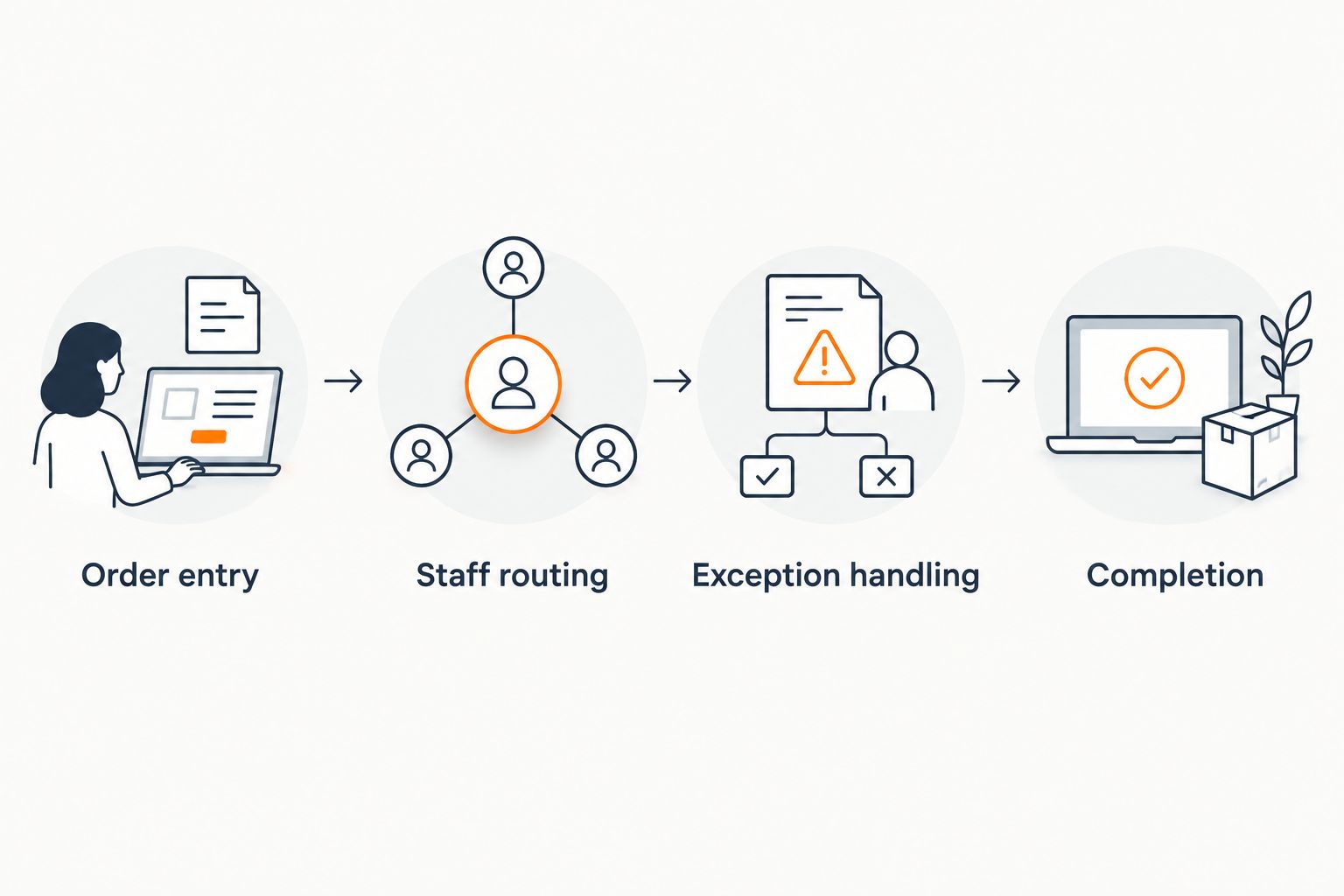
Record the outcome of each workflow in plain language: passed, failed, or requires a defined change. Include the responsible party and the acceptance condition for every change.
Keep payment and compliance questions separate from assumptions about platform scope. Ask vendors to demonstrate the exact payment methods, accessibility requirements, and SNAP EBT workflows included in your project where applicable. Do not infer support from a general grocery or kiosk label.
The pilot should also expose staff responsibilities. Identify who updates product information, handles customer questions, resolves fulfillment exceptions, and contacts technical support. A successful demonstration with vendor staff is not the same as a repeatable process for your store team.
When staying with Eflyn is the right call
Keep Eflyn when the existing kiosk meets your requirements and a replacement solves no additional operational problem. A grocery ecommerce project does not automatically require replacing every in-store component.
Before approving a change, compare replacement with retention. Ask whether the current kiosk can remain within the proposed operating arrangement, then test that arrangement rather than assuming compatibility.
For your 2026 decision, make the scope explicit: retain the kiosk, replace the kiosk, add ecommerce, or replace the broader ordering operation. Those are separate decisions. Combine them only when the demonstrated workflow supports doing so.
FAQ
What's the best Eflyn alternative for independent grocery stores?
Localexpress is the best fit on this shortlist for U.S. regional and independent grocers seeking grocery-focused unified commerce. Its stated offering includes grocery websites, branded apps, prepared-food kiosks, order management, last-mile delivery, and retail media tools.
Is Shopify an alternative to Eflyn for grocery ecommerce?
Shopify is an alternative for a general-purpose online storefront, not an automatic replacement for a kiosk configuration. Evaluate grocery fulfillment and in-store ordering requirements separately.
Is WooCommerce a good choice for an independent grocer?
WooCommerce fits a WordPress-based commerce project with accountable technical ownership. Test the complete implementation and assign responsibility for maintenance and order exceptions before launch.
Do I need to replace my Eflyn kiosk to launch online grocery ordering?
Online grocery ordering does not automatically require replacing your Eflyn kiosk. Evaluate retention and replacement against the proposed workflow, then demonstrate any connection you intend to use.
What should I ask for in a grocery platform demonstration?
Ask for a standard grocery basket, a substitution scenario, and a made-to-order deli order. Follow each through order entry, staff routing, exception handling, and completion.
How should I compare Eflyn alternatives in 2026?
Compare Eflyn alternatives against the same written store requirements in 2026. Separate storefront, kiosk, fulfillment, delivery, payment, and support responsibilities rather than judging only the customer-facing screen.
When should a grocer choose custom development?
Choose custom development when a documented operational requirement justifies it and a technical team owns maintenance. Do not commission a custom system merely to recreate functions that already meet your needs.
One last thing
Ask the demonstrator to change an order after it has reached staff. Watch what happens next. That single test forces the proposed system to show customer communication, staff responsibility, and order status together.
A clean checkout is only the beginning of grocery ordering. Approve the system that handles the exception as clearly as the original order.