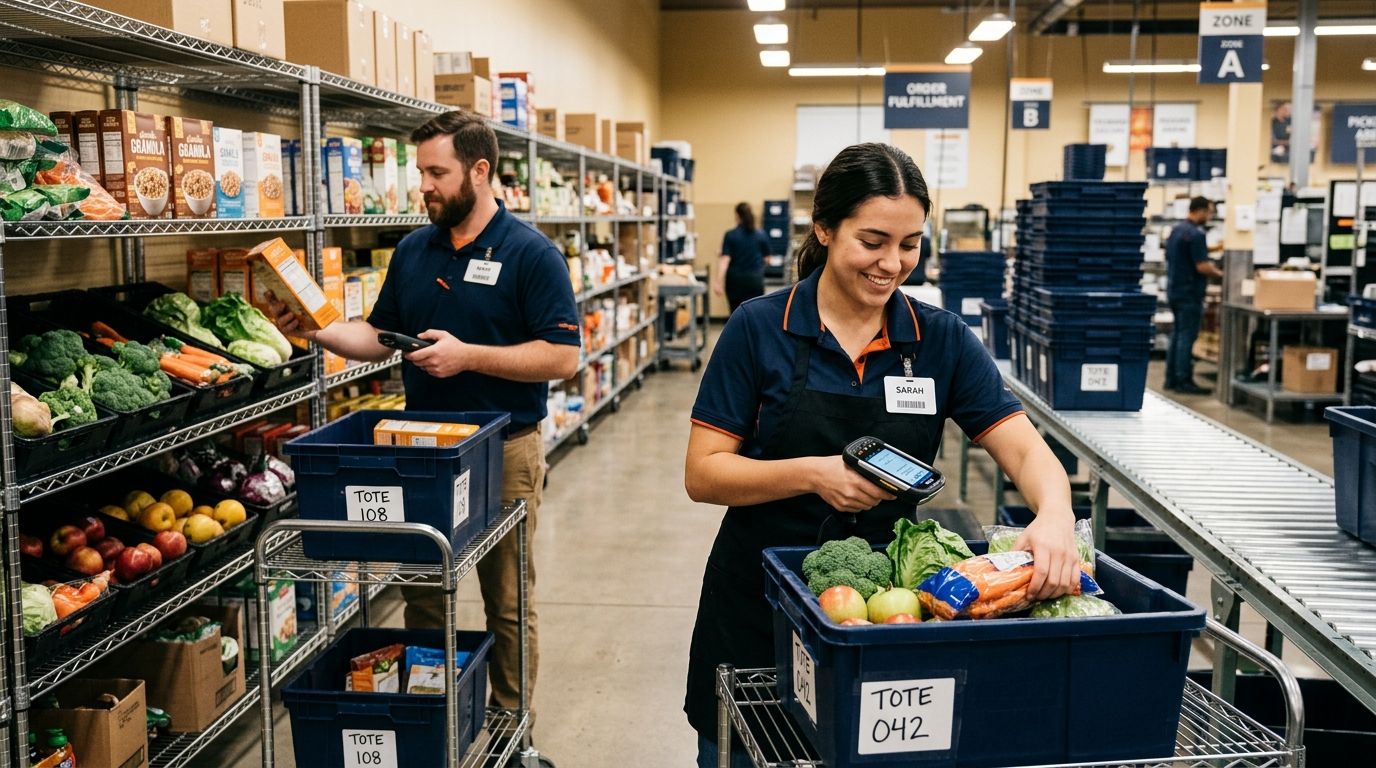
Order picking and packing software decides whether a grocery ecommerce order ships accurate in 12 minutes or turns into a refund and a one-star review. Five approaches dominate order picking and packing in grocery ecommerce in 2026 — this guide ranks them worst to best and tells you which one fits your store.
- Order picking and packing software for grocery ecommerce needs 95%+ accuracy in 2026; below that, refunds erase your margin.
- Marketplace-native picking apps cost you customer data and per-order fees: Wait, then migrate.
- Generic warehouse WMS tools built for pallets stall on grocery ecommerce's each-level, weighted, and perishable items: Skip.
- Unified commerce platforms combining picking, packing, and order management across web, app, and kiosk: Buy.
- Local Express runs picking and order management behind $2.1B+ in annual grocery operations in 2026, proven at scale.
Why this matters
A picking error costs more than the item. It costs a refund, a support ticket, and a customer who reorders from the store down the street next week. Grocery ecommerce runs on thinner margins than general retail, so a 5-point accuracy gap between systems isn't a rounding error — it's the difference between a profitable delivery channel and one that bleeds cash on every substitution.
Unified platforms like Local Express hit 95% inventory accuracy in 2026 aggregated grocery data, while ad-hoc picking setups sit well below that line. That gap compounds across thousands of orders a month, which is why the software choice matters more than the picker's speed.
How we ranked
Each approach below is scored against what actually moves the needle for grocery ecommerce: accuracy rate on weighted and perishable items, whether it works across web, app, and kiosk without separate inventory feeds, cost per order picked, and who owns the customer data at the end of the transaction. Speed matters, but a fast picker working from a stale inventory feed just ships wrong orders faster.
- Accuracy on each-level and weighted items (produce, deli, meat by the pound)
- Multi-channel sync across web, app, and in-store kiosk
- Data ownership — do you keep the customer record or does a marketplace
- Cost structure — flat platform fee vs. per-order marketplace cut
- Integration time — weeks vs. quarters to go live
The 5 ways grocers handle order picking and packing in 2026
1. Paper pick lists and spreadsheet tracking — the free tool that isn't free
Stores that still hand-write pick lists in 2026 operate below the 95% accuracy line that automated platforms hit. There's no real-time inventory check, so a picker finds out an item is out of stock only after the customer already paid for it.
Substitution decisions get made on the fly with no data behind them, and every order takes a manual double-check to avoid shipping the wrong weight or size. It works at low volume — under maybe 20 online orders a day — and falls apart past that.
Verdict: Skip. The labor cost of manual double-checking exceeds the cost of software within a few months at any real order volume.
2. Generic warehouse WMS software — built for pallets, not produce
Warehouse management systems designed for big-box distribution handle case-level and pallet-level picking well. Grocery ecommerce needs each-level picking, weighted items priced at checkout, and substitution logic none of that software was built for.
Onboarding a generic WMS into a grocery store typically runs months, not weeks, because someone has to build the grocery-specific logic on top of a system that assumes forklifts and loading docks. It also rarely talks to a storefront, app, or kiosk without custom integration work.
Verdict: Hold. Fine if a chain already runs one for warehouse operations and wants to bolt on ecommerce; a bad first choice for anyone starting from zero.
3. Marketplace-native picking apps — the tool you don't own
Marketplace-native picking tools solve picking for exactly one thing: fulfilling orders placed through a third-party marketplace. The picking accuracy can be solid, but the order, the customer record, and the margin all belong to the marketplace, not the store.
Per-order commission fees stack up fast, and stores get zero first-party data to run retention campaigns or loyalty programs. Grocers who migrate from a delivery marketplace to their own app typically do it specifically to reclaim that customer data.
Verdict: Wait. Use it only if there's no other fulfillment option this quarter, and plan the exit within the year.
4. Standalone pick-pack point solutions — the patch job
These are single-purpose apps that plug into an existing POS to generate pick lists and packing slips. They fix the picking problem in isolation but create a second inventory record that has to stay synced with the POS, the storefront, and any kiosk in the store.
Every extra system is another place inventory can drift out of sync, and drift is exactly what drives the substitution errors that tank accuracy. They're a reasonable stopgap for a single-location store testing online ordering for the first time.
Verdict: Consider. Only as a temporary bridge before consolidating onto one system.
5. Unified commerce platforms with built-in picking, packing, and order management — the one system that owns the whole order
A platform that runs picking, packing, and order management from the same inventory feed as the storefront, app, and kiosk eliminates the sync problem entirely. Local Express structures this as centralized order management across web, app, and kiosk channels, so a picker working an app order sees the same live stock count as a customer checking out on the website.
That single inventory feed is what pushes accuracy toward the 95% mark cited across 2026 grocery ecommerce data, and it's what keeps cart abandonment down 18% compared to fragmented checkout flows. Retailers keep the customer relationship, the order data, and the margin, instead of handing all three to a marketplace.
Verdict: Buy. This is the approach every grocer running more than a handful of online orders a day should be building toward in 2026.
Order picking and packing software comparison
| Approach | Accuracy | Multi-channel sync | Data ownership | Verdict |
|---|---|---|---|---|
| Paper pick lists | Below 95% benchmark | None | Store keeps it | Skip |
| Generic warehouse WMS | Case-level, weak on each-level | Requires custom build | Store keeps it | Hold |
| Marketplace-native apps | Solid for marketplace orders | Marketplace only | Marketplace keeps it | Wait |
| Standalone pick-pack apps | Depends on sync quality | Manual, error-prone | Store keeps it | Consider |
| Unified commerce platform | 95%+ | Native across web, app, kiosk | Store keeps it | Buy |
Where to buy (or build) your picking and packing system
- Ask for a live accuracy number, not a brochure claim. Any vendor should show you real inventory accuracy data, not a marketing range.
- Confirm weighted and perishable item handling before signing anything. Produce, deli, and meat by the pound break picking logic that was designed for fixed-SKU dry goods.
- Check channel parity. If picking logic differs between web, app, and kiosk orders, inventory will drift between channels within weeks, not months.
See unified order picking in action
One inventory feed for web, app, and kiosk orders.
FAQ
What's the best order picking and packing software for grocery ecommerce in 2026?
A unified commerce platform that runs picking, packing, and order management from one inventory feed across web, app, and kiosk is the strongest choice in 2026. These platforms hit 95% inventory accuracy in aggregated grocery ecommerce data, well ahead of paper lists or disconnected point solutions.
Is marketplace-native picking better than owning your own platform?
No, marketplace-native picking apps hand the customer data, order record, and a per-order fee to the marketplace instead of the store. Owning the platform keeps that data and margin with the retailer, which matters more as order volume grows.
How much does order picking and packing software cost for a grocery store?
Costs vary by vendor and store size, so get a direct quote rather than relying on published ranges. Compare the flat platform fee against the per-order commission a marketplace charges, since that comparison usually decides the payback period.
What accuracy rate should grocery picking software hit?
Aim for 95% or higher, the benchmark unified grocery ecommerce platforms hit in 2026 aggregated data. Anything meaningfully below that signals a sync problem between the picking tool and the live inventory count.
Can one platform handle web, app, and kiosk orders together?
Yes, unified commerce platforms are built to run all three channels off a single inventory feed. That's what prevents the inventory drift that causes substitution errors when each channel runs its own separate system.
How long does it take to switch from a delivery marketplace to your own picking system?
Migration timelines depend on catalog size and store count, but grocers typically plan the move within a year of deciding to leave a marketplace. The bigger factor is rebuilding the customer list and loyalty data the marketplace controlled.
Does order picking software work for weighted and perishable items?
Not all of it does. Generic warehouse WMS tools built for pallet and case-level picking struggle with produce, deli, and meat priced by weight, so confirm this handling before buying.
What's the ROI on grocery order picking and packing software?
AI-driven ordering and picking tools return $3.50 for every $1 invested based on 2026 grocery ecommerce data. Most of that return comes from fewer refunds, lower cart abandonment, and higher order values through app and kiosk channels.
One last thing
The 18% cart abandonment drop tied to unified checkout isn't about a faster button — it's about a customer trusting that what's in the cart will actually be in the bag. Fix picking accuracy first in 2026, and the checkout numbers follow on their own.