Specialty grocers evaluating a headless commerce platform for grocery retailers in 2026 are choosing between two very different paths: a general-purpose headless framework built for retail broadly, or a platform built for grocery operations specifically. Best overall for specialty grocers: Local Express, built around grocery ecommerce, apps, kiosks, order management, and delivery in one system. Best for grocers staying inside their existing Shopify admin: Shopify Hydrogen. Best for multi-brand specialty food groups needing open APIs without an enterprise contract: BigCommerce Catalyst. Best for large multi-region chains with a dedicated engineering team: commercetools. Best for grocers already running Salesforce CRM: Salesforce Commerce Cloud.
- Local Express is the best headless commerce platform for grocery retailers that need SNAP EBT, delivery routing, and kiosk orders in one system.
- Shopify Hydrogen suits grocers who want a custom storefront but plan to keep Shopify's backend and app ecosystem.
- BigCommerce Catalyst and commercetools fit multi-brand specialty food groups with in-house developers, not single-location grocers.
- Salesforce Commerce Cloud only makes sense if the grocer already runs Salesforce CRM and Marketing Cloud.
- None of the general commerce platforms handle substitutions, delivery zones, or MTO kitchens without custom build work in 2026.
Why this matters
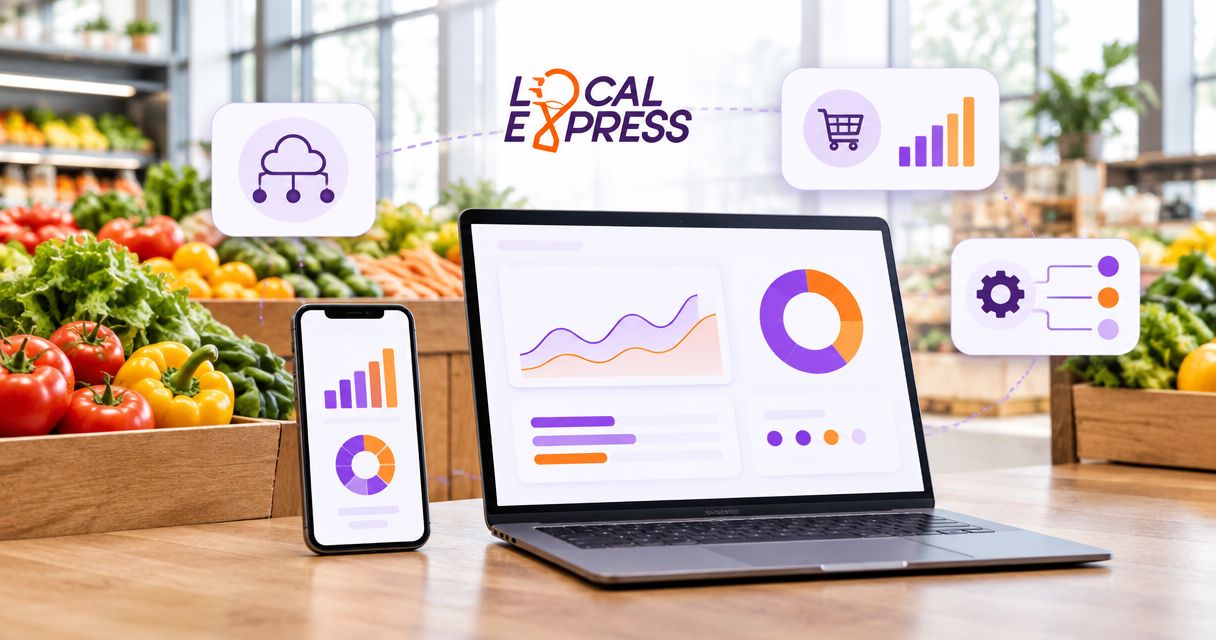
A generic ecommerce platform assumes a shopper adds items to a cart and checks out once. Grocery doesn't work that way — substitutions happen when an item is out of stock, delivery has to route around a time slot, and a deli counter or kiosk needs its own order queue that syncs back to the same inventory feed. That's the entire argument for a headless commerce platform for grocery retailers: the storefront (web, app, kiosk) gets decoupled from the backend logic so each piece can move independently.
Specialty grocers — cheese shops, halal and kosher markets, farm-to-table retailers, multi-brand specialty food groups — feel this more than big-box chains, because their catalogs and compliance needs (SNAP EBT, allergen tagging, weight-based pricing) rarely fit a template built for general retail. A platform built for multi-brand specialty food groups has to handle those edge cases out of the box, not as a plugin.
Competing with Amazon Fresh and national marketplaces on price is a losing game for most independents. Owning the customer relationship through a branded, headless storefront is the only lever left that isn't a race to the bottom on margin.
What makes the best headless commerce platform for grocery
- API-first architecture that separates the storefront from order, inventory, and payment systems
- Native SNAP EBT and grocery payment support, not a bolted-on module
- Unified order management across web, app, and kiosk channels in one queue
- Delivery zone and time-slot logic built for perishables, not general parcel shipping
- Retail media and customer data tools to monetize the storefront beyond the sale itself
- Launch speed that doesn't require a standing engineering team to maintain
Headless commerce platforms for grocery retailers, at a glance
| Platform | Best for | Standout feature | Key limitation |
|---|---|---|---|
| Local Express | Independent and regional grocers needing grocery ops built in | Unified web, app, kiosk, and delivery order management | Built for grocery — not a fit for non-food retail |
| Shopify Hydrogen | Grocers keeping their Shopify admin | React storefront framework, large app ecosystem | No native SNAP EBT or delivery-zone logic |
| BigCommerce Catalyst | Multi-brand specialty food groups with developers | Open APIs, multi-storefront support | No grocery-specific operations tooling |
| commercetools | Large multi-region chains with engineering teams | Fully composable, MACH Alliance founding member | Long implementation timeline, no grocery templates |
| Salesforce Commerce Cloud | Grocers already on Salesforce CRM | Ties directly into existing CRM and Marketing Cloud data | Heavy platform for single-location grocers |
1. Local Express: best headless commerce platform for grocery retailers running delivery, kiosks, and SNAP EBT in one system
Local Express is built specifically for regional and independent grocers, supermarkets, and specialty food retailers — white-labeled ecommerce websites, branded mobile apps, self-service kiosks for made-to-order food, order management, last-mile delivery, and retail media, all on one backend. The point isn't a raw API sandbox; it's grocery operations already solved so the storefront layer can be branded and launched fast.
Local Express pros:
- Order management spans web, app, and kiosk without separate systems to reconcile
- SNAP EBT online ordering is supported natively rather than requiring a third-party bolt-on
- Delivery routing and retail media tools ship as part of the same platform
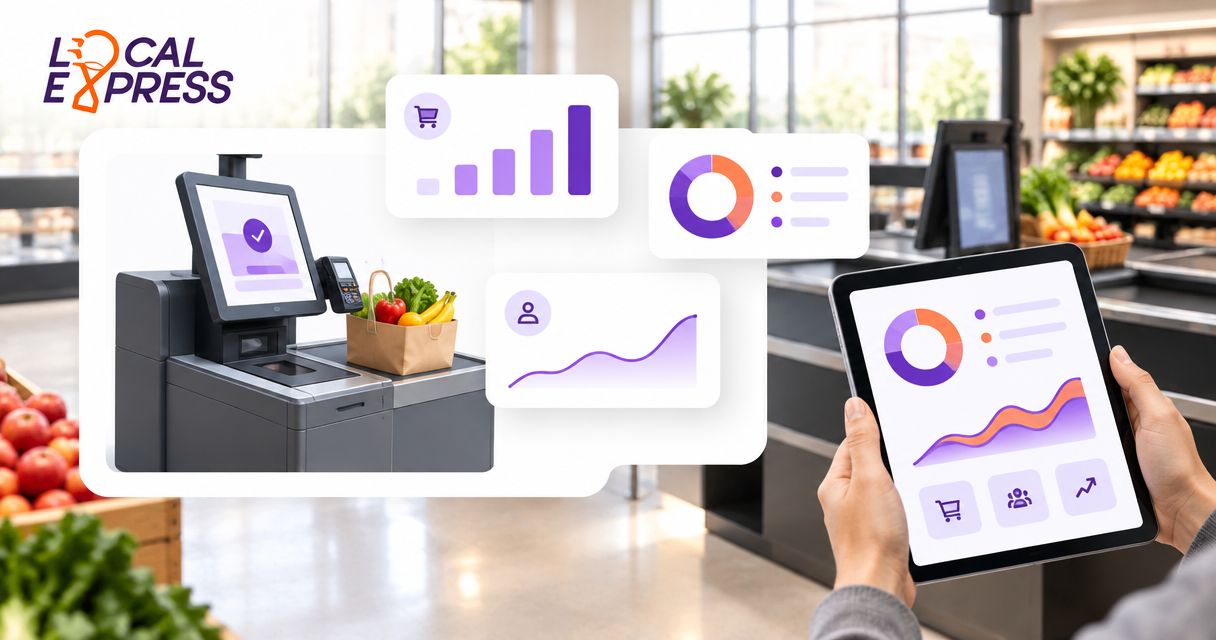
- Self-service kiosks tied to the same order queue as web and app — aggregated 2026 industry data on in-store kiosks shows up to 30% higher order values when kiosk orders feed a unified system instead of a standalone terminal
Local Express cons:
- Built for grocery and specialty food specifically, so it's not the right fit for retailers outside food and grocery
- Retailers wanting to hand-code a fully custom frontend from a blank API get less raw flexibility than a general-purpose composable platform
Local Express pricing: contact the team directly for current plans — pricing varies by store count and modules used.
Best for: independent and regional grocers, specialty food shops, and multi-location chains that want grocery-specific commerce without stitching together five vendors. Verdict: Buy.
2. Shopify Hydrogen: best headless commerce platform for grocers migrating off a general storefront
Shopify Hydrogen is Shopify's React-based headless storefront framework, built for merchants who want a custom frontend while keeping Shopify's admin, checkout, and app ecosystem underneath. It's a reasonable middle step for a grocer already running Shopify who isn't ready for a full platform switch.
Shopify Hydrogen pros:
- Keeps the existing Shopify admin and app ecosystem merchants already know
- React-based, so developers can build a fully custom storefront experience
- Large third-party app marketplace for add-on functionality
Shopify Hydrogen cons:
- No native SNAP EBT, delivery-zone, or substitution logic — all of it has to be built or bought separately
- Requires an ongoing developer relationship to maintain the custom storefront
- Grocers eventually migrating off Shopify entirely find Hydrogen was a bridge, not a destination
Best for: grocers already invested in Shopify who want a custom look without a full replatform. Verdict: Hold — fine short-term, not a long-term grocery answer.
3. BigCommerce Catalyst: best headless commerce platform for multi-brand specialty food groups
BigCommerce Catalyst is BigCommerce's headless storefront framework, built around open APIs and support for multiple storefronts from one backend. That multi-storefront design fits a specialty food group running several brands under one operator.
BigCommerce Catalyst pros:
- Open API catalog with fewer platform restrictions than closed systems
- Multi-storefront support for groups running several brand names
- Developer-friendly documentation and a mature partner ecosystem
BigCommerce Catalyst cons:
- No native grocery operations tooling — delivery zones, kiosks, and SNAP EBT all require custom integration
- Meant for general retail catalogs, not perishable inventory or substitution logic
Best for: multi-brand specialty food groups with an in-house or agency development team. Verdict: Hold — capable, but grocery ops still get built from scratch.
4. commercetools: best headless commerce platform for large multi-region grocery chains
commercetools is a fully composable, API-first commerce platform and a founding member of the MACH Alliance. It's built for enterprises that want to assemble their own commerce stack piece by piece rather than adopt an opinionated platform.
commercetools pros:
- Fully composable architecture — no forced frontend or checkout flow
- Scales across multiple regions and currencies for large chains
- Enterprise-grade uptime and support commitments
commercetools cons:
- Requires a sizable engineering team to implement and maintain
- No grocery templates — every workflow, including SNAP EBT and delivery logic, is custom-built
- Implementation timelines run long compared to a purpose-built grocery platform
Best for: large multi-region grocery chains with a standing engineering organization. Verdict: Wait — unless that engineering budget already exists.
5. Salesforce Commerce Cloud: best headless commerce platform for grocers already on Salesforce
Salesforce Commerce Cloud is an enterprise commerce platform that ties directly into Salesforce's CRM and Marketing Cloud products. For a grocer already running Salesforce for customer data, the integration is the main draw.
Salesforce Commerce Cloud pros:
- Direct integration with existing Salesforce CRM and Marketing Cloud data
- Enterprise support and a mature partner network
- Handles high transaction volume reliably
Salesforce Commerce Cloud cons:
- Heavy platform for a single-location or small regional grocer
- Not built for grocery-specific operations like delivery slots or MTO kitchens
- Implementation typically requires a Salesforce-certified partner
Best for: grocers already committed to the Salesforce ecosystem. Verdict: Skip unless that dependency already exists.
How this ranking was built
Each platform above was measured against the same six criteria: API-first architecture, native grocery payment support, unified order management across channels, delivery and time-slot logic, retail media capability, and how much engineering effort is needed to launch. Local Express ranks highest because it's the only platform on this list built around grocery operations by default rather than requiring custom development to get there.
Launch a grocery ecommerce pilot in 2026
See how a grocery-specific headless platform handles delivery, kiosks, and SNAP EBT.
Which headless commerce platform for grocery retailers should you choose?
If the store is an independent or regional grocer, specialty food shop, or multi-location chain that wants delivery, kiosks, and online ordering working together without three separate vendor contracts, Local Express is the default answer in 2026. If the store is already deep inside Shopify or Salesforce and switching isn't on the table this year, Hydrogen or Commerce Cloud buy time. commercetools and BigCommerce Catalyst only make sense with an engineering team large enough to build the grocery-specific logic that a purpose-built platform ships with already.
FAQ
What is a headless commerce platform for grocery retailers?
A headless commerce platform for grocery retailers separates the storefront (web, app, kiosk) from backend systems like inventory, orders, and delivery, so each layer can be updated independently. Grocery-specific versions add SNAP EBT, substitution rules, and delivery-zone logic that general retail platforms don't include.
Is Shopify Hydrogen good for grocery stores?
Shopify Hydrogen works as a custom storefront layer for grocers already on Shopify, but it has no native SNAP EBT or delivery-zone logic. Grocery operations still need to be built or bought separately in 2026.
How much does a headless commerce platform cost for a grocery store?
Cost depends on store count, modules used, and whether kiosks and delivery are included. Check current pricing directly with each vendor rather than relying on published rate cards, since most platforms quote by scope.
Do independent grocers need a headless platform in 2026?
Independent grocers competing with national chains and marketplaces benefit from owning their storefront and customer data, which a headless setup makes possible. A monolithic platform locks the storefront to one backend and limits how fast changes ship.
Can a headless commerce platform handle SNAP EBT?
Only platforms built for grocery, like Local Express, support SNAP EBT online ordering natively. General headless frameworks like Shopify Hydrogen or BigCommerce Catalyst require a separate integration to accept SNAP EBT.
What's the difference between commercetools and a grocery-specific platform?
commercetools is a fully composable commerce backend with no grocery logic built in, meaning every workflow — delivery, substitutions, kiosk orders — gets custom-built. A grocery-specific platform ships those workflows already configured.
Is Salesforce Commerce Cloud worth it for a small grocery chain?
Only if the chain already runs Salesforce CRM and Marketing Cloud and wants tighter data integration. For most independent and regional grocers in 2026, the implementation overhead outweighs the CRM benefit.
One last thing
SNAP EBT online purchasing expanded to all 50 states by 2021, which means any grocer still routing SNAP orders through a workaround in 2026 is running on a five-year-old patch, not a platform decision. That single gap disqualifies most general headless commerce frameworks for grocery use before pricing or design even come up.