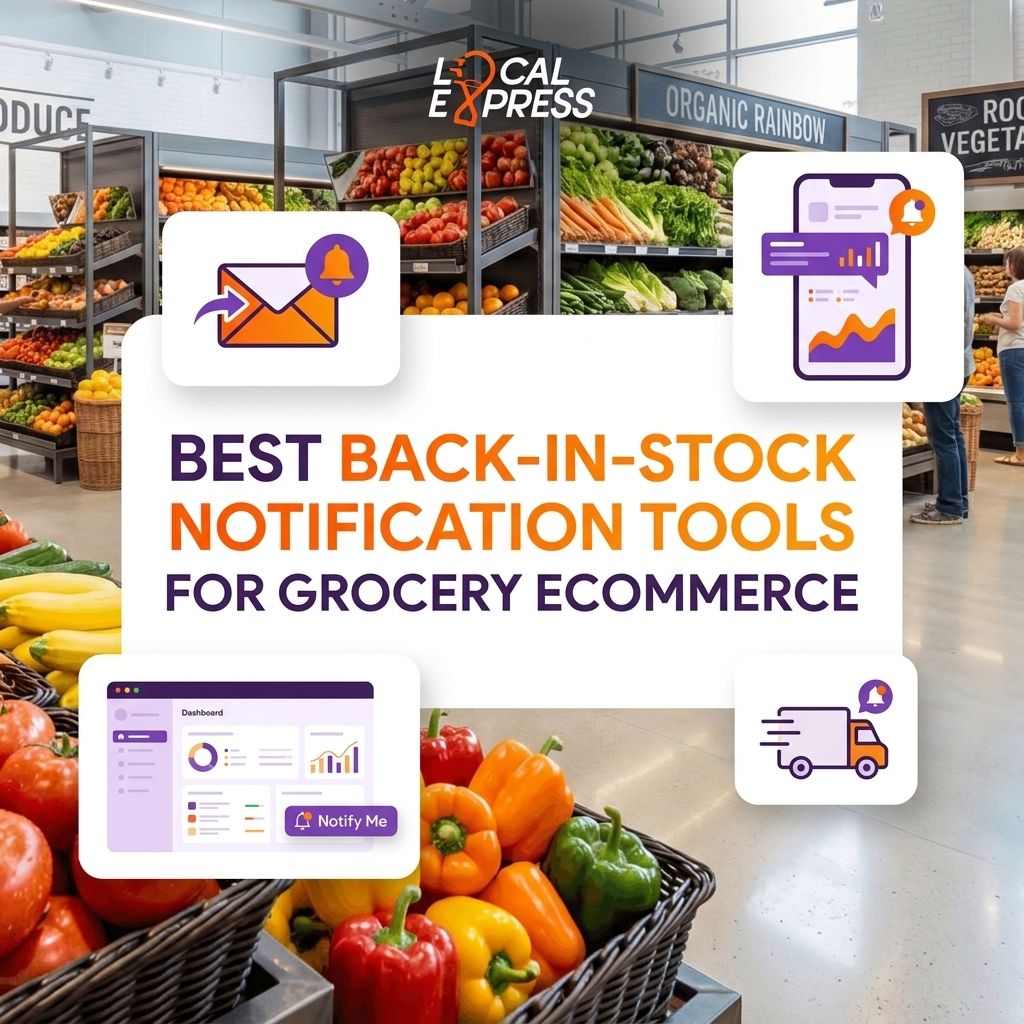
Grocery shoppers who hit a sold-out product page bounce fast — a back-in-stock notification tool recovers that sale by texting, emailing, or pushing an alert the moment the SKU is back on the shelf. This guide ranks the tools that actually hold up against grocery-scale SKU counts, not just the ones built for apparel and gift shops.
- Local Express's grocery-native push and SMS tools win for regional chains running high SKU counts in 2026 — Buy.
- Klaviyo handles back-in-stock flows well for single-store grocers already using it for email marketing — Consider.
- Yotpo SMS & Email suits grocers wanting SMS-first restock alerts without switching platforms — Consider.
- Shopify's native notify-me feature works for tiny catalogs but stalls past a few thousand SKUs — Skip.
- Any back in stock notification tool for grocery ecommerce needs real-time sync across web, app, and kiosk to be worth paying for.
Why this matters
A sold-out organic milk SKU or a paused seasonal item isn't a shrug for a grocery shopper — it's a reason to open a marketplace app instead. Apparel-first back-in-stock tools were built for one product going out of stock at a time, not a grocery catalog where hundreds of SKUs cycle in and out weekly because of weather, supplier gaps, or seasonal demand.
That's why generic back-in-stock apps break down at grocery scale. They weren't built with multi-location inventory sync in mind, and most regional grocers run several store locations feeding one ecommerce catalog. Get the restock alert wrong — send it before the item actually lands on the shelf, or miss it entirely — and you compound cart abandonment on your grocery site instead of fixing it.
AI-driven grocery ecommerce platforms report cart abandonment drops of up to 18% when stock-related friction gets addressed directly, based on aggregated 2026 platform data. Back-in-stock alerts are one of the few tools that hit that friction point head-on.
How we ranked
Every tool on this list gets evaluated against grocery-specific realities, not generic ecommerce checklists. The criteria: does it handle a catalog that can run past 30,000 SKUs, does it trigger from real-time inventory changes rather than a manual re-list, does it work across web, app, and kiosk channels instead of just a browser popup, and does it support multiple store locations without a separate integration per store.
Tools that were built for single-SKU apparel drops or gift-shop catalogs get marked down even if they're well-reviewed in their original category — grocery's SKU velocity and perishable turnover break assumptions that work fine elsewhere.
The ranked list
1. Local Express — the grocery-native pick
Local Express's push notification and SMS marketing tools built for grocery apps trigger restock alerts straight from live inventory data across web, branded app, and self-service kiosk — not a bolted-on plugin watching a single storefront. With average grocery assortments running near 30,000 SKUs, alerts get batched by category so a shopper isn't pinged for every restocked item in the store, just the ones they actually wanted.
The fit is the multi-location piece: one dashboard covers alerts across a regional chain's stores instead of a separate app install per location. For a grocer already running Local Express for ecommerce or delivery, this closes a gap most third-party tools can't. Verdict: Buy.
2. Klaviyo — the marketing-suite standby
Klaviyo built its back-in-stock flow as one branch of a much larger email and SMS automation platform, and it went public on the NYSE in 2023 on the strength of that broader ecommerce marketing business. If a grocer is already running Klaviyo for weekly ad emails or loyalty campaigns, the back-in-stock flow bolts on without adding a new vendor relationship.
Where it struggles is grocery-specific SKU velocity — Klaviyo's flows were designed around single-product restocks for general retail, not a catalog rotating hundreds of perishable and seasonal items a week. It also doesn't natively sync across web, app, and kiosk the way a grocery-built tool does. Verdict: Consider for single-location grocers already inside Klaviyo's ecosystem.
3. Yotpo SMS & Email — the SMS specialist
Yotpo acquired SMSBump in 2020 and folded it into what's now marketed as Yotpo SMS & Email, giving grocers an SMS-first option for restock alerts alongside review and loyalty features. SMS open rates outperform email for time-sensitive alerts like "back in stock today," which matters for perishables with a short shelf window.
Like Klaviyo, it wasn't built around grocery SKU counts or multi-store catalogs, so accuracy depends heavily on how clean the underlying inventory feed is. Verdict: Consider for grocers prioritizing SMS over email and running a single storefront.
4. Swym Back in Stock — the single-purpose plug-in
Swym's Back in Stock app does one job: watch a product page and fire an email or SMS when stock returns. That narrow focus makes setup fast for a small specialty catalog, but grocery's high SKU turnover means it's watching thousands of pages instead of a handful of best-sellers.
It has no native multi-location logic, so a regional chain with several stores feeding one site needs a separate workaround per location. Verdict: Consider only for a single-store specialty grocer with a limited catalog.
5. Appikon Back in Stock Alert — the budget option
Appikon's restock alert app covers the basics — email signup on a sold-out product page, alert on restock — at a lower complexity tier than the marketing-suite tools above. That simplicity is also the ceiling: no SMS-first workflow, no app or kiosk trigger, no multi-location inventory awareness.
For a grocer running one storefront with a few hundred SKUs, it's a fine stopgap. For a regional chain or a catalog anywhere near supermarket SKU counts, it runs out of runway fast. Verdict: Skip for anything beyond a small single-location catalog.
6. Shopify's native "Notify Me" feature — the free fallback
Shopify's built-in notify-me option lets a shopper enter their email on a sold-out product page with zero app installs. It costs nothing extra and takes minutes to turn on, which makes it the default for a lot of small grocers who haven't shopped this category yet.
The tradeoff: email-only, no SMS, no push, no multi-location logic, and no batching for a catalog with hundreds of SKUs restocking weekly. Verdict: Skip once the catalog or store count grows past a very small footprint.
Comparison table
| Tool | Channel | Built for grocery SKU volume | Multi-location support | Verdict |
|---|---|---|---|---|
| Local Express | Push + SMS | Yes | Yes | Buy |
| Klaviyo | Email + SMS | No | Limited | Consider |
| Yotpo SMS & Email | SMS + Email | No | Limited | Consider |
| Swym Back in Stock | Email + SMS | No | No | Consider |
| Appikon Back in Stock Alert | No | No | Skip | |
| Shopify native Notify Me | No | No | Skip |
Where to buy
- Match the tool to your channel count first. A grocer running only a website can get by with an email-only tool; one running a branded app and a self-checkout kiosk needs a tool that triggers across all three, not one.
- Check the inventory feed before the notification layer. No back-in-stock notification tool for grocery ecommerce is accurate if the underlying SKU status isn't syncing in real time from the store's POS or OMS.
- Pilot on one high-turnover category before rolling out storewide. Dairy, produce, or a weekly seasonal set restocks often enough in 2026 to show whether the alert timing and batching actually work before committing across the full catalog.
See grocery-built restock alerts
Push, SMS, and email triggered from live inventory across web, app, and kiosk.
FAQ
What's the best back-in-stock notification tool for grocery ecommerce in 2026?
Local Express's push and SMS tools rank highest for grocers because they trigger from live multi-location inventory and cover web, app, and kiosk in one dashboard. Generic ecommerce tools like Klaviyo or Yotpo work for single-store catalogs but weren't built for grocery SKU volume.
Is Klaviyo good for grocery back-in-stock alerts?
Klaviyo works for a single-location grocer already using it for email marketing, but it wasn't designed around grocery's SKU turnover or multi-store catalogs. It's a reasonable add-on, not a purpose-built solution.
Do grocery shoppers actually use back-in-stock notifications?
Yes — a sold-out grocery SKU is one of the top reasons shoppers abandon a cart or switch to a marketplace app instead. AI-driven grocery ecommerce platforms report cart abandonment drops of up to 18% in 2026 when stock-related friction is addressed directly.
How much does back-in-stock software cost for a grocery store?
Pricing depends heavily on SKU volume, number of store locations, and whether SMS is included alongside email. Check current plans directly with each vendor rather than relying on a flat rate, since grocery catalogs push most tools past their base tier fast.
Can back-in-stock alerts work across web, app, and kiosk at once?
Only a small number of tools do this natively — most third-party apps were built for a single web storefront. A grocer running a branded app and self-checkout kiosks needs a tool built for all three channels, not a web-only plugin.
What's the difference between SMS and push notifications for restock alerts?
SMS reaches a shopper without requiring an app install and has higher open rates for time-sensitive alerts, while push notifications work inside a branded grocery app and cost nothing per message. Grocers with a branded app usually run both together.
Does Shopify have a built-in back-in-stock notification feature?
Yes, Shopify's native notify-me feature lets shoppers enter an email on a sold-out product page at no extra cost. It's email-only with no SMS, push, or multi-location logic, so it works best for very small single-store catalogs.
How many SKUs does a grocery back-in-stock tool need to handle?
A typical supermarket assortment runs near 30,000 SKUs, and a regional chain multiplies that across locations. Tools built for a few hundred apparel SKUs at a time struggle to batch and manage alerts at that scale.
One last thing
The tools that fail grocers aren't bad tools — they're apparel-and-gift-shop tools wearing a grocery label. The tell is always the same: no multi-location logic, no SMS-first option, and no way to batch alerts so a shopper doesn't get five pings in one hour because their whole cart restocked at once. Fix the batching and channel mix before worrying about the vendor's brand name.