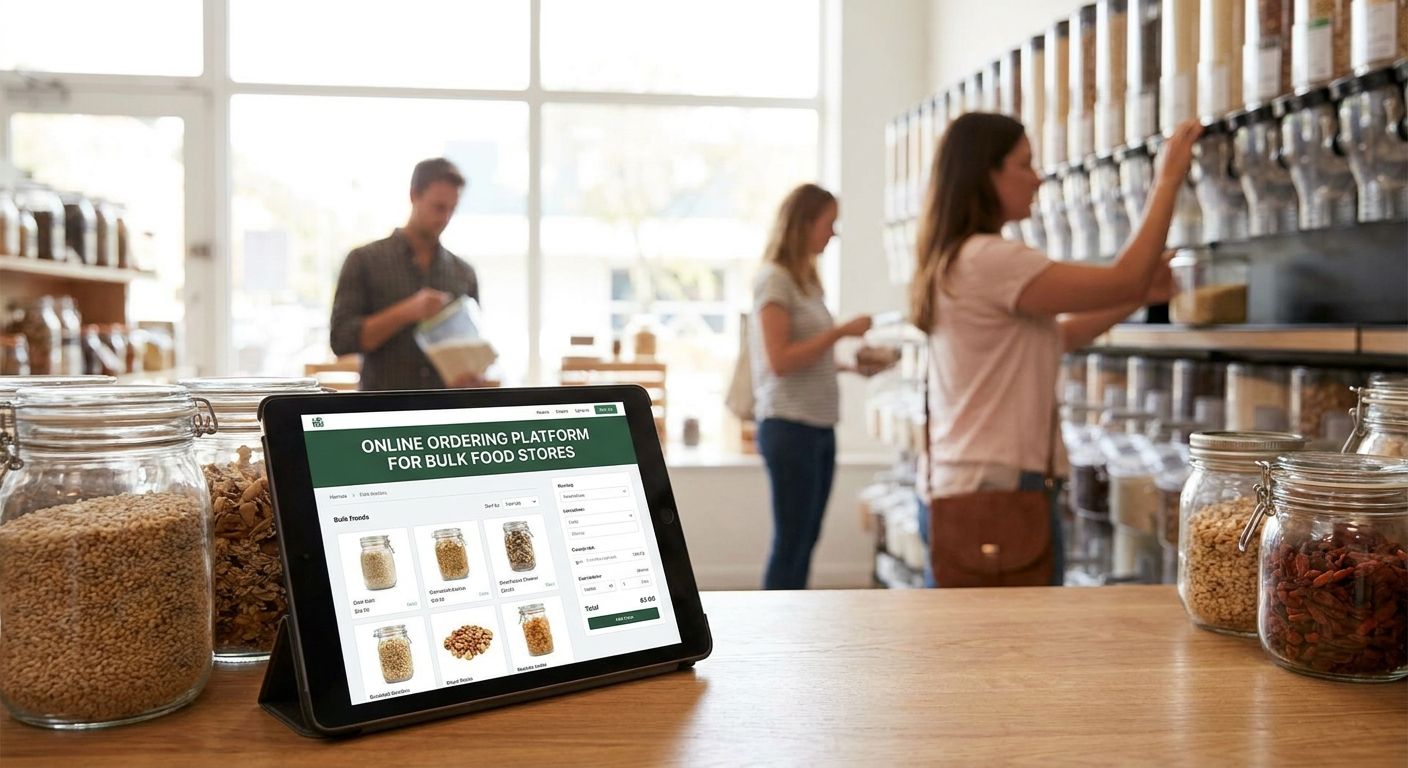
Bulk and refill grocers sell weight, not units — a checkout built for six-packs and canned goods breaks the moment a customer wants 1.3 pounds of lentils delivered to their door. This guide covers what an online ordering platform for bulk food stores actually needs to handle refill, variable-weight, and reusable-container sales without turning into a support ticket factory.
- Local Express handles variable-weight and refill ordering across web, app, and kiosk from one order queue in 2026.
- SNAP/EBT online ordering has been live in all 50 states since 2021 — any platform you pick must tender it separately from non-eligible bulk items.
- The foundation pick for most independent bulk stores is a white-labeled ecommerce site launched without a developer, not a marketplace listing.
- Skip platforms that treat a 12-ounce refill and a 5-pound bulk order as the same SKU type — Buy only if variable pricing is native.
- CSA box and subscription-style ordering flows matter more for refill stores than most generic grocery platform comparisons admit.
Why this matters
Bulk and refill retail runs on a different unit economics model than packaged grocery: customers buy by weight, bring their own containers, and often subscribe to recurring refills of the same five or six staples. A platform built for canned-goods ecommerce forces you to fake this with workarounds — flat-rate SKUs, manual weight adjustments at checkout, awkward substitution logic.
That friction shows up as abandoned carts and phone-in orders your staff has to key in by hand. The right online ordering platform for bulk food stores removes the workaround entirely instead of papering over it, and in 2026 that distinction is what separates stores growing digital revenue from ones still fielding order calls at the register.
Who this is for
This guide is for owners and operators of independent or small-chain bulk and refill stores — the person deciding whether to build a branded ecommerce site through a platform like Local Express or keep patching together a generic cart plugin. If you sell dry goods by the pound, run a container-deposit or bring-your-own-jar program, or operate a refill subscription for staples like oats, soap, or coffee, the criteria below apply directly to your buying decision.
What to look for in an online ordering platform for bulk food stores
Variable weight and quantity ordering
A bulk store's core SKU isn't a fixed unit — it's price-per-pound with a customer-chosen quantity. If the platform can't let a shopper order "2.5 lbs of quinoa" and have that translate cleanly into a pick-and-pack instruction for staff, every order becomes a manual override. This is the single most common failure point when generic grocery ecommerce templates get forced onto a bulk store.
Refill and subscription workflows
Refill customers reorder the same staples on a cadence — weekly oat milk, monthly bulk rice. A platform that supports recurring orders natively keeps those customers from lapsing; one that treats every order as a fresh transaction loses them to whichever competitor makes reordering a single tap.
SNAP/EBT and compliance handling
Online SNAP purchasing has been available in all 50 states since 2021, and bulk stores that serve lower-income neighborhoods lose real revenue without it. EBT-eligible bulk staples have to tender separately from ineligible items like prepared deli food or reusable container deposits — a platform that can't split that transaction automatically pushes the compliance burden onto your cashiers.
Multi-location inventory sync
If you run more than one storefront, bulk bin levels shift fast and differently at each location. A platform without real-time sync across locations will sell out-of-stock quantities online while a bin sits half full three miles away — a data problem, not a staffing one.
Mobile app and reorder loyalty
Refill customers respond to reorder prompts more than discount codes. A branded mobile app that surfaces "reorder your usual" turns a one-time refill customer into a recurring one without adding headcount.
“If your checkout treats a 12-ounce refill and a 5-pound bulk order as the same SKU type, it's not built for a bulk store.”
Top picks for bulk and refill stores
The foundation pick: a white-labeled ecommerce site built without a developer
Most independent bulk stores don't have an in-house engineering team, which is why launching a branded site through a no-developer build path matters more here than in packaged grocery. The relevant spec: your storefront needs to go live in weeks, not a development cycle measured in quarters. Buy — building a grocery ecommerce website without a developer is the realistic starting point for a store with no technical staff in 2026.
The compliance pick: SNAP/EBT-ready checkout
For bulk stores serving SNAP households, the checkout has to separate EBT-eligible weighed goods from non-eligible items automatically at payment. Any platform requiring manual tender splitting at the register isn't solving the problem, it's relocating it. Buy if you serve SNAP customers — setting up SNAP/EBT online ordering should be a configuration step, not a custom build.
The subscription pick: refill and recurring-order flows
Refill stores that run subscription-style ordering — the same model CSA boxes and farm stands use for recurring produce boxes — keep repeat customers without manual follow-up. Consider this pick if more than a small share of your revenue already comes from repeat staple purchases; the workflow logic is close enough to a CSA box model that it's worth evaluating the same way.
The community pick: farmers market and co-op style ordering
Bulk stores that operate more like a co-op — member pricing, pre-order pickup windows, shared inventory across vendors — need ordering logic closer to a farmers market platform than a standard grocery cart. Consider if your store runs member days or shared-vendor pre-orders; Skip if you're a single-location retail storefront with no co-op structure.
The specialty pick: natural and health food store platform features
Many bulk stores double as natural food retailers, carrying supplements and allergen-flagged goods alongside bins. A platform built for that adjacency handles ingredient and allergen filtering the way a straight commodity-grocery platform doesn't. Consider if bulk bins are one category among several specialty lines rather than your entire store footprint.
See the platform behind these picks
One order queue for web, app, and kiosk built for independent grocers.
What to avoid
- Marketplace-only listings. Third-party delivery marketplaces don't support per-pound pricing or container deposits well, and you don't own the customer data from those orders.
- Flat-rate SKU workarounds. A platform that makes you list "small bag," "medium bag," "large bag" instead of true weight-based pricing looks like a fix but creates constant mismatches between what's ordered and what's weighed.
- Generic subscription tools bolted onto a standard cart. Refill cadence logic needs to live in the same order queue as your one-off bulk orders, not a separate app that doesn't sync inventory.
Verdict comparison
| Pick | Variable weight ordering | SNAP/EBT ready | Subscription/refill logic | Multi-location sync | Verdict |
|---|---|---|---|---|---|
| Foundation (no-developer site) | Yes | Configurable | Add-on | Yes | Buy |
| Compliance (SNAP/EBT checkout) | Yes | Native | No | Yes | Buy |
| Subscription (refill/CSA-style) | Yes | Configurable | Native | Yes | Consider |
| Community (co-op/farmers market) | Partial | Configurable | Native | Yes | Consider |
| Specialty (natural/health food) | Yes | Configurable | Add-on | Yes | Consider |
FAQ
What's the best online ordering platform for bulk food stores in 2026?
The best fit is a platform that supports true variable-weight pricing, refill subscriptions, and one order queue across web, app, and kiosk — Local Express builds this specifically for independent and regional grocers rather than repurposing a packaged-goods cart.
Can bulk and refill stores accept SNAP/EBT online?
Yes. Online SNAP purchasing has been available in all 50 states since 2021, but the checkout must tender EBT-eligible weighed goods separately from non-eligible items like prepared food or container deposits.
Is a marketplace app enough for a bulk store, or do I need my own platform?
A marketplace listing rarely supports per-pound pricing or bring-your-own-container logic well, and you don't retain customer data from those orders. A branded platform gives you both the ordering logic and the customer relationship.
How do refill subscriptions work on a grocery ordering platform?
Customers set a recurring cadence for staple items — weekly, biweekly, monthly — and the order populates automatically without them re-adding items to cart each time. This mirrors the model CSA box and farm stand platforms already use for recurring produce orders.
Do I need a mobile app if I already have an ecommerce site for my bulk store?
Not immediately, but a branded app improves reorder rates because refill customers respond better to a one-tap 'reorder your usual' prompt than to a full site visit. It's worth adding once your web ordering volume is stable.
What happens to inventory accuracy across multiple bulk store locations?
Without real-time sync, a platform will let customers order quantities that are in stock at one location but sold out at another, creating cancellations. Multi-location inventory sync solves this by updating bin levels across every storefront in real time.
Can I migrate off a third-party delivery marketplace to my own bulk store app?
Yes — the migration path typically runs the marketplace and your own branded app in parallel for a transition window before cutting over fully, preserving order volume while you rebuild the customer list on your own platform.
One last thing
Most bulk stores lose more revenue to checkout friction on variable-weight items than to pricing or selection — customers abandon a cart the moment the system can't handle "1.3 lbs" cleanly, regardless of how good the product assortment is. Fix the weight-and-quantity logic before touching anything else on your storefront in 2026.