Choose Local Express if your U.S. regional or independent grocery business needs branded ecommerce, mobile apps, prepared-food ordering, delivery, and retail media; choose Toast if your grocery deli operates primarily as a restaurant and needs restaurant POS and kitchen workflows. This 2026 comparison separates whole-store grocery commerce from restaurant-led prepared-food operations.
- Local Express wins the grocery ecommerce comparison; Toast wins when restaurant operations define the buying decision.
- For local express vs toast, compare whole-store grocery ordering against restaurant POS and kitchen workflows.
- Both address prepared-food ordering and delivery, but those capabilities do not establish identical grocery coverage.
- Choose your operating model first, then test integrations, fulfillment, payment requirements, and contract scope.
Why this matters
A grocery deli and a restaurant kitchen both prepare food. That does not make their technology requirements interchangeable. Your decision changes when the same business also sells packaged groceries, manages online baskets, and delivers orders from multiple departments.
The Local Express grocery commerce platform serves regional and independent grocers with white-label websites, branded mobile apps, made-to-order kiosks, order management, last-mile delivery, and retail media tools. Toast centers its platform on restaurant operations, including POS, ordering, and kitchen workflows.
For a 2026 purchase, define the operation you need to connect—not just the counter where customers order. A strong deli demonstration does not answer whether a platform fits your wider grocery business. Conversely, broad grocery coverage does not establish the right fit for a restaurant-style service model.
At a glance
| Dimension | Local Express | Toast |
|---|---|---|
| Best for | U.S. regional and independent grocers seeking connected commerce | Grocery delis run around restaurant-style service |
| Grocery scope | Grocery ecommerce alongside prepared food | Restaurant POS and foodservice operations |
| Standout feature | White-label grocery websites and fully branded grocery apps | Restaurant-focused POS and kitchen workflows |
| Prepared-food ordering | Made-to-order ordering through self-service kiosks | Restaurant ordering and kitchen order handling |
| Restaurant service | Evaluate against the deli's specific service requirements | Better starting point for restaurant-style service |
| Delivery | Last-mile grocery delivery within the platform's stated scope | Restaurant delivery ordering capabilities |
| Retail media | Retail media tools are explicitly part of the offering | Evaluate separately from the restaurant operating system |
| Pricing model | Compare a scoped grocery platform proposal | Evaluate restaurant software, hardware, and payment-processing commitments |
Treat this table as a buying outline, not an integration guarantee. Every required connection, payment method, and operational exception belongs in a demonstration and the written agreement. A category fit is the starting point; a working grocery workflow is the acceptance test.
Local Express wins on whole-store grocery commerce
Local Express is the better grocery ecommerce fit for U.S. regional and independent grocers connecting branded ordering, prepared food, and delivery. Its stated scope covers grocery retailers rather than treating the supermarket as an extension of a restaurant menu.
That distinction matters when your deli shares customers with the rest of the store. A shopper ordering dinner ingredients and a prepared sandwich creates a different operational problem from a diner ordering a meal. You need to evaluate the grocery basket, the kitchen task, and the handoff together.
Toast is the stronger restaurant starting point, but its restaurant focus is not proof of whole-store grocery suitability. Test grocery requirements directly rather than assuming a restaurant ordering screen covers them.
The grocery platform's limitation is equally clear: broad scope creates a broader implementation decision. You still need to establish which systems connect, who maintains product information, and how staff resolve exceptions. Do not mistake a wider product scope for a completed integration plan.
Branded grocery websites and apps favor the grocery platform
A regional grocer seeking both a white-label ecommerce website and a fully branded grocery mobile app has a direct match in the grocery platform's stated offering. Those channels support a retailer-led commerce strategy rather than making a prepared-food menu the center of the digital experience.
Toast offers restaurant digital ordering. That makes it relevant when your customer journey starts with a deli meal, but restaurant ordering alone does not establish the same scope as a grocery website and branded grocery app.
Ask to see the customer journey from product discovery through order confirmation. Then inspect the operator's view: product maintenance, order handling, and customer-service access. Your staff should understand where each task happens before you approve the project.
The tradeoff is responsibility. Branded channels still need a maintained catalog, useful merchandising, and clear fulfillment instructions. Buying software does not replace that work.
For a restaurant-led deli, a focused meal-ordering journey is an advantage. Choose the grocery platform for a storewide digital storefront; choose Toast when restaurant ordering defines the customer journey.
Both address prepared-food ordering; the handoff decides
Made-to-order food is a genuine overlap. The grocery platform explicitly includes self-service kiosks for prepared food, while Toast supports restaurant ordering and kitchen operations. Neither platform deserves an automatic win simply because your store sells sandwiches or hot meals.
A grocery deli should test modifiers, order routing, staff acknowledgment, and the pickup handoff. Use your actual menu structure. A polished demonstration with a simplified menu leaves the difficult operational questions unanswered.
The grocery-focused option fits when prepared food belongs inside a wider grocery commerce plan. Toast fits when the kitchen and restaurant POS are the main operating system for the counter.
Both require careful workflow definition. Decide who handles an unavailable ingredient, a customer change, or an order that reaches the kitchen before the customer finishes shopping.
This dimension is a tie at the category level—not a claim of feature-by-feature parity. For a narrower evaluation, use the guide to Toast alternatives for grocery deli and MTO kitchens.
Toast wins when the deli operates like a restaurant
Toast is the better starting point when your grocery deli's essential requirements are restaurant POS, kitchen coordination, and restaurant-style service. Its restaurant orientation is an advantage when those workflows define the operation.
Consider a supermarket with a separately managed, full-service dining area. The dining operation needs an evaluation centered on servers, meal orders, kitchen handling, and settlement—not just the store's online grocery catalog.
The grocery platform's stated strengths sit elsewhere: branded grocery commerce, kiosks, order management, delivery, and retail media. Those strengths do not establish an equivalent restaurant service system.
Toast's limitation appears when the buying decision expands beyond the dining area. A successful restaurant deployment does not settle questions about full grocery baskets or retailer-wide digital channels.
Choose Toast for restaurant-led service, but keep the grocery requirements visible. If the dining area and supermarket need separate systems, define the boundary deliberately rather than discovering it after launch.
Both support delivery; test the order, not the label
Delivery is another honest overlap. The grocery platform includes last-mile grocery delivery, and Toast supports delivery ordering for restaurant businesses. The useful question is which order type and staff workflow you need to deliver.
A prepared-food delivery and a grocery delivery create different evaluation scenarios. Your demonstration should reflect the departments involved, the customer's instructions, and the handoff between preparation and dispatch.
For either platform, establish:
- Who accepts and prepares the order.
- Who decides when it is ready for dispatch.
- Who handles an unavailable item or delayed preparation.
- Who communicates with the customer.
- Who resolves a failed delivery or disputed order.
Do not infer specific fleet capabilities, coverage, or service commitments from the word delivery. Put your required operating model into the proposal.
Delivery is a tie on broad capability; grocery versus restaurant fulfillment determines the fit. For your 2026 evaluation, insist on an end-to-end demonstration with your own delivery scenario rather than a generic checkout walkthrough.
Retail media favors the grocery platform
Retail media tools are explicitly included in the grocery platform's offering. That makes it the stronger starting point when your commerce project also includes a retailer-managed advertising program for grocery brands.
Toast's restaurant operating focus does not establish an equivalent grocery retail media offering. Assess that requirement separately rather than treating restaurant marketing and grocery retail media as interchangeable.
Define the commercial process before selecting tools. Decide which placements you intend to offer, who approves campaigns, and what reporting advertisers need. The software evaluation should follow those decisions.
The limitation is operational: retail media needs ownership inside your business. Somebody must coordinate participating brands, approve material, and explain reporting. Treat retail media as an additional business workflow, not an automatic revenue result.
For a deli whose immediate problem is kitchen coordination, retail media is not a reason to reject Toast. For a grocer building a broader digital commerce program, it is a relevant distinction.
Pricing in 2026: compare the full operating commitment
Compare the grocery platform as a scoped commerce proposal and Toast as a restaurant technology arrangement involving software, hardware, and payment processing. Your decision needs the full contract structure, not an isolated software line item.
For the grocery proposal, request separate scope for the website, mobile app, kiosk ordering, order management, delivery, and retail media. Specify what belongs in the initial deployment and what requires a later agreement. This separates the business case from a list of desirable capabilities.
For Toast, establish the selected software scope, required devices, payment-processing terms, and any additional restaurant capabilities in the proposal. Ask what happens when you add another counter or location.
Predictability comes from a defined scope; flexibility comes from clear expansion terms. Neither follows automatically from the platform category.
Compare both proposals against the same operating requirements. Include implementation responsibilities, training, ongoing support, contract duration, and data export terms. A narrower proposal and a broader proposal are not directly comparable until you identify what each actually delivers.
Run a grocery-specific acceptance test
For a 2026 evaluation, start with 1 pilot store, 3 workflows, and 10 scripted test orders. These are recommended test boundaries, not vendor performance claims. Keep the initial test small enough that store staff can inspect every handoff.
Use these three workflows:
- Grocery basket: An online order involving products from multiple store departments.
- Prepared food: A made-to-order request with modifiers and a kitchen handoff.
- Delivery handoff: A completed order moving from store staff to dispatch and customer communication.
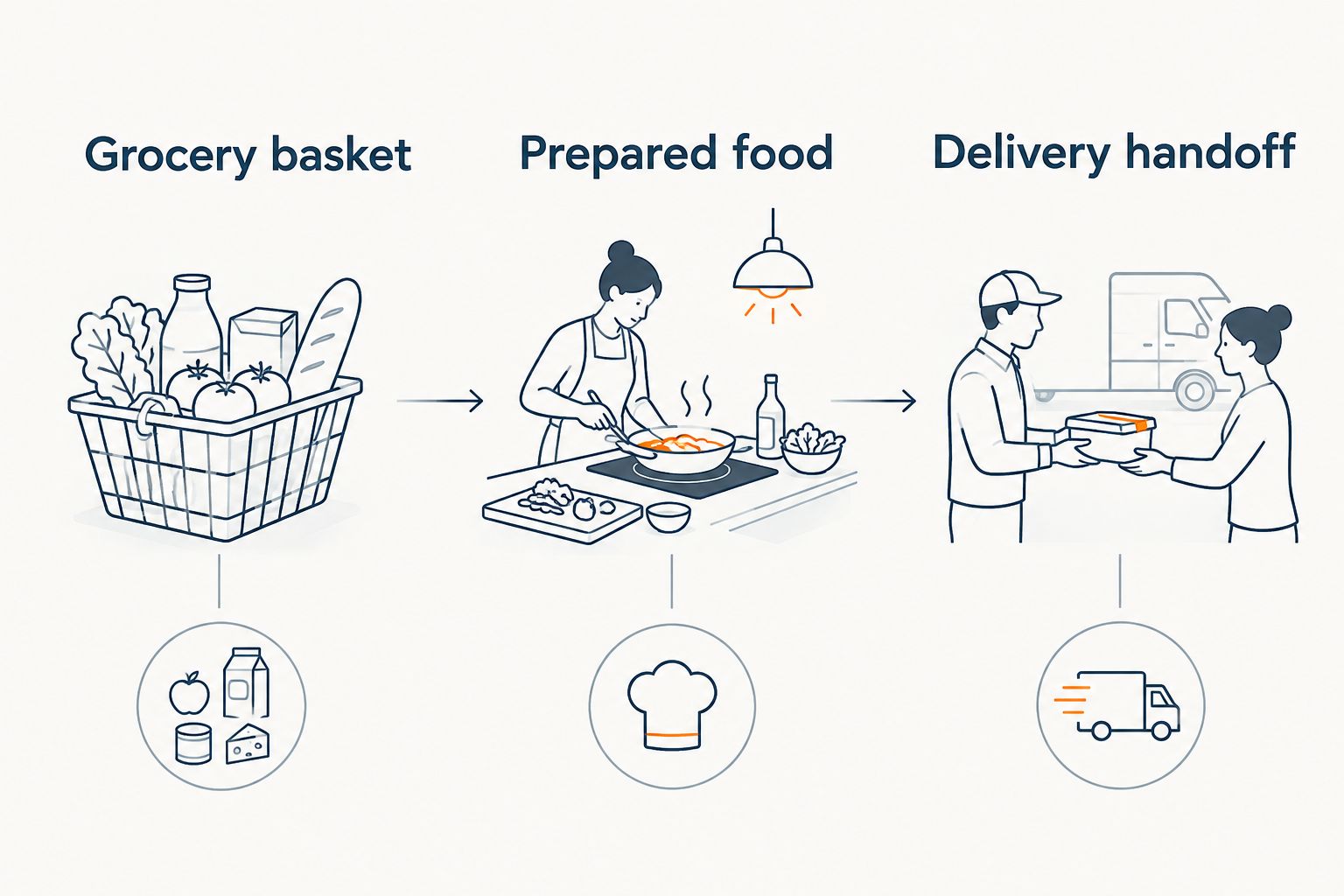
Spread the 10 scripted test orders across those workflows and include an exception in each. Ask staff to complete the tasks without the salesperson taking over. Record where they need a workaround or another system.
Evaluate the customer-facing experience and the store-facing process together. A checkout that looks simple is not enough if the order becomes difficult to prepare, change, or reconcile.
Approve workflows, not presentations. Request written confirmation for requirements demonstrated verbally, especially integrations and payment methods. Neither a grocery platform nor a restaurant POS category guarantees your particular configuration.
Final verdict for 2026
Choose Local Express if you run a regional grocery commerce program
Best for: a U.S. independent grocer or regional supermarket operator connecting online groceries, branded apps, prepared-food kiosks, delivery, and retail media. The grocery-centered scope matches that buying brief directly.
Choose it for the storewide commerce problem. Confirm the integrations and operating responsibilities before deployment, and keep restaurant-style service requirements explicit if your store includes a dining operation.
Choose Toast if your grocery deli is restaurant-led
Best for: a grocery deli manager whose main requirement is restaurant POS, kitchen operations, and restaurant-style service. Toast's restaurant focus fits that operating model.
Choose it for the restaurant problem. Do not extend that verdict to whole-store grocery ecommerce without a separate acceptance test.
| Dimension | Winner |
|---|---|
| Best for | Grocery platform for grocers; Toast for restaurant-led delis |
| Grocery scope | Grocery platform |
| Branded grocery websites and apps | Grocery platform |
| Prepared-food ordering | Tie at category level; validate the handoff |
| Restaurant service | Toast |
| Delivery | Tie at category level; validate fulfillment |
| Retail media | Grocery platform |
| Pricing model | No automatic winner; compare written commitments |
FAQ
Is Local Express better than Toast for an independent grocery store?
Local Express is the better category fit for an independent grocer seeking branded grocery ecommerce, mobile apps, prepared-food kiosks, delivery, and retail media. Toast is the better starting point when restaurant POS and kitchen operations define the requirement.
Is Toast a good choice for a grocery deli?
Toast is a good starting point for a grocery deli operated around restaurant-style service. Test the kitchen workflow and assess whole-store grocery requirements separately.
Can both platforms handle prepared-food ordering?
Both address prepared-food ordering. The grocery platform explicitly includes made-to-order self-service kiosks, while Toast supports restaurant ordering and kitchen operations; test the exact staff handoff.
Which option fits a branded grocery website and mobile app?
The grocery platform is the direct fit because white-label grocery websites and fully branded grocery mobile apps are part of its stated offering. Evaluate Toast against a restaurant ordering brief rather than assuming identical grocery coverage.
Which platform should a supermarket with a full-service dining area choose?
Toast is the stronger starting point for the dining area's restaurant requirements. Evaluate the supermarket's grocery commerce separately and define any required connection between the operations.
How should I compare the contracts?
Compare written scope, software commitments, hardware requirements, payment-processing terms, implementation responsibilities, and support. Use the same operating requirements for both proposals so a narrower deployment is not mistaken for an equivalent one.
What should I test before choosing in 2026?
Test a grocery basket, a prepared-food order, and a delivery handoff using your store's actual operating rules. Include exceptions and have store staff complete the workflows without the salesperson taking over.
One last thing
Test a mixed order before testing another feature. A basket containing packaged groceries and a made-to-order deli item exposes the boundary between grocery commerce and restaurant operations.
Ask who sees the order, who prepares each part, and who tells the customer it is ready. That specific handoff is more useful than another slide listing capabilities.