Choose Local Express if your U.S. regional or independent grocery business needs branded ecommerce, mobile apps, prepared-food kiosks, order management, and last-mile delivery in a grocery-focused platform; choose Shopify if your priority is a configurable online storefront for packaged specialty foods. In 2026, the deciding factor is grocery operating scope versus general-purpose ecommerce flexibility.
- Local Express vs Shopify comes down to grocery operations versus general-purpose ecommerce flexibility.
- Local Express is the better grocery ecommerce fit for retailers combining branded apps, prepared-food ordering, and delivery.
- Shopify is the better fit for a storefront-led specialty grocer that wants themes and an app ecosystem.
- Test fulfillment, customer-data access, and total implementation scope before choosing either platform.
Why this matters
A regional grocer needs more than a checkout page. An online order must reach the correct store, survive item substitutions, and arrive through the promised pickup or delivery workflow. A prepared-food order also needs a clear handoff to the people making it.
A specialty grocer selling packaged pantry goods has a different starting point. Product presentation, checkout, shipping, and merchandising can matter more than connecting a deli counter to a grocery delivery operation. Choose the platform around the work your employees must complete, not the longest feature list.
For your 2026 decision, separate the online shopping experience from the operational workflow. A polished website does not establish that your team can process a mixed grocery basket without re-entering information.
At a glance
| Dimension | Local Express | Shopify |
|---|---|---|
| Best for | Regional and independent grocers connecting grocery channels | Storefront-led specialty grocers selling packaged foods |
| Storefront | White-label grocery ecommerce websites | General-purpose ecommerce storefront with themes |
| Standout feature | Grocery-focused scope spanning apps, kiosks, orders, and delivery | Configurable storefront and broad app ecosystem |
| Mobile shopping | Fully branded grocery mobile apps | Mobile-friendly storefront; evaluate branded-app extensions separately |
| Prepared food | Made-to-order prepared-food ordering through self-service kiosks | Evaluate a separate prepared-food ordering workflow |
| Fulfillment | Order management and last-mile grocery delivery | Order management, shipping, local delivery, and pickup features |
| Extensions | Grocery-focused platform scope | Broad selection of apps and integrations |
| Customer control | White-label channels and retail media tools | Merchant-branded storefront and customer-management tools |
| Pricing evaluation | Request written scope for the grocery deployment | Review subscription plan, selected apps, and implementation scope |
The table describes platform orientation, not a promise that every integration or workflow is included in your agreement. Evaluate the exact configuration your store will use, especially where your POS, fulfillment process, and prepared-food counter meet.
Local Express is the better fit for connected grocery operations
Best for: regional and independent grocers operating several customer-ordering channels. The grocery-focused platform covers white-label websites, fully branded mobile apps, made-to-order kiosks, order management, last-mile delivery, and retail media tools. That scope matches a retailer evaluating grocery commerce as an operating system rather than an isolated website.
The advantage is relevance. You can frame the evaluation around grocery tasks from the beginning: accepting an order, coordinating fulfillment, handling prepared food, and reaching customers through your own channels.
The tradeoff is that scope still needs definition. A capability appearing in the platform description does not establish how it connects to your existing systems or who handles each implementation task. Ask for a demonstration using your actual departments and handoff rules.
Shopify deserves consideration when your project is narrower. If you mainly need a branded catalog and checkout for shelf-stable specialty foods, grocery-specific operational breadth is not automatically an advantage. Buying around workflows you do not use adds evaluation work without proving value.
Shopify is the better fit for a storefront-led specialty grocer
Best for: an independent specialty food retailer prioritizing online product merchandising. Shopify provides a general-purpose ecommerce storefront, themes, product management, and checkout. Its app ecosystem lets merchants add functionality around that foundation.
That approach suits a grocer whose online business centers on packaged coffee, spices, pantry products, or gift assortments. You can evaluate the storefront first and add selected capabilities around a clearly defined selling model.
The limitation appears when the storefront must become a grocery operating workflow. A product page and checkout do not, by themselves, prove how substitutions, prepared-food timing, or store-level delivery coordination work. Treat each additional requirement as a separate acceptance test.
For a 2026 storefront project, ask your team to distinguish essential extensions from optional enhancements. Shopify's flexibility is useful when someone owns the configuration and keeps the complete setup working. Flexibility is not the same as having every grocery workflow ready within the base configuration.
Local Express has the clearer branded grocery app proposition
Best for: grocers making a retailer-branded mobile app part of their customer strategy. Fully branded grocery mobile apps are explicitly part of the platform offering. That is a different proposition from giving shoppers a website that works on a phone.
Shopify supports mobile-friendly online stores. That is a genuine option for a specialty grocer that wants customers to browse and purchase without requiring a separate app. A branded app should earn its place through a defined customer use case, not a desire to check another channel off a list.
The tradeoff runs both ways. A mobile website keeps the customer journey centered on the storefront; a branded app introduces another channel to manage. App content, customer communications, and order handling still need accountable owners.
Make the app decision separately from the website decision. Ask each provider to show how a customer moves from browsing to an order and how staff see that order afterward. Do not score a responsive website and a retailer-branded app as identical deliverables.
Local Express is the better starting point for prepared-food kiosks
Best for: independent grocers with deli or made-to-order prepared-food counters. The offering explicitly includes made-to-order prepared food through self-service kiosks. This makes the counter workflow part of the platform discussion rather than an unrelated website requirement.
Shopify is not limited to selling shelf-stable goods, but a standard ecommerce storefront does not establish a self-service prepared-food kiosk workflow. Require the proposed configuration to demonstrate ordering, modifiers, staff handoff, and completion before treating it as equivalent.
For either system, test what happens when a customer changes an order or requests an unavailable ingredient. The relevant question is not whether the software can display a sandwich. It is whether counter staff receive an actionable order without guessing what to prepare.
The grocery-focused option still needs operational scrutiny. Kiosk ordering does not eliminate kitchen staffing, menu maintenance, or the need to assign responsibility for exceptions. Choose the demonstrated counter workflow, not a kiosk screenshot.
Both need a complete fulfillment test before either wins
Best for: grocers comparing pickup and delivery against their real store process. Both platforms have relevant order-handling capabilities. Shopify supports shipping, local delivery, and pickup; the grocery-focused offering includes order management and last-mile delivery.
That supports an honest tie at the capability level. It does not support a tie on execution, because the result depends on the workflow you configure and the handoffs your team must perform.
Start with centralized order management across web, app, and kiosk channels. Establish where orders appear, who accepts them, and how the customer receives updates. Then examine delivery or pickup as the next stage of that same order, not as a detached feature.
Test an unavailable grocery item, a delayed prepared-food component, and a change to the fulfillment method. Ask the vendor to show the employee action and the customer-facing result for each exception. Neither platform wins fulfillment until your staff can complete the order without an undocumented workaround.
Shopify offers broader general-purpose extension choice
Best for: specialty grocers that want to assemble a storefront around selected apps. Shopify's app ecosystem covers a broad range of merchant needs. That makes it a strong starting point when your requirements extend beyond grocery-specific workflows and your team wants to choose individual extensions.
The benefit is configuration choice. The drawback is coordination: adding an app introduces another component whose permissions, settings, support responsibilities, and interactions need review.
A grocery-focused platform takes a different starting position by centering its offering on grocery commerce functions. That is useful when your goal is to evaluate those functions together. It does not establish that every requested external tool is compatible.
For your 2026 shortlist, make an integration inventory before selecting either approach. Identify the systems you must retain, the data each system needs, and the person responsible when information stops moving. Shopify wins on general-purpose extension breadth; grocery fit still needs a separate decision.
Neither platform wins customer control through branding alone
Best for: grocers protecting their direct customer relationship. Both options support merchant-branded online selling. White-label websites and branded grocery apps address presentation; Shopify's merchant storefront also lets a retailer sell under its own brand.
That is an honest branding tie, not proof of identical customer-data rights. A logo on the checkout page does not answer who can export order records, manage customer permissions, or move information when the retailer changes systems.
Retail media tools are explicitly included in the grocery-focused offering. If supplier-funded merchandising matters to your business, evaluate that capability separately from ordinary storefront promotion. Ask what the retailer controls and what reporting the proposed deployment provides.
For both vendors, request a demonstration of the records you will use operationally. Check customer profiles, order history, consent information, and export procedures against your requirements. Treat data access as a contract and workflow question, not a branding claim.
Pricing: compare the operating scope, not just the subscription
Shopify uses a subscription-plan model, with the final setup depending on the selected plan, apps, and implementation work. This gives you a visible platform starting point, but the complete operating scope extends beyond choosing a plan.
For the grocery-focused deployment, request a written commercial proposal that identifies the website, app, kiosk, order-management, delivery, and retail-media components you intend to use. Separate implementation responsibilities from ongoing service responsibilities. Do not assume that a named platform capability is included in every agreement.
Compare both proposals against the same scope:
- Which customer channels are included?
- Which integrations require separate work?
- Who supports each component?
- What changes when you add a store or channel?
- What data and configuration can you take with you?
Predictability comes from a defined scope; flexibility comes from being able to change that scope. Your 2026 buying decision needs both, particularly when an independent grocery team has limited capacity to maintain multiple systems.
Choose with a grocery pilot, not a generic demo
Use 1 store, 3 test orders, and 2 exception cases as a focused acceptance test. These are recommended pilot parameters, not vendor performance claims. Run the same test against both proposed configurations.
Catalog review
Use products your store actually sells. Confirm that descriptions, product options, and the proposed inventory workflow make sense to your employees.
Order placement
Place a packaged-food order, a grocery pickup order, and a prepared-food order if that channel is in scope. Follow each through the employee workflow rather than stopping at checkout.
Exception handling
Test an unavailable item and a delayed handoff. Record what staff change, what the customer sees, and whether information must be entered again.
Data review
Inspect the completed orders and the customer records your team needs. Confirm export procedures and support ownership before approving the rollout.
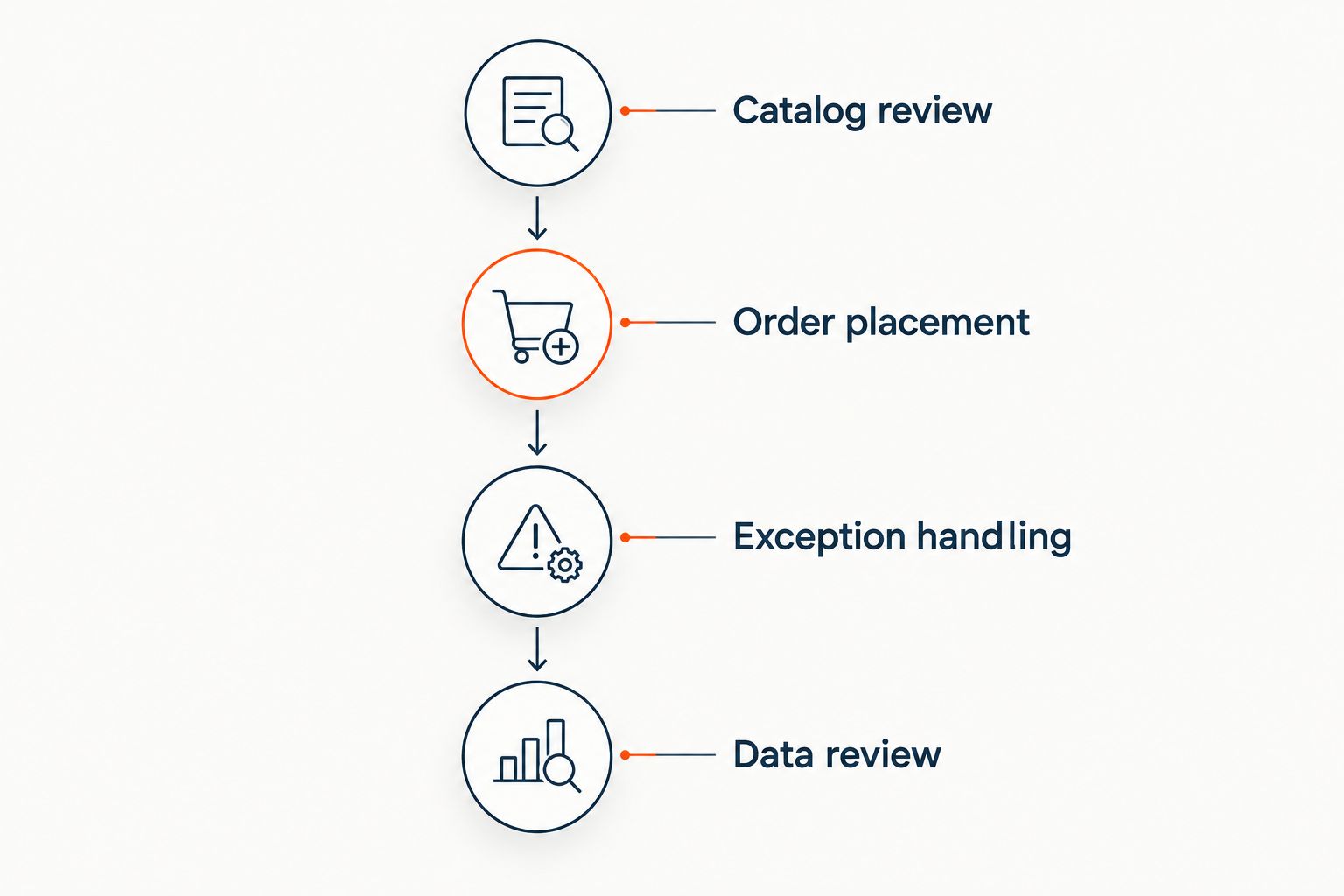
A 2026 pilot should end with a written list of accepted workflows and unresolved requirements. Do not let a successful storefront demonstration stand in for a successful grocery operation.
Final verdict
Choose Local Express for a connected regional grocery operation
You operate an independent supermarket or regional grocery group and need your website, branded app, prepared-food counter, and delivery operation considered together. The grocery-focused platform is the better fit for that scope. Confirm integrations and channel responsibilities through the pilot before signing.
Choose Shopify for a storefront-led specialty food business
You operate an independent specialty grocer whose online priority is merchandising and selling packaged products. You want a configurable storefront and are prepared to select and manage extensions. Shopify is the better fit for that narrower ecommerce-first brief.
| Dimension | Winner |
|---|---|
| Connected grocery operating scope | Grocery-focused platform |
| Packaged-food storefront focus | Shopify |
| Explicit branded grocery app offering | Grocery-focused platform |
| Explicit prepared-food kiosk offering | Grocery-focused platform |
| Fulfillment execution | Tie pending workflow test |
| General-purpose extension choice | Shopify |
| Merchant-branded online selling | Tie |
| Pricing predictability | Defined proposal and scope decide |
FAQ
Is Local Express better than Shopify for an independent grocery store?
Local Express is the better fit when an independent grocer needs branded apps, prepared-food kiosks, order management, and last-mile delivery considered together. Shopify is the better fit when the project centers on a configurable storefront for packaged specialty foods.
Can Shopify sell grocery products online?
Yes, Shopify supports online product selling, including food products. A grocer should separately test the proposed configuration for fulfillment exceptions, prepared-food workflows, and any store-specific requirements.
Which platform is better for a branded grocery mobile app?
The grocery-focused offering has the clearer starting proposition because fully branded grocery mobile apps are explicitly included in its platform scope. A mobile-friendly Shopify storefront is not the same deliverable as a retailer-branded app.
Which platform is better for a grocery deli kiosk?
The grocery-focused platform is the better starting point because its offering explicitly includes made-to-order prepared-food kiosks. Test modifiers, staff handoff, unavailable ingredients, and order completion before approving the setup.
Does choosing Shopify mean giving up pickup or local delivery?
No, Shopify supports local delivery and pickup features. Compare the configured employee workflow with your actual store process rather than assuming that a feature label proves grocery fulfillment fit.
How should a grocer compare the pricing models?
Compare Shopify's subscription and selected extension scope with a written proposal for the grocery-focused deployment. Include implementation, integrations, channels, and support responsibilities in the same evaluation.
Should a grocery store replace a working Shopify website in 2026?
Replace a working Shopify website only when the proposed alternative resolves a defined operational requirement. Use a store-level pilot to demonstrate the needed workflow before committing to migration.
One last thing
Ask the vendor to demonstrate a failed order, not just a successful one. An unavailable item or delayed prepared-food handoff exposes the staff decisions that a polished checkout demo leaves hidden. That is where your grocery operation needs a clear process.