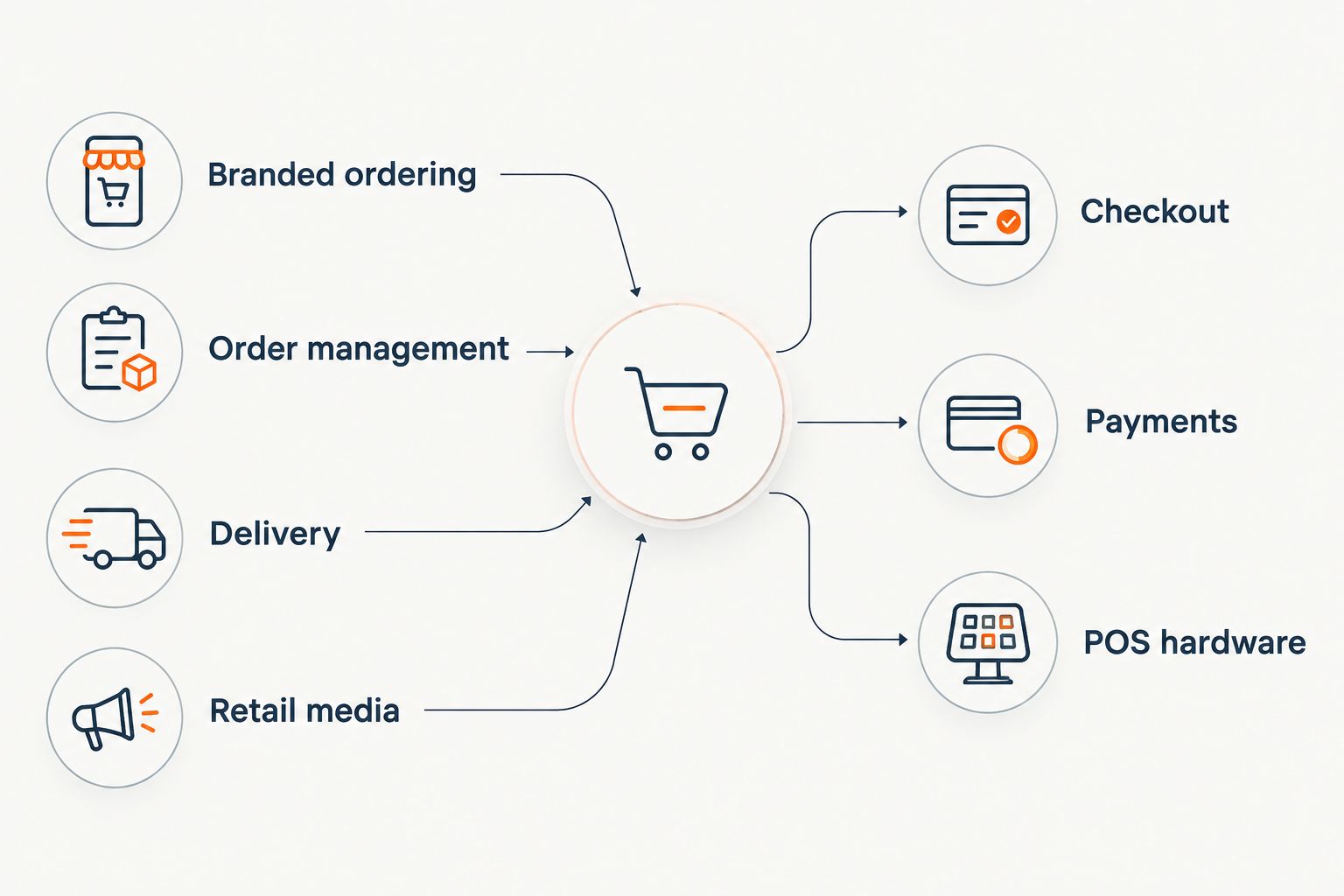
Choose Local Express if your U.S. regional or independent grocery business needs branded online ordering, mobile apps, prepared-food kiosks, order management, delivery, and retail media; choose Clover if your immediate priority is point-of-sale hardware and payment acceptance. The local express vs clover decision in 2026 is grocery commerce infrastructure versus checkout-centered operations—not a contest between interchangeable products.
- Local express vs clover: choose Local Express for branded grocery ecommerce; choose Clover for POS-centered checkout.
- Clover fits retailers prioritizing payment acceptance and point-of-sale hardware over a broader grocery commerce project.
- Compare prepared-food workflows and integrations through live demonstrations, not feature labels.
- Evaluate software, hardware, processing, implementation, and fulfillment separately before signing.
Why this matters
Your grocery store needs checkout and order fulfillment to work together, but they are different jobs. A successful card transaction does not prove that an online grocery order reaches the right picking team, prepared-food counter, or delivery workflow.
For a 2026 purchasing decision, start with the operational problem. Replacing a register, launching a branded grocery app, and coordinating delivery require different evaluation criteria. Buy against the workflow you need to fix, not the longest feature list.
The distinction also protects your existing systems. If your checkout lanes already work, evaluate the commerce layer separately before deciding that the entire store needs a POS replacement.
At a glance
| Dimension | Local Express | Clover |
|---|---|---|
| Best for | U.S. regional and independent grocers building branded commerce channels | Retailers prioritizing POS and payment acceptance |
| Standout feature | Grocery-focused platform spanning ordering, fulfillment, and retail media | POS hardware and payment-centered software |
| Branded ordering | White-labelled grocery websites and fully branded mobile apps | Evaluate online ordering against your grocery requirements |
| Checkout hardware | Evaluate checkout requirements separately from commerce capabilities | Dedicated POS devices and payment acceptance |
| Prepared food | Made-to-order ordering through self-service kiosks | Restaurant-oriented POS and ordering capabilities; test grocery-counter fit |
| Delivery and media | Last-mile grocery delivery and retail media tools | Evaluate delivery requirements and any additional applications separately |
| Integration | Verify your POS, catalog, payment, and operational connections | Verify your selected devices, applications, and grocery workflows |
| Pricing model | Request an itemized proposal for the required scope | Evaluate software subscriptions, hardware, and payment-processing terms |
The table separates stated scope from purchasing checks. Neither a grocery-focused platform nor a general POS system earns an automatic pass on your store's actual operating requirements.
Local Express wins on grocery commerce scope
Local Express is the better fit for independent grocers building branded grocery ecommerce across multiple ordering channels. Its stated scope includes grocery websites, branded mobile apps, made-to-order kiosks, order management, last-mile delivery, and retail media.
That scope fits an operator trying to connect shopping and fulfillment rather than simply replace a payment terminal. The benefit is alignment with the project: grocery ordering and fulfillment belong in the same evaluation.
Clover wins the narrower brief. If your main requirement is a POS system with payment acceptance, evaluate that first instead of expanding the purchase into an ecommerce, app, delivery, and advertising program.
The tradeoff is project breadth. A wider commerce rollout requires decisions about catalog maintenance, order ownership, staff responsibilities, and customer service. That is an implementation responsibility, not evidence of a performance problem with either vendor.
Use a written scope to prevent unnecessary expansion:
- Checkout: What must change at the register?
- Branded ordering: Which customer ordering channels must launch?
- Order management: Who receives and owns each order?
- Delivery: Which fulfillment responsibilities stay with the store?
- Retail media: Is advertising part of the current project or a later phase?
Grocery-first scope wins for branded online ordering
The grocery platform explicitly provides white-labelled ecommerce websites and fully branded grocery mobile apps. That makes it the stronger starting point when your goal is a customer-facing shopping experience under your store's brand.
Clover's POS role does not make it a poor business tool. It means you should assess its online capabilities against a grocery shopping journey rather than assume that payment acceptance solves ecommerce.
For your 2026 demonstration, bring a realistic basket containing packaged groceries, a variable-weight item, and a prepared-food order. Ask each vendor to show what happens when an item becomes unavailable, a shopper requests a substitution, or the final basket changes.
Those are acceptance tests, not promises about either platform. Require the demonstration to show the complete journey from customer selection to staff action and final payment.
Best for branded grocery ordering: the grocery-focused platform. The limitation is equally clear: branding alone does not establish catalog accuracy, substitution handling, or compatibility with your existing systems. Those requirements still need proof.
Clover wins when checkout hardware is the purchase
Clover's core offering combines POS devices, software, and payment acceptance. That makes it the clearer candidate when your purchasing brief centers on in-store transactions and register equipment.
Keep the hardware review practical. Have a cashier demonstrate scanning, tender selection, refunds, receipts, and end-of-day reporting using the equipment and software configuration you would actually buy.
For a U.S. grocery store, also require a demonstration of the payment methods your business accepts. If SNAP EBT, split tenders, or variable-weight products are requirements, include them explicitly. A generic retail demo is not evidence that your grocery checkout workflow is supported.
The grocery platform's ecommerce and fulfillment scope does not establish it as a replacement for every checkout device. Do not infer scanner, scale, cash-drawer, or register compatibility from a unified-commerce description.
Best for a POS-centered hardware decision: Clover. Its limitation in this comparison is scope: a checkout purchase does not, by itself, establish a branded grocery app, delivery operation, or retail media program.
Prepared-food fit is a demonstration decision
The grocery platform explicitly includes made-to-order prepared-food ordering through self-service kiosks. Clover also serves restaurant POS and ordering use cases, making prepared food a legitimate evaluation area for both options.
This is not an automatic tie on every feature. It is a tie on the need for operational proof: neither a kiosk label nor a restaurant feature list settles the workflow at your grocery deli.
Ask each vendor to demonstrate the same order. Include a customer modification, an unavailable ingredient, and a pickup request, then follow the order through preparation and completion.
The key questions are specific:
- Where does the order appear for the preparation team?
- How do employees communicate changes to the customer?
- Who marks the order ready or complete?
- How do prepared-food orders interact with the rest of the basket?
- What happens when the counter stops accepting orders?
Best for a deli or made-to-order counter: the option that passes your counter's workflow test. The grocery-focused scope earns consideration; Clover's restaurant-oriented capabilities also earn consideration. A live demonstration decides the purchase.
Grocery-first scope wins for delivery and retail media
Last-mile grocery delivery and retail media tools are explicitly part of the grocery platform's offering. These capabilities matter when your project extends beyond accepting orders to managing fulfillment and creating advertising opportunities.
Clover's checkout-centered offering answers a different primary question. Evaluate any delivery or advertising requirement separately rather than treating it as an automatic consequence of choosing a POS.
There are 3 stated ordering channels in the grocery platform's scope: website, mobile app, and kiosk. Your operational review should establish how orders from those channels reach staff and how responsibility changes between ordering, preparation, and fulfillment.
Use the guide to centralized order management across web, app, and kiosk channels to organize that discussion. Your acceptance criteria should name the person responsible for each order stage—not just the screen displaying it.
Delivery tools do not eliminate store-level decisions about staffing, service areas, handoffs, or customer communication. Retail media tools also do not establish advertising revenue by themselves. Set the operating plan before treating either capability as a financial result.
Integration is a shared acceptance test
Neither vendor wins integration on its name alone. Your existing POS, catalog structure, payment setup, and store processes determine what must connect.
For the 2026 evaluation, require a written integration map. It should identify the source of product information, the direction of updates, the order handoff, and the team responsible when a connection fails.
Then run 2 distinct order paths: an ordinary completed order and an exception order requiring a change. These are proposed test cases, not published performance benchmarks. The exception path reveals whether staff must repair the transaction manually or whether the configured workflow supports it.
Ask these questions of both vendors:
- Which connections are included in the proposed scope?
- Which require another application or implementation provider?
- Who supports each connection after launch?
- How are failed updates and order errors surfaced?
- What information can the store export?
This is an honest tie in the scorecard because compatibility is configuration-specific. Do not reward either vendor for an integration that your store has not verified.
Pricing: compare the commercial structure, not a headline
Clover's commercial structure can involve POS software subscriptions, hardware, and payment-processing terms. Evaluate those components together, including any applications required for your grocery workflows.
For the grocery commerce platform, request an itemized proposal covering the channels and services you need. Separate recurring software commitments from implementation work, hardware, payment arrangements, and delivery-related responsibilities. Do not assume one fee includes every component.
Organize both proposals into 4 review categories:
- Recurring commitments: Software and ongoing service obligations.
- Deployment: Configuration, catalog preparation, training, and launch work.
- Transactions and fulfillment: Payment and delivery arrangements.
- Ownership and exit: Data export, termination terms, and equipment obligations.
These categories are a purchasing framework, not vendor-specific billing claims. Require each vendor to state what applies and what does not.
Predictability comes from clearly defined inclusions. Flexibility comes from adding only the capabilities you need. Either model creates problems when important work sits outside the proposal, so compare the complete operating scope before signing.
Final verdict for 2026
Choose Local Express if you are building branded grocery commerce
Best for: A U.S. independent supermarket or regional grocery operator launching branded ecommerce, mobile ordering, prepared-food kiosks, delivery, or retail media.
Choose the grocery-focused platform when those channels are the project. Its stated scope matches that brief, but your approval should still depend on demonstrated grocery workflows, integration requirements, and a clear implementation plan.
Do not choose a broader commerce rollout solely because you need a new register. Keep the purchase proportional to the problem.
Choose Clover if you are replacing or standardizing POS
Best for: A U.S. grocery operator whose immediate priority is checkout hardware, payment acceptance, and POS-centered store operations.
Choose Clover when the register is the project. Validate grocery-specific tenders, equipment, and transaction exceptions on the exact proposed configuration.
Do not treat a POS decision as proof that branded grocery ecommerce and delivery requirements are solved. Evaluate those separately if they belong in your plan.
One-glance scorecard
| Dimension | Winner |
|---|---|
| Grocery commerce scope | Grocery-focused platform |
| Branded grocery websites and apps | Grocery-focused platform |
| POS hardware and payment-centered purchasing | Clover |
| Narrow checkout replacement brief | Clover |
| Prepared-food counter fit | Demonstration decides |
| Stated delivery and retail media scope | Grocery-focused platform |
| Integration with your existing systems | Shared acceptance test |
| Commercial structure | Itemized proposals decide |
FAQ
Is Local Express better than Clover for an independent grocery store?
Local Express is the better fit when the project is branded grocery ecommerce, mobile apps, prepared-food kiosks, order management, delivery, or retail media. Clover is the clearer fit when the immediate purchase centers on POS hardware and payment acceptance.
Which is better if I only need to replace my grocery store's registers?
Clover is the clearer starting point for a register-centered purchase. Test the exact hardware, payment methods, grocery transactions, and software configuration before signing.
Can Clover handle everything needed for online grocery ordering?
A Clover POS purchase does not establish that every online grocery requirement is covered. Require demonstrations of catalog handling, variable-weight items, substitutions, order changes, and fulfillment on the proposed configuration.
Should I replace my POS when launching a branded grocery app?
A branded grocery app project does not automatically require replacing your POS. Define the required connections and evaluate whether your existing checkout system can remain in the operating plan.
Which platform is better for a grocery deli or made-to-order counter?
Choose the platform that demonstrates your complete prepared-food workflow. Test modifications, unavailable ingredients, preparation handoffs, pickup, and order completion rather than deciding from a kiosk or restaurant feature label.
How should I compare the two vendors' pricing models?
Compare recurring software commitments, hardware, implementation, payment arrangements, and fulfillment responsibilities separately. Request an itemized proposal so included services and additional obligations are clear.
What should a grocery operator test before choosing in 2026?
Test a completed order and an exception order on the proposed configuration. Also verify required payment methods, product-data connections, staff handoffs, support responsibilities, and data export.
One last thing
An exception order is a better purchasing test than a polished checkout demonstration. Bring a basket that changes after submission and ask the vendor to follow the change through staff action, payment, and fulfillment.
The practical question is not whether the software looks complete. It is whether your employees can finish the customer's order without losing ownership of the task.