Local Express wins for independent grocers who want POS-connected self-checkout kiosks, online ordering and delivery running off one data layer instead of three disconnected systems. Clover is the best all-around register replacement for a single-location grocery store. Square for Retail is the budget pick for small shops with tight hardware budgets. Lightspeed Retail fits multi-location chains that need centralized inventory. ECRS Catapult wins for full-service supermarkets that need scale integration and SNAP/EBT built in at the register.
- Local Express wins for independent grocers unifying self-checkout kiosks, POS data and online ordering in 2026.
- Clover is the best all-around register replacement for single-location grocery stores.
- Square for Retail is the budget pick for small grocery and specialty food shops.
- Lightspeed Retail fits multi-location chains needing centralized inventory sync.
- ECRS Catapult handles grocery-specific needs like scale integration and SNAP/EBT better than general retail POS.
Why this matters
A grocery POS system isn't just a cash register anymore. It's the record of truth for inventory, loyalty, and increasingly, online orders that need to sync with in-store stock in real time.
Retailers who connect POS data to AI-driven inventory and ordering report 95% inventory accuracy and an 18% drop in cart abandonment, based on aggregated 2026 industry data. The Local Express platform is built around that connection — pairing checkout hardware with the same system that runs your ecommerce site, kiosks, and delivery.
The wrong pick locks you into a system that handles the register fine but can't talk to your ecommerce site, your loyalty program, or your delivery fleet. That's the gap most independent grocers hit in year two, once online ordering volume grows past what a spreadsheet or a bolt-on app can handle.
What makes the best POS system for a grocery store
- Grocery-specific checkout logic — scale integration for produce and deli, case-lot pricing, and age verification for alcohol
- SNAP/EBT and WIC support built into the payment flow, not bolted on
- Real-time inventory sync across register, self-checkout kiosk, and online ordering
- Loyalty and customer data that connects to marketing, not a siloed punch-card app
- Multi-location reporting if you run more than one store
- Uptime and support that matches grocery hours — most stores can't afford a register outage during a Saturday rush
Best POS systems for grocery stores at a glance
| System | Best for | Standout feature | Key limitation |
|---|---|---|---|
| Local Express | Unifying kiosks, POS and online ordering | Same data layer runs checkout, ecommerce, and delivery | Not a standalone traditional register system |
| Clover | Single-location independent grocers | Fast setup, simple hardware | Add-on apps needed for grocery-specific features |
| Square for Retail | Small grocery and specialty food shops | Low-friction hardware and setup | Thinner grocery-specific tooling (scale, SNAP nuance) |
| Lightspeed Retail | Multi-location grocery chains | Centralized inventory across stores | Steeper setup for grocery-specific workflows |
| ECRS Catapult | Full-service supermarkets | Deep scale, SNAP/EBT, and self-checkout integration | Heavier system, longer implementation |
1. Local Express: best POS-connected platform for unifying kiosks, ecommerce and delivery
Local Express isn't a standalone cash register system — it's the layer that connects your grocery store's checkout data (in-store and self-checkout kiosk) to your ecommerce site, mobile app, order management, and last-mile delivery. For an independent or regional grocer already running a POS but drowning in disconnected apps for online ordering, loyalty, and delivery, this is the fix.
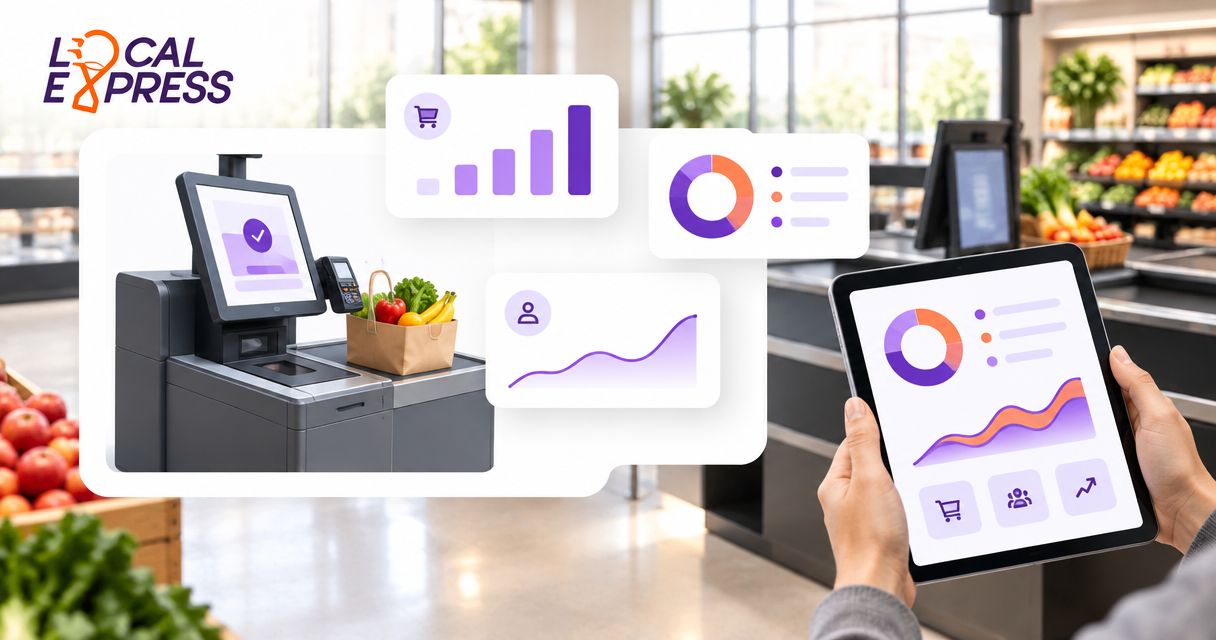
The platform includes white-labeled grocery ecommerce, branded mobile apps, self-service kiosks for prepared food, and order management that pulls from the same inventory feed as the register. Retailers running self-checkout kiosks alongside a legacy POS often find the two systems don't share data — Local Express is built to close that gap.
Local Express pros:
- Connects POS-level checkout data to ecommerce, delivery, and kiosk ordering in one system
- White-labeled storefront and app carry your brand, not a marketplace's
- Loyalty data feeds directly into segmentation and retail media tools
Local Express cons:
- Not a replacement for a traditional in-lane cash register system on its own
- Best suited to grocers already running or planning online ordering, not stores that only need a register
Local Express pricing: check current plans directly with the platform; pricing depends on store count and modules selected.
Best for: independent and regional grocers who need checkout, online ordering, and delivery on one data layer instead of three separate vendors. Verdict: Buy if online ordering and kiosk checkout are part of your 2026 roadmap.
2. Clover: best all-around POS for single-location independent grocers
Clover, owned by Fiserv, is one of the most widely deployed small-business POS systems in the US, with a hardware and app-store model that lets a single grocery store get a register running quickly. It handles basic grocery transactions, tax rules, and simple inventory counts out of the box.
Clover pros:
- Fast setup for a single storefront
- Large app marketplace for add-ons
- Widely supported by payment processors
Clover cons:
- Grocery-specific features (scale integration, produce PLU codes) often require third-party apps
- Multi-location reporting is less native than dedicated grocery platforms
Clover pricing: check current hardware and processing rates directly with Clover or your payment processor.
Best for: a single-location independent grocery store that wants a proven, widely supported register system without heavy customization. Verdict: Buy for simple, single-store operations.
3. Square for Retail: best budget POS for small grocery and specialty food shops
Square for Retail is built for small retail footprints and works well for compact grocery formats, specialty food shops, and convenience-style grocers that don't need deep supermarket tooling.
Square for Retail pros:
- Low upfront hardware cost relative to enterprise POS systems
- Simple setup, no long implementation cycle
- Built-in payment processing
Square for Retail cons:
- Limited grocery-specific tooling for scale items, case pricing, or SNAP nuance
- Reporting depth thins out as store count grows
Square for Retail pricing: check current transaction and subscription rates directly with Square.
Best for: a small grocery, specialty food, or convenience-format shop running lean on hardware spend. Verdict: Buy for small-format stores; Wait if you're a full-service supermarket.
4. Lightspeed Retail: best POS for multi-location grocery chains
Lightspeed Retail is built for retailers running more than one location and needing centralized inventory and reporting across stores. It's a common pick for regional grocery groups that have outgrown single-store POS tools.
Lightspeed Retail pros:
- Centralized inventory across multiple locations
- Consolidated reporting for chain-level decisions
- Broad integration ecosystem
Lightspeed Retail cons:
- Setup and configuration take longer than single-store systems
- Grocery-specific workflows (scale, SNAP/EBT) need additional configuration
Lightspeed Retail pricing: check current plans directly with Lightspeed; pricing scales with store count.
Best for: a regional grocery chain running multiple locations that needs one inventory view. Verdict: Buy for multi-store operators; Skip if you're a single storefront.
5. ECRS Catapult: best POS for full-service supermarkets
ECRS Catapult is built specifically for grocery and supermarket operations, with scale integration, WIC and SNAP/EBT handling, and self-checkout support baked into the core system rather than added on.
ECRS Catapult pros:
- Deep grocery-specific functionality (scale, SNAP/EBT, produce codes) built in
- Strong self-checkout integration for full-service stores
ECRS Catapult cons:
- Longer implementation timeline than lighter POS systems
- More system than a small specialty shop typically needs
ECRS Catapult pricing: check current pricing directly with ECRS; implementation cost scales with store complexity.
Best for: a full-service supermarket that needs deep grocery checkout logic out of the box. Verdict: Buy for supermarket-scale operations; Wait if you're a small specialty shop.
How we ranked these
Each system was weighed against the criteria above: grocery-specific checkout logic, SNAP/EBT support, real-time inventory sync, loyalty and customer data connectivity, multi-location reporting, and support hours matched to grocery operations. No two entries compete for the same use case — the goal is a decision tree, not a leaderboard.
See how kiosks connect to your POS
Check inventory sync and self-checkout options for your store.
Which POS system should you choose?
If your grocery store already has online ordering, kiosks, or delivery in the plan for 2026, Local Express is the pick — it keeps checkout, ecommerce, and delivery data in one place instead of three disconnected tools. If you run a single-location store and just need a reliable register, Clover is the safer default. Multi-location chains should default to Lightspeed Retail, and full-service supermarkets with SNAP/EBT and scale-heavy departments should default to ECRS Catapult.
Grocers also managing loyalty programs tied to their POS should confirm the system they pick can push that data into segmentation and marketing tools before signing a contract.
FAQ
What's the best POS system for a grocery store in 2026?
Local Express is the best pick for grocers who want POS checkout connected to online ordering, kiosks, and delivery in one system. For a single-location store that just needs a register, Clover is the more common default.
Is Local Express a POS system or something else?
Local Express is a unified commerce platform that connects self-checkout kiosks, order management, and ecommerce to your grocery store's checkout data — it's not a standalone in-lane register replacement on its own.
How much does a grocery POS system cost?
Cost varies by hardware, transaction fees, and number of locations. Check current pricing directly with each vendor rather than relying on published rate cards, since processing rates change.
Can a grocery POS system handle SNAP/EBT payments?
Grocery-specific systems like ECRS Catapult build SNAP/EBT handling directly into the register flow. General retail POS systems like Clover or Square often need a third-party app to process SNAP/EBT correctly.
Do independent grocers need self-checkout kiosks along with a POS?
Not every store needs kiosks, but grocers adding online ordering or high foot traffic benefit from kiosks that share inventory data with the main POS rather than running as a separate system.
What's the difference between Clover and Square for Retail for grocery stores?
Clover has a larger app marketplace for grocery-specific add-ons, while Square for Retail is simpler to set up and cheaper on hardware for small-format stores. Neither has deep native grocery tooling like scale integration out of the box.
How does a POS system connect to online ordering and delivery?
The POS needs to share real-time inventory with whatever platform runs your ecommerce site and delivery, or you risk selling out-of-stock items online. Platforms like Local Express are built to keep that data synced across channels.
Is Lightspeed Retail good for multi-location grocery chains?
Yes, Lightspeed Retail centralizes inventory and reporting across multiple stores, which makes it a common choice for regional grocery chains that have outgrown single-store POS systems.
One last thing
The system most independent grocers regret isn't the POS itself — it's picking one that can't talk to whatever they add next. A store that starts with just a register in 2026 usually adds online ordering, then a kiosk, then delivery within 18 months. Pick the POS that can share data with those additions before you need them, not after.