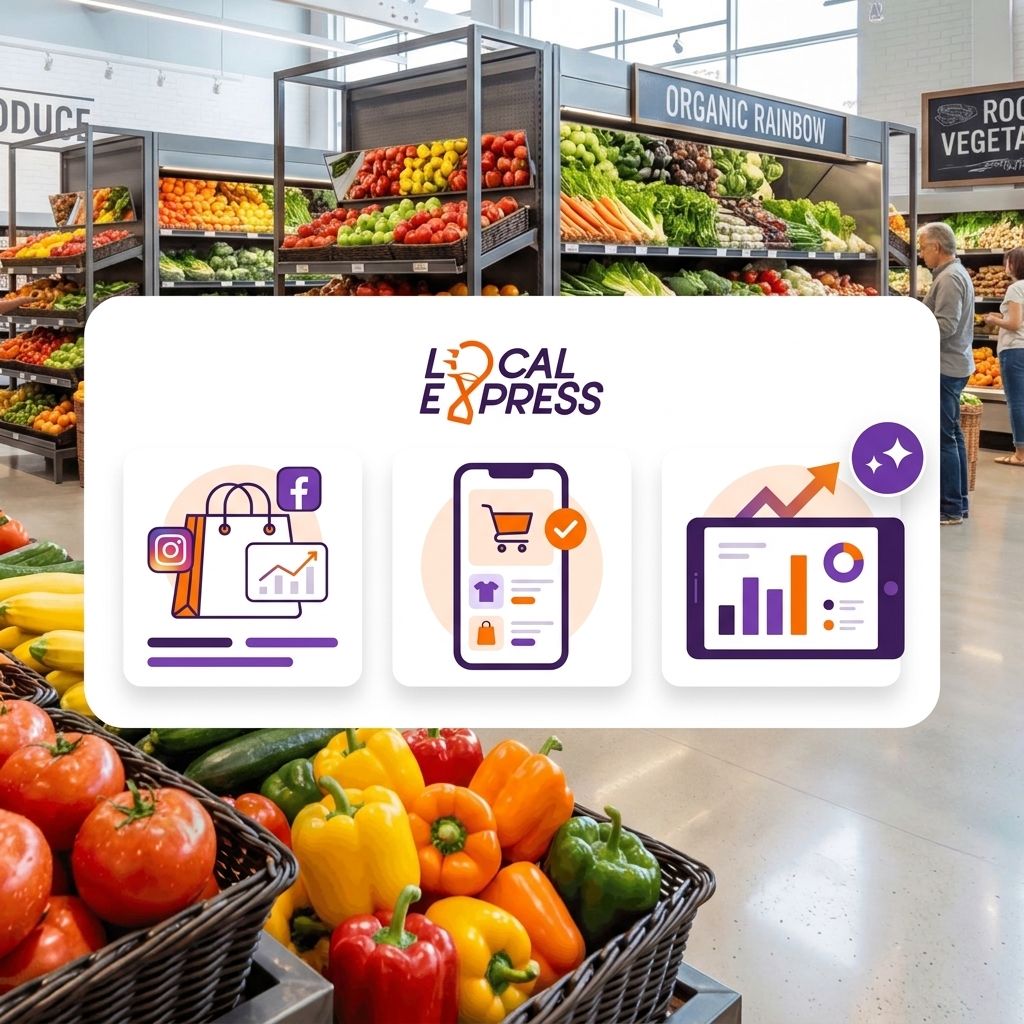
Selling groceries through Instagram and Facebook Shops in 2026 means syncing a product catalog to Meta Commerce Manager and routing checkout to your own grocery ecommerce site, not Meta's native checkout. Most independent and regional grocers use the channel as a discovery and marketing tool that feeds an existing storefront, because native checkout doesn't handle SNAP/EBT, age-restricted items, or delivery zone logic.
- You sell groceries on Instagram and Facebook Shops by syncing a catalog feed to Meta Commerce Manager and routing checkout to your own site.
- Meta's native checkout doesn't process SNAP/EBT or age-restricted items, so most grocers use checkout-on-website in 2026.
- Product tags on posts, Reels, and Stories drive traffic; your own platform still closes the sale and keeps the margin.
- Grocers running a Local Express storefront connect existing inventory feeds to Instagram and Facebook Shops without rebuilding the catalog by hand.
Why this matters
Grocers spend heavily to get discovered on Instagram and Facebook, then lose the transaction to a marketplace or a checkout that can't handle a beer age-gate or an EBT card. Social commerce for grocery in 2026 works best as a funnel, not a full storefront, and the setup decisions you make in Commerce Manager determine whether that funnel actually protects your margin or just feeds someone else's app.
The catalog and checkout choices below apply to any independent or regional grocery operation, from a single specialty market to a multi-location chain. A grocery ecommerce website is the piece that makes checkout-on-website work — without one, Instagram and Facebook Shops has nowhere useful to send the customer.
How to sell groceries on Instagram and Facebook Shops
The setup runs through Meta Business Suite and Commerce Manager, and it takes five to seven steps depending on how many sales channels you're already running.
- Create a Meta Business Suite account and link your Instagram and Facebook business profiles to one Commerce Manager account.
- Build a product catalog feed — a CSV, XML, or API feed pulling from your existing inventory system, not a manually typed list.
- Submit the catalog for Meta's commerce policy review. Grocery and packaged food SKUs generally clear; tobacco is banned outright and alcohol requires extra handling.
- Pick your checkout method — checkout on your website (redirect) versus native Meta checkout. For grocery, checkout-on-website wins almost every time.
- Tag products in feed posts, Reels, and Stories so shoppers can tap straight from content to a product page.
- Sync inventory in real time so items that sell out in-store stop showing as available on Instagram the same day.
- Point Meta Pixel or Conversions API at your own ecommerce site so you can measure which posts actually drive orders.
Checkout on your website vs. native Meta checkout
| Checkout method | How it works | Best for | Verdict |
|---|---|---|---|
| Checkout on your website | Meta redirects the shopper to your own grocery ecommerce site to finish the order | Stores with SNAP/EBT customers, age-restricted SKUs, or delivery zone rules | Buy |
| Native Meta checkout | Shopper pays inside Instagram or Facebook without leaving the app | Simple non-restricted SKUs with no age gate and no delivery logic | Hold |
| Marketplaces (generic third-party delivery apps) | A third-party app lists your products and controls the customer relationship | Stores with no ecommerce site at all yet | Skip for margin control |
Most regional grocers land on checkout-on-website because it's the only option that plugs into SNAP/EBT processing, age verification for beer and wine, and store-specific delivery zones. Native checkout looks convenient on paper, but it hands Meta the customer data and the payment relationship — a trade most grocery operators aren't willing to make once they've built their own site.
A flash sale run through your own grocery app is a good example of what checkout-on-website unlocks that native checkout can't: time-boxed pricing, loyalty tie-ins, and delivery slot logic Meta was never built to handle.
Turn Instagram traffic into orders
Sync your catalog and route checkout to your own grocery storefront.
Why Instagram and Facebook Shops setup varies by grocery store
No two grocery catalogs behave the same way on Meta's platform. The setup that works for a packaged snack retailer breaks for a specialty market selling wine or halal meat. Factors that change your setup:
- Alcohol and tobacco rules — tobacco is banned from Meta catalogs entirely; alcohol needs age verification your own checkout has to enforce.
- SNAP/EBT dependency — stores with a heavy EBT customer base can't rely on native checkout at all, since Meta doesn't process EBT cards.
- Catalog size and SKU turnover — a 200-SKU specialty shop can manage a feed manually; a 5,000-SKU supermarket needs an automated inventory sync.
- Delivery zone complexity — multi-zone or multi-location chains need checkout logic Meta's native flow doesn't support.
- Specialty certifications — kosher, halal, and other certified product lines often carry labeling requirements that a generic catalog feed doesn't capture well.
- Prepared and perishable items — anything made fresh daily needs same-day inventory updates, not a once-a-week feed refresh.
Push and SMS tools help close the loop once a shopper lands on your site from an Instagram tag — SMS marketing tools built for grocery apps turn a one-time click into a repeat order.
Can you sell alcohol through Instagram Shops?
No, not through Meta's native checkout in 2026 — alcohol sales have to route to your own website where you control age verification and state compliance. Tobacco products are blocked from Meta commerce catalogs outright, with no workaround.
Does Facebook Shops support SNAP/EBT?
No, Facebook Shops does not process SNAP/EBT payments inside its native checkout. Grocers with EBT customers need checkout-on-website routing to an ecommerce platform that already handles EBT payment splits.
Do you need a website to sell groceries on Instagram Shops?
You don't need a website to list products, but you need one to actually take orders correctly in 2026. Native checkout works for simple, non-restricted items, but it can't handle age gates, EBT, or delivery zones — all things most grocery orders touch.
Most of the manual work in this setup is the catalog feed and the inventory sync behind it. Grocers running a Local Express storefront point the same product feed that powers their site straight into Commerce Manager, so Instagram and Facebook Shops stays in sync without a second data entry step. That's the difference between a catalog that goes stale after a week and one that reflects what's actually on the shelf.
FAQ
What's the best checkout method for selling groceries on Instagram and Facebook Shops in 2026?
Checkout on your website is the best method for grocery in 2026 because it's the only option that supports SNAP/EBT, age verification, and delivery zone rules. Native Meta checkout works only for simple, non-restricted SKUs.
Can grocery stores accept SNAP/EBT through Instagram Shops?
No, Meta's native checkout does not process SNAP/EBT cards. Grocers accepting EBT route Instagram and Facebook Shops traffic to their own checkout instead.
Can you sell alcohol or tobacco through Facebook Shops?
Tobacco is banned outright from Meta's commerce catalogs. Alcohol can appear in a catalog but has to sell through your own site's age-verified checkout, not Meta's native flow.
How do you sync grocery inventory with Instagram Shops?
Inventory syncs through a product feed — CSV, XML, or API — pulled from your existing point-of-sale or ecommerce platform. A live feed keeps out-of-stock items from showing as available.
Is Instagram Shops better than a delivery marketplace for grocery?
Instagram Shops is a discovery channel, not a full replacement for a marketplace or your own site. It works best paired with checkout-on-website so you keep the customer data and the margin.
Do product tags on Instagram posts link straight to checkout?
Product tags open a product detail page inside the app first. Whether the shopper checks out in-app or gets redirected depends on which checkout method your catalog uses.
Do you need a developer to set up Facebook Shops for a grocery store?
No, Meta Commerce Manager doesn't require a developer to launch, but connecting a live inventory feed usually needs an ecommerce platform that already generates one automatically.
One last thing
The grocers getting the most out of Instagram and Facebook Shops in 2026 aren't treating it as a second storefront — they're treating it as a billboard that points at one storefront: their own. Tag your weekly ad specials in Stories on the day they go live, send the tap straight to your site, and let your own checkout handle the EBT card, the age gate, and the delivery slot Meta was never built to manage.