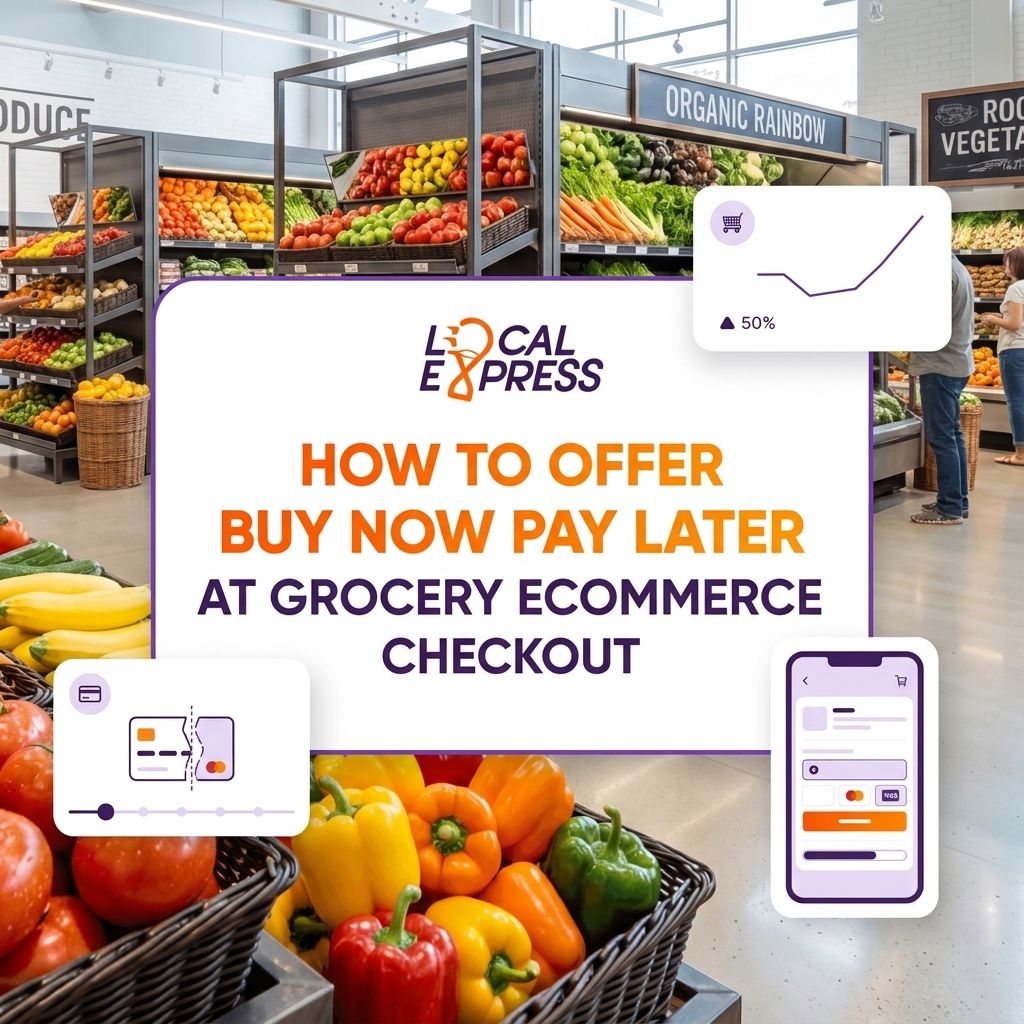
Adding buy now pay later to a grocery ecommerce checkout means plugging a provider like Affirm, Klarna, Afterpay, or Sezzle into your existing payment gateway, then deciding which orders actually qualify. This guide covers the setup steps, the SNAP EBT restriction most grocers overlook, and which provider fits a weekly basket versus a bulk holiday order in 2026.
- Klarna and Afterpay's four-installment, zero-interest plans fit everyday grocery baskets; Affirm suits large one-time hauls.
- BNPL cannot touch the SNAP-eligible portion of an EBT order under federal rules — the checkout has to split the tender.
- Merchant BNPL fees run roughly 2% to 8% of order value, well above the 1.5% to 3% grocers pay for card processing.
- Age-restricted items like beer and wine typically get excluded from BNPL installment plans entirely.
- Pilot buy now pay later grocery ecommerce on delivery and pickup orders above a set minimum before rolling it out storewide in 2026.
Why this matters
Grocery ecommerce checkouts lose shoppers the moment the full basket total lands on the screen — that's the entire case for buy now pay later grocery ecommerce checkout options. Regional grocers testing BNPL in 2026 are limiting it to delivery and pickup orders instead of every SKU in the store, because reducing cart abandonment on a grocery ecommerce website matters less if the fee behind the fix erases the margin on the order.
Grocery runs on thinner margins than apparel or electronics. A merchant fee that a clothing retailer shrugs off can turn a profitable basket into a break-even one, so the decision to flip on BNPL is a margin call before it's a checkout-design call.
The grocers getting this right treat BNPL as a targeted tool for large or occasional orders, not a blanket feature turned on for every cart. That distinction — targeted versus storewide — decides whether the fee pays for itself or just adds a line item to the cost of running an online storefront in 2026.
How to offer buy now pay later at grocery ecommerce checkout
Turning on buy now pay later at a grocery ecommerce checkout is a payments-integration project, not a full redesign. Six steps cover most implementations:
- Confirm the provider supports grocery merchant codes. Affirm, Klarna, Afterpay, and Sezzle all run grocery merchant accounts, but approval and fee terms differ by merchant category code. Confirm eligibility with the provider directly before building anything into the checkout flow.
- Connect through your existing payment gateway. Most grocery ecommerce platforms add BNPL through the same gateway integration already used for Apple Pay and Google Pay setup, so a full checkout rebuild usually isn't necessary.
- Set category exclusions before launch. Age-restricted items — beer, wine, spirits, tobacco — typically can't run through a BNPL installment plan and need to route to a standard card charge in the same cart.
- Wall off SNAP EBT dollars. BNPL can't touch the SNAP-eligible portion of a mixed cart under federal program rules. Configure checkout so the SNAP EBT online ordering balance draws from the EBT card while the rest of the cart runs through BNPL.
- Test the split-tender flow end to end. A cart with SNAP items, age-restricted items, and BNPL-eligible groceries needs three payment paths to clear correctly before it goes live, not just one.
- Monitor fraud and chargeback patterns after launch. BNPL orders carry different fraud signals than straight card orders — mismatched delivery addresses, rapid reorders, split-tender abuse — and a platform that centralizes order management catches those patterns faster than a bolt-on checkout plugin.
A platform built for grocery, rather than a generic ecommerce plugin, handles steps three through five natively. Local Express routes SNAP EBT, card, and BNPL tender types through one checkout on its grocery ecommerce platform, so the exclusions and splits above don't require custom development layered on top of the base build.
What buy now pay later costs a grocery store
The fee is the part most grocers underestimate. Merchant fees for BNPL run roughly 2% to 8% of the order total, depending on the provider and the agreement, compared with 1.5% to 3% for standard card processing. On a general retail order, that difference is a rounding error. On a grocery order running thin single-digit margins, it can be the entire profit on the sale.
That's why BNPL makes more sense on larger, less frequent orders — holiday catering, freezer stock-ups, bulk pantry restocks — where the checkout lift from offering installments outweighs the added fee. It makes less sense as a default option on every routine weekly basket, where the fee simply subtracts from an already thin margin.
Comparing BNPL providers for grocery orders
| Provider | Installment structure | Best for | Verdict |
|---|---|---|---|
| Klarna | Four payments, 0% interest, over six weeks | Everyday weekly grocery baskets | Buy for general checkout |
| Afterpay | Four payments, 0% interest, over six weeks | Recurring delivery and pickup orders | Buy for general checkout |
| Affirm | Longer terms, sometimes interest-bearing | Large one-time orders — holiday catering, freezer stock-ups | Consider for bulk-order promotions |
| Sezzle | Four payments, 0% interest, weekly schedule | Budget-conscious, price-sensitive shoppers | Consider for value-tier customers |
Klarna and Afterpay's four-payment structure matches the size and frequency of a typical grocery basket without adding interest. Affirm's longer terms fit occasional large purchases better than everyday orders. Sezzle serves a narrower, price-sensitive segment and works best layered in alongside one of the shorter-term options rather than as the only provider offered.
Why buy now pay later adoption varies for grocers
Not every regional grocer needs the same BNPL setup. A handful of factors decide whether the fee is worth paying:
- Average basket size. BNPL earns its fee on larger orders — bulk buys, holiday hauls, freezer restocks — where splitting the total actually changes the buying decision. On a routine weekly basket, the fee eats more of the margin than the checkout lift returns.
- SNAP EBT mix. Stores with a high share of SNAP EBT online orders get less benefit from BNPL overall, since the SNAP-eligible dollars can't run through it at all — only the non-SNAP portion of a mixed cart qualifies.
- Perishability and return risk. A refund on a perishable item still has to route through the BNPL provider's own refund process, not the store's standard return flow, which adds a step grocers with higher spoilage rates feel more than a dry-goods retailer would.
- Checkout platform compatibility. Grocers on a unified platform like Local Express turn BNPL on as a native checkout option; grocers stitching together separate plugins often hit compatibility gaps around split-tender carts and age-restricted exclusions.
- Margin per category. Grocery margins run thinner than general retail, so the same 2%-8% merchant fee that's routine in apparel or electronics can turn a marginal grocery order unprofitable.
- Customer base. Price-sensitive, budget-focused shoppers respond to installment options more than shoppers who already pay by card without hesitation — the same feature that drives conversion in one store may sit unused in another.
Run BNPL through one grocery checkout
See how Local Express handles SNAP EBT, card, and BNPL tender types in one order flow.
Does buy now pay later work with SNAP EBT grocery orders?
No, buy now pay later cannot apply to the SNAP-eligible portion of an EBT grocery order under federal program rules. The SNAP balance has to come off the EBT card directly; shoppers can still use BNPL on the non-SNAP items in the same cart, like household goods or age-restricted products, as long as checkout splits the tender correctly at payment.
Which BNPL provider fits everyday grocery orders best?
Klarna and Afterpay fit everyday grocery orders best because their four-payment, zero-interest structure matches a typical weekly basket without adding interest charges. Affirm suits large one-time purchases — holiday catering, freezer stock-ups — where a longer repayment term makes more sense than a six-week split.
Is buy now pay later worth it for independent grocers in 2026?
Buy now pay later is worth piloting on delivery and pickup orders above a set minimum in 2026, not rolling out across the entire catalog, because the merchant fee cuts into grocery margins that are already thin. Grocers that test it on larger baskets first can see whether the checkout lift covers the fee before deciding to widen it storewide.
FAQ
What is buy now pay later grocery ecommerce checkout?
Buy now pay later grocery ecommerce checkout lets a shopper split their order total into smaller installments — usually four payments over six weeks at 0% interest — instead of paying the full amount at checkout. It runs through third-party providers like Affirm, Klarna, Afterpay, or Sezzle rather than the grocer's own payment system.
Can you use buy now pay later on SNAP EBT grocery orders?
No, buy now pay later cannot cover the SNAP-eligible portion of an EBT grocery order under federal program rules. Shoppers can still use BNPL on non-SNAP items in the same cart, like household goods or age-restricted products, as long as the checkout splits the tender correctly.
How much does buy now pay later cost a grocery store?
Merchant fees for buy now pay later run roughly 2% to 8% of the order total, compared with 1.5% to 3% for standard card processing. The exact rate depends on the provider, order size, and the grocer's negotiated agreement.
Which BNPL provider is best for grocery stores?
Klarna and Afterpay fit everyday grocery orders best because their four-installment, interest-free plans match a typical weekly basket. Affirm works better for large one-time purchases, like holiday catering orders or freezer stock-ups, where longer repayment terms make more sense.
Does buy now pay later work on alcohol or tobacco orders?
Most buy now pay later providers exclude age-restricted items like beer, wine, and tobacco from installment plans entirely. A grocery cart with those items typically needs to split into a standard card charge for the restricted SKUs and a BNPL charge for the rest.
Is buy now pay later worth it for independent grocery stores in 2026?
Buy now pay later is worth piloting on delivery and pickup orders above a set minimum in 2026, not rolling out across every SKU, because the fee cuts into already thin grocery margins. Grocers that test it on larger baskets first see whether the checkout lift covers the fee before going wider.
Do I need a developer to add buy now pay later to my grocery site?
Most grocery ecommerce platforms connect BNPL providers through the existing payment gateway, the same integration path used for Apple Pay and Google Pay, so a full site rebuild usually isn't required. Confirm with your platform whether Affirm, Klarna, Afterpay, or Sezzle already has a supported connection before requesting custom development.
One last thing
A BNPL installment plan doesn't pause when a delivery shows up short or a perishable item needs a refund. The shopper still owes the next installment on the provider's schedule until the grocer processes the credit through the provider's own refund system — not through the store's standard return process. Grocery ecommerce platforms that centralize order management, like Local Express, make it easier to reconcile a mid-installment refund without extra manual tracking between the storefront and the BNPL provider's dashboard. Build the refund-timing gap into your customer service script before launch in 2026, or the first short delivery on a BNPL order turns into a support ticket nobody on staff knows how to close.