Grocery delivery lives or dies on the driver model, and most independent grocers pick one without ever running the math on the other. This guide walks through how to decide between employee drivers and gig drivers for grocery delivery in 2026, step by step, using the cost and control tradeoffs that actually move your margins.
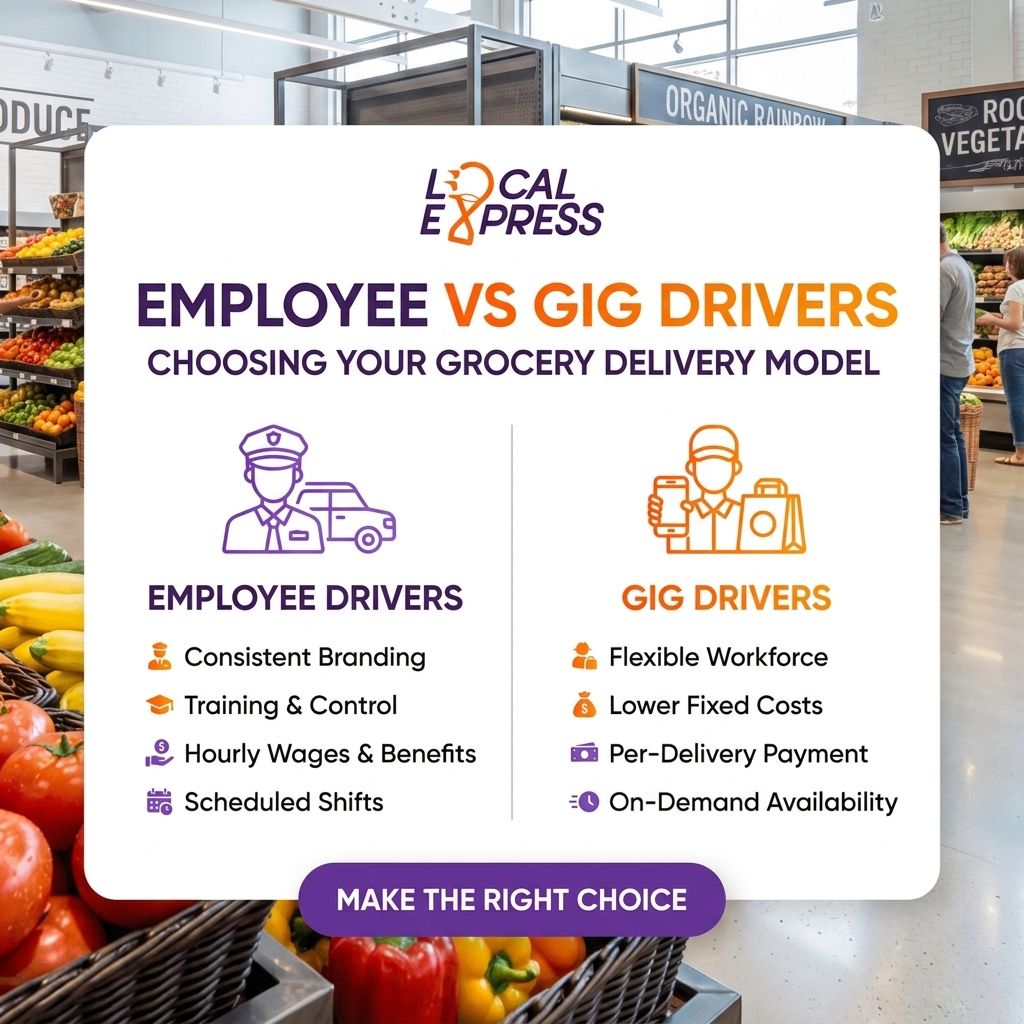
- Employee drivers win on order accuracy, brand control, and cold-chain reliability for grocery delivery.
- Gig drivers win on flexibility and lower fixed cost during slow seasons or unproven delivery zones.
- Run a 60-90 day pilot with both models before committing a full fleet in 2026.
- Worker classification rules vary by state and change how much a gig model actually saves you.
- Hybrid fleets — employee drivers for peak hours, gig drivers for overflow — are the default for most regional grocers in 2026.
Why this matters
The driver decision isn't a staffing question. It's a margin question that shows up in cart abandonment, refund rates, and whether customers trust your app enough to reorder.
Grocery delivery is unforgiving compared to restaurant or parcel delivery: frozen items melt, produce bruises, and a wrong substitution triggers a refund request instead of a shrug. Employee drivers give you training control and accountability. Gig drivers give you elasticity when order volume swings 40% between a Tuesday and a Saturday. Neither model is universally right — the right call depends on your delivery radius, order density, and how much control you need over the last mile of your grocery delivery operation.
What you'll need
- 90 days of order data broken out by delivery zone, time of day, and average basket size
- A cost worksheet covering wages or per-delivery payouts, insurance, vehicle costs, and fuel or mileage reimbursement
- A copy of your state's worker classification rules (independent contractor tests vary significantly by state in 2026)
- A written driver pay and tipping policy before you hire or onboard anyone
- A staffing and vehicle plan mapped to your actual order volume — see how to plan delivery staffing and vehicle needs for the intake questions to answer first
- Insurance quotes for both models — commercial auto for employees, contingent liability coverage for gig drivers
The steps
1. Map your delivery volume and radius
Pull 90 days of order history and plot delivery density by zone and hour. This tells you whether you have steady, predictable volume (favors employee drivers) or spiky, unpredictable demand (favors gig drivers).
A grocer running 15-20 deliveries a day in a tight 5-mile radius can usually staff that with two to three employee drivers on fixed shifts. A grocer with volume that swings from 8 orders to 60 orders depending on the day needs the flexibility a gig pool provides. Skipping this step is the single most common mistake — grocers hire full-time drivers based on gut feel, then can't fill the slow shifts.
Common mistake: using last month's numbers instead of a full quarter. Grocery order volume shifts with school calendars, weather, and holidays, and a single month misses the pattern.
2. Calculate true cost per delivery for each model
Employee driver cost includes hourly wage, payroll tax, workers' comp, and vehicle costs if you own the fleet. Gig driver cost includes per-delivery payout, any platform or dispatch fee, and higher per-mile reimbursement since gig drivers typically use personal vehicles.
Run both numbers against your actual order volume from step 1, not a hypothetical. The model that looks cheaper on paper often flips once you factor in idle time — an employee driver sitting between orders still draws a wage, while a gig driver only gets paid per completed delivery.
Model your delivery cost per order
See how a unified order and delivery platform tracks driver cost in real time.
3. Check state and local worker classification rules
This step gets skipped constantly, and it's the one that creates legal exposure. States like California apply strict tests (the ABC test under AB5) to determine whether a driver is truly an independent contractor or should be classified as an employee.
Misclassifying gig drivers exposes you to back pay, penalties, and audits — costs that erase any per-delivery savings you thought you had. Pull the current classification test for every state you deliver in before you build a gig fleet, not after.
Common mistake: assuming a national gig platform's classification model automatically applies to your own branded delivery operation. It doesn't — you own the classification risk once drivers work directly for your store.
4. Pilot both models over a fixed window
Run a 60-90 day pilot with a small employee crew in your highest-density zone and a gig pool covering your lower-density or overflow zones. Track on-time rate, substitution accuracy, and customer complaints for each group separately.
This is the only way to see real performance differences instead of assumptions. Employee drivers usually post better accuracy scores early because they're trained on your specific packing and substitution rules; gig drivers usually close that gap by week four if the app gives clear item photos and substitution logic.
Expected outcome: by day 60 you should have a cost-per-delivery and complaint-rate comparison clean enough to make a permanent staffing call.
5. Set pay and tipping policy before you scale
Driver pay structure changes behavior fast. Flat per-delivery pay encourages speed over care; tiered pay based on basket size and distance encourages drivers to handle heavier, more fragile grocery orders correctly.
Write the driver pay and tipping policy down before your pilot starts, not after you see the first round of complaints. Retroactively changing pay structure after drivers have started working creates turnover in both models.
6. Build a hybrid failover plan
Most regional grocers running delivery in 2026 don't pick one model exclusively — they run employee drivers for guaranteed peak-hour coverage and keep a gig pool for overflow, holiday spikes, or zones that don't justify a full-time route yet.
Build the failover trigger into your dispatch logic: if employee driver capacity hits 100% for more than 15 minutes, orders route automatically to available gig drivers instead of queuing. This keeps delivery windows tight without carrying full-time headcount for volume that only shows up twice a month.
7. Track performance weekly, not quarterly
On-time rate, cost per delivery, and complaint rate should be reviewed weekly for the first two quarters of any driver model change. Grocery delivery margins are thin enough that a bad week compounds fast if nobody catches it.
Set a simple dashboard: cost per delivery by model, complaint rate by model, and driver utilization rate. If gig driver cost per delivery creeps above employee driver cost during your busiest zones, that's your signal to shift headcount, not tolerate it.
Troubleshooting
Gig drivers are inconsistent on cold-chain handling. Add a mandatory photo-confirmation step for frozen and refrigerated items at pickup and drop-off, and drop drivers who fail it twice.
Employee driver costs are eating your delivery margin during slow months. Cut shifts to your proven peak windows from step 1 and route off-peak overflow to a gig pool instead of carrying full staffing year-round.
Classification questions keep coming up from your own team. Put your state's current independent contractor test in writing and review it every time you expand into a new delivery zone — rules differ by state and by city ordinance in some markets.
Substitution errors are higher with gig drivers than employees. The gap usually isn't the driver — it's unclear substitution instructions in the app. Fix the item-level notes before changing the driver model.
Pilot data looks noisy after 30 days. Thirty days isn't enough for grocery delivery, especially with weather or holiday variance. Extend to a full 60-90 day window before drawing conclusions.
Drivers are turning down orders during peak hours. Check your pay-per-delivery rate against distance and basket weight — flat pay across all order sizes pushes drivers toward the easiest orders and leaves your heaviest baskets sitting.
Tools and resources
- Driver staffing and vehicle needs planner — sizing your fleet against real order volume
- Driver pay and tipping policy guide — structuring pay before you scale either model
- Route optimization software for grocery last-mile delivery — cutting delivery time and fuel cost regardless of driver model
- State labor department classification test (check your state directly — rules changed in multiple states heading into 2026)
- A dispatch system that can route orders to employee and gig drivers from the same order queue, so you're not running two disconnected operations
What to do next
Once you've picked a model — or a hybrid split — the next decision is whether to keep routing orders through a third-party marketplace at all. Read how to reduce dependency on third-party delivery marketplaces before you lock in your driver structure, since the answer changes what you need from your delivery fleet.
FAQ
Are employee drivers or gig drivers better for grocery delivery?
Employee drivers work better for grocers with steady, dense delivery volume who need consistent cold-chain handling and brand control. Gig drivers work better for grocers with unpredictable volume or new delivery zones where fixed headcount doesn't pencil out yet.
How much does it cost to run employee drivers for grocery delivery?
Cost includes hourly wage, payroll tax, workers' comp, and vehicle expense if you own the fleet, and it holds steady whether or not the driver is on an active delivery. Compare that against your actual order volume from a full quarter, not a single month, before deciding.
Is it legal to use gig drivers for grocery delivery?
Yes, but classification rules vary by state, and some states apply strict tests like California's ABC test under AB5 to determine if a driver should be classified as an employee. Check your state's current classification rules before building a gig-only fleet in 2026.
Can grocery stores use both employee and gig drivers?
Yes, a hybrid model is the most common setup for regional grocers in 2026 — employee drivers cover guaranteed peak-hour routes, and gig drivers absorb overflow or holiday spikes. This keeps fixed cost lower without sacrificing delivery windows during busy periods.
How long should a delivery driver pilot run before deciding?
Run the pilot for 60 to 90 days, not 30. Grocery order volume shifts with weather, school calendars, and holidays, and a shorter window won't show the full pattern you need to compare cost and performance fairly.
Do gig drivers hurt grocery order accuracy?
Not inherently — most accuracy gaps trace back to unclear substitution instructions in the ordering app rather than the driver itself. Fixing item-level notes and photo confirmation closes most of the accuracy gap between gig and employee drivers.
What should be in a grocery driver pay policy?
A grocery driver pay policy should tie pay to distance and basket weight, not a flat per-delivery rate, since flat pay pushes drivers toward the easiest orders. Set the policy in writing before your pilot starts to avoid retroactive changes that drive turnover.
How do I know if my delivery zone needs employee drivers?
If a zone consistently produces 15 or more deliveries a day within a tight radius, fixed employee shifts usually cost less per delivery than a gig pool. Lower-density or inconsistent zones typically favor gig drivers until volume proves out.
One last thing
The grocers who get the driver decision wrong almost never fail on cost math — they fail on step 3. Worker classification exposure has cost more grocers more money than a bad per-delivery rate ever will, and it's the one step that gets skipped when everyone's focused on comparing wages to gig payouts.