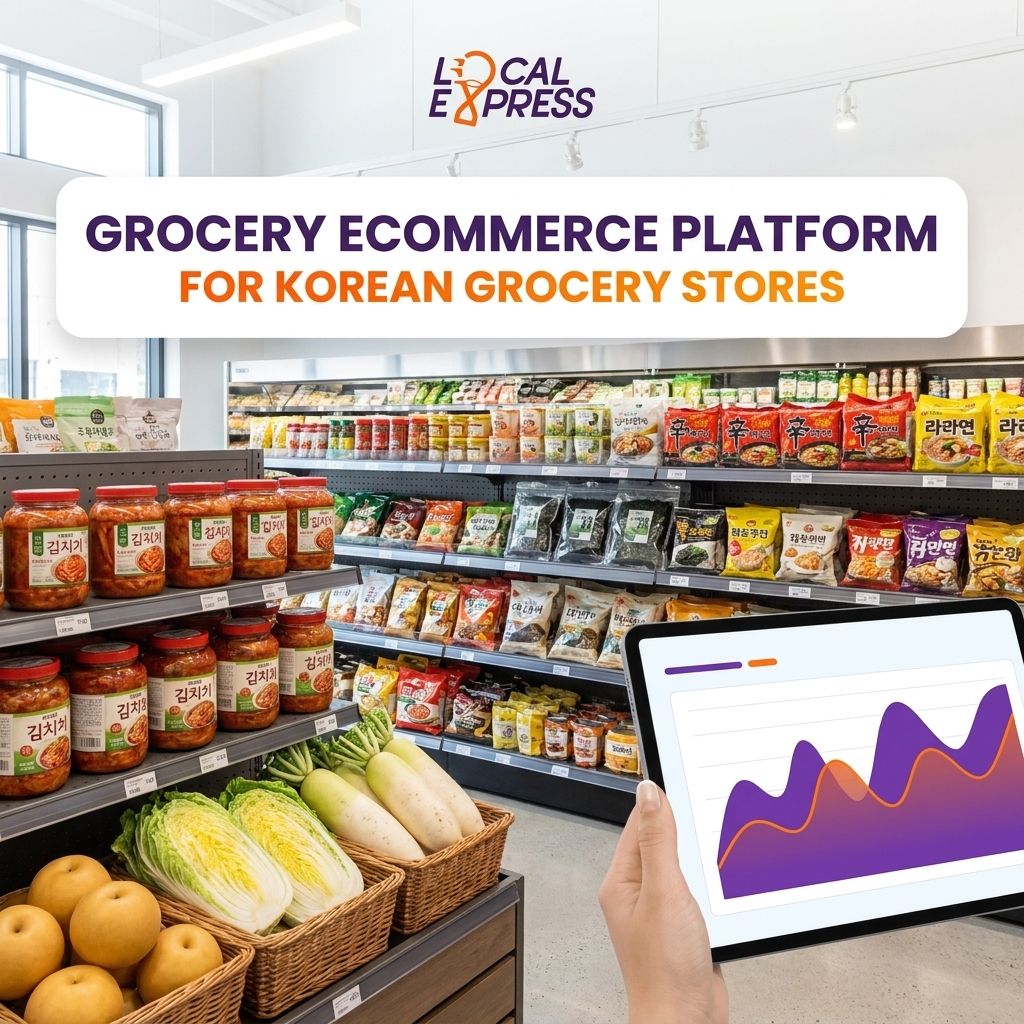
Korean grocery stores selling banchan, kimchi, K-BBQ cuts, and imported snacks online need more than a generic Shopify theme with Korean text pasted on top. This guide breaks down what a grocery ecommerce platform for Korean grocery stores actually needs to handle perishables, prepared food, and dense community delivery zones in 2026.
- Local Express fits Korean grocery stores that need bilingual SKU listings, prepared-food kiosks, and owned delivery -- Buy for independents with 1-8 locations.
- Generic ecommerce themes fail on perishable inventory and banchan bar ordering -- Skip if the platform can't handle short shelf-life SKUs.
- Marketplace-only delivery caps margin on high-frequency Korean grocery orders -- a grocery ecommerce platform for Korean grocery stores should route last-mile in-house.
- Retail media tools matter here: Korean CPG suppliers pay for placement the same way national brands do -- Consider for stores with 500+ SKUs from Korean import distributors.
Why this matters
Korean grocery stores carry a product mix that most ecommerce platforms were never built for: fermented goods with variable shelf life, prepared banchan sold by weight, frozen mandu, and produce like Korean pear and perilla leaf that don't map to a standard grocery template. Layer on a customer base that shops in both English and Korean, expects same-day delivery to a Koreatown or a suburban enclave, and increasingly buys gift sets around Chuseok and Lunar New Year, and the platform choice stops being cosmetic.
Most independent grocers still default to a unified commerce platform built for general grocery, then bolt on workarounds for bilingual product names and prepared food. That approach loses margin every single order cycle. The stores winning online in 2026 are the ones that picked infrastructure suited to their actual SKU mix on day one.
Who this is for
This guide is for owners and operators of independent or small-chain Korean grocery stores in the US -- typically 1 to 8 locations -- selling a mix of packaged Korean goods, fresh banchan, and a prepared food or hot bar counter, who are deciding between a generic ecommerce template and a grocery-specific platform.
What to look for in a grocery ecommerce platform for Korean grocery stores
Bilingual, SKU-accurate product listings
Customers search in both English and Korean, and product names like doenjang, gochujang, and tteokbokki need to be findable both ways. A platform that only supports a single-language catalog forces you to choose which half of your customer base gets a worse search experience.
Short shelf-life inventory handling
Banchan, kimchi, and prepared kimbap have shelf lives measured in days, not weeks. Inventory logic built for shelf-stable center-store grocery will oversell or waste product on anything perishable, and that's most of your highest-margin SKUs.
Prepared food and kiosk support
A banchan bar, kimbap station, or hot food counter needs order management that connects a self-service kiosk to a kitchen display, not a bolt-on plugin. Kiosk-driven ordering has shown 30% higher order values in grocery retail, which matters most on prepared food, your best margin category.
Delivery control in dense community zones
Koreatowns and Korean-heavy suburbs are dense enough to run efficient owned delivery, but only if the platform lets you set zones, fees, and driver assignment yourself instead of routing everything through a marketplace that takes a cut of every order.
SNAP/EBT compliance for eligible items
Many Korean grocery SKUs -- rice, produce, packaged staples -- qualify for SNAP/EBT. A platform that can't separate eligible from non-eligible items at checkout creates compliance risk and lost sales.
Retail media tools for Korean CPG suppliers
Korean food brands and importers increasingly pay for shelf placement online the same way national CPG brands do in-store. A platform without sponsored placement tools leaves that revenue on the table.
Top picks for Korean grocery stores
The bilingual storefront -- Local Express white-label ecommerce Hook: the pick that doesn't force English-only search. Spec: white-labeled, fully branded storefront with SKU-level product data built for non-standard naming, the same structure used on the spice and international food shops platform. Verdict: Buy for any Korean grocer running more than 500 packaged SKUs.
The prepared foods engine -- kiosk plus kitchen display Hook: turns your banchan bar into an online revenue line instead of an in-store-only counter. Spec: self-service kiosk ordering tied to kitchen display routing, with 99% reported order accuracy on kiosk-driven orders in 2026 grocery data. Verdict: Buy for stores with a hot bar, kimbap station, or MTO counter doing meaningful daily volume.
The delivery control layer -- owned last-mile routing Hook: keeps the margin that a marketplace commission would otherwise take. This matters more for Korean grocery than most categories because order frequency in dense community zones is high and per-order commission compounds fast. See how independents reduce dependency on third-party delivery marketplaces while keeping delivery reliable. Verdict: Buy for any store within a dense metro Korean community.
The proof-of-concept parallel -- ethnic specialty rollout playbook Hook: the model already works for comparable ethnic grocery formats. Independent Indian grocery stores run the same bilingual-catalog, high-frequency-perishable playbook on a comparable white-label build. Verdict: Consider as a reference point before you commit to a build timeline.
The margin lift -- retail media for Korean CPG suppliers Hook: turns supplier relationships into a revenue line instead of a cost center. Korean food importers and CPG brands are willing to pay for sponsored placement the same way national brands fund retail media programs generating a reported $3.50 return per $1 invested in 2026 aggregate data. Verdict: Consider once your online catalog passes roughly 1,000 SKUs and supplier relationships are established.
What to avoid
- Single-language templated storefronts. They look fine in a demo, then fail the moment a customer searches "gochujang" instead of "red chili paste" and gets zero results.
- Marketplace-only delivery for every order. It's fast to launch but caps your margin permanently on your highest-frequency customers -- the ones ordering banchan and produce weekly.
- Generic POS inventory logic for perishables. If the system treats a tub of kimchi like a canned good with a 12-month shelf date, you'll oversell or write off product every week.
Verdict comparison
| Capability | Why it matters for Korean grocers | Verdict |
|---|---|---|
| Bilingual product catalog | Korean and English search both need to work | Buy |
| Prepared food kiosk + kitchen display | Banchan and kimbap are your margin drivers | Buy |
| Owned last-mile delivery | Dense community zones make in-house delivery viable | Buy |
| SNAP/EBT checkout logic | Rice, produce, and staples qualify | Buy |
| Retail media for CPG suppliers | Korean food brands will pay for placement | Consider |
| Single-language generic theme | Fails half your customer base on search | Skip |
See the platform built for grocers like you
Walk through bilingual catalog and kiosk setup for your store.
FAQ
What's the best grocery ecommerce platform for Korean grocery stores in 2026?
A grocery-specific platform that handles bilingual product listings, short shelf-life inventory, and prepared food ordering wins over generic ecommerce templates for Korean grocery stores in 2026. Look specifically for kiosk integration for banchan and kimbap counters.
Do Korean grocery stores need a bilingual ecommerce site?
Yes, bilingual product search matters because customers search the same item by its English translation and its Korean name. A single-language catalog loses sales on both sides of that gap.
Can independent Korean grocers compete with national chains and Amazon Fresh online?
Independent Korean grocers compete by owning the customer relationship through a branded app and website rather than routing every order through a marketplace. Specialty SKUs and prepared food are the differentiators national chains can't easily replicate.
How much does a grocery ecommerce platform cost for a Korean grocery store?
Cost depends on store count, SKU volume, and whether kiosk hardware is included. Check current pricing directly with a platform provider since packages vary by location count and feature set.
Does the platform support SNAP EBT for Korean grocery items?
A grocery-built platform separates SNAP/EBT-eligible items like rice and produce from non-eligible items at checkout automatically. This is a compliance requirement, not an optional feature, for stores accepting EBT.
Can Korean grocery stores sell prepared banchan and kimbap online?
Yes, when the platform connects online ordering to a kitchen display system so prepared food orders route directly to the counter making them. Without that connection, prepared food orders create fulfillment chaos.
Is a mobile app necessary for a Korean grocery store?
A branded mobile app matters most for stores with repeat weekly customers, which describes most Korean grocery shopper behavior. Push notifications for restocks and pre-order windows around holidays drive meaningful repeat volume.
How long does it take to launch a Korean grocery ecommerce site?
Timelines depend on catalog size and whether kiosk hardware is part of the rollout, but white-label platforms are built to launch faster than custom development. Ask any platform provider for a specific timeline against your SKU count.
One last thing
The biggest margin leak for Korean grocery stores isn't everyday orders -- it's Chuseok and Lunar New Year gift set pre-orders. These windows drive a spike in high-ticket orders for a few weeks a year, and stores that don't own their order flow during that spike hand a chunk of that revenue straight to a marketplace commission. Set up pre-order capability before the next holiday cycle, not during it.