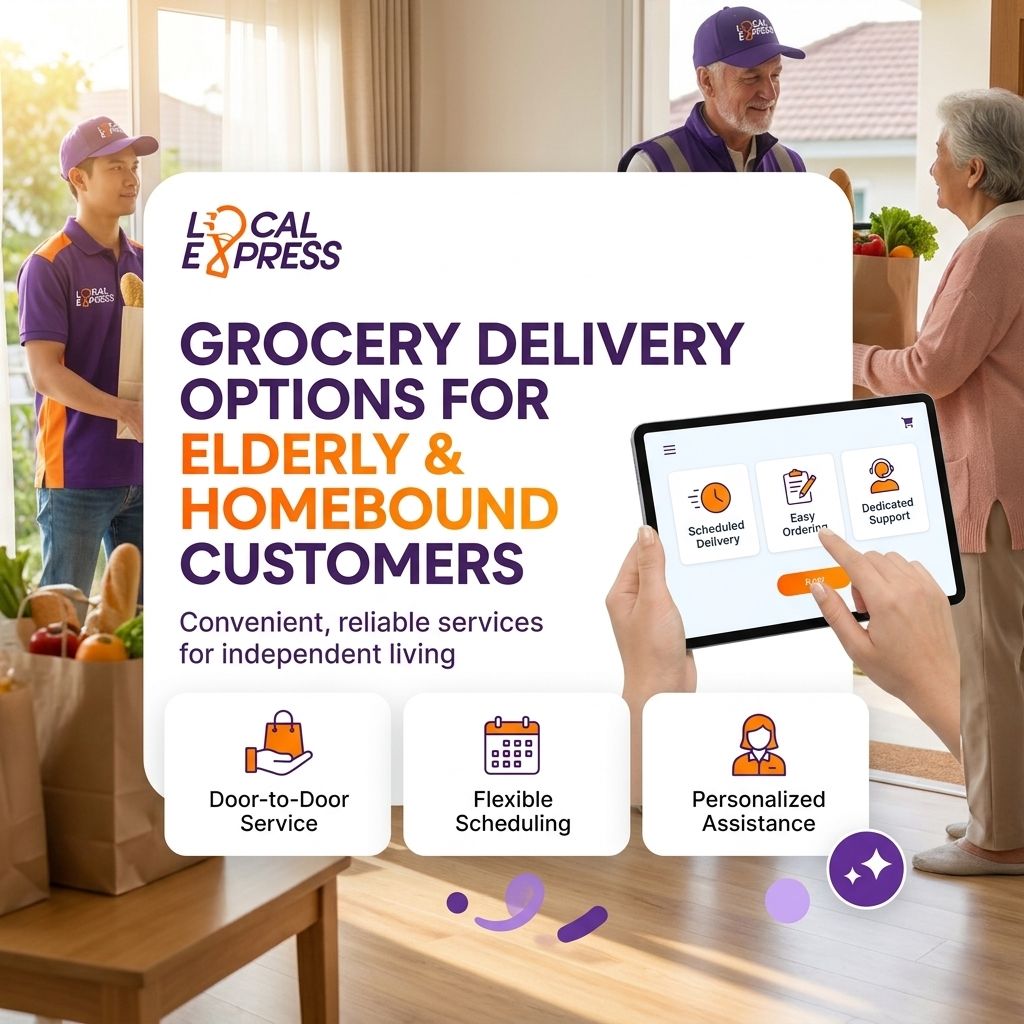
Elderly and homebound grocery delivery is a service model built around minimal physical effort, simple payment, and predictable timing, with the goal of keeping seniors and shut-in customers fed without a store trip. This segment needs slower-paced support, phone-based ordering, and drivers trained for doorstep hand-offs — needs a healthy 28-year-old app user never has.
- Grocery delivery for elderly and homebound customers works best with phone ordering, SNAP EBT support, and named delivery windows.
- Local Express lets independent grocers run delivery in-house instead of routing seniors through a marketplace app.
- Skip app-only ordering: many homebound shoppers over 65 don't have a smartphone or a reliable data plan.
- Recurring orders cut missed deliveries for customers who can't reorder every week on their own.
Why grocery delivery matters for elderly and homebound customers
The U.S. Census Bureau projects that by 2030, one in five Americans will be 65 or older, and a growing share of that group will shop from home instead of driving to a store. Independent grocers who ignore this shift lose repeat business to national chains and marketplaces that already run senior-friendly delivery.
Elderly and homebound customers don't behave like a typical delivery segment. They order fewer, more predictable items, they need a live person to answer questions, and a meaningful share pay with SNAP or EBT instead of a credit card. A grocer that sets up SNAP EBT online ordering before building out the rest of the program removes the single biggest access barrier for this group in 2026.
Map your elderly and homebound customer base
Start with the data you already have before building anything new.
- Pull loyalty and order history to flag customers over 65 or with delivery-only ordering patterns
- Ask store staff and drivers which regular customers rarely walk into the store anymore
- Cross-check delivery zip codes against senior housing or assisted-living addresses on file
- Note which customers call in orders instead of using the app or website
- Flag accounts that consistently use SNAP/EBT or a caregiver's payment card
Build an ordering channel that doesn't require a smartphone
App-only delivery excludes a large share of this segment before they ever place an order.
- Keep a staffed phone line for order-taking during regular store hours
- Offer a simplified, large-text version of the online ordering site
- Let a caregiver or family member set up a proxy account with delivery permissions
- Provide a printed weekly order form customers can call in or mail
- Test the checkout flow with someone unfamiliar with apps before launch
Simplify checkout and payment for this group
Payment friction is the fastest way to lose a homebound customer mid-order.
- Support SNAP EBT alongside standard card payments at checkout
- Save a default cart of frequent items so reordering takes one phone call, not twenty
- Offer a single flat delivery fee instead of one that changes by order size
- Keep the same card or EBT balance on file across every order
- Skip mandatory app downloads for anyone who orders exclusively by phone
Set delivery windows and driver protocols this group can count on
An all-day delivery estimate is unusable for someone who can't move quickly to answer the door.
- Give a fixed 1-2 hour window instead of an all-day estimate
- Call or text 15-30 minutes before arrival, not just an automated push notification
- Require a name check at the door for high-value or medication-adjacent orders
- Train drivers to bring bags to the kitchen counter when asked, not just the porch
- Build a callback protocol for no-answer deliveries instead of leaving groceries unattended
Offer recurring and subscription orders for household staples
A repeat order removes the burden of rebuilding a cart every week.
- Let customers set a weekly or biweekly repeat order for milk, bread, produce, and staples
- Send a reminder call or text 24 hours before the order locks in, so they can adjust it
- Cap subscription changes to a simple add, remove, or skip list instead of rebuilding a cart
- Bundle subscription orders on a fixed delivery day so drivers can batch routes efficiently
- Review skipped or canceled orders monthly, since a pattern change can flag a customer who needs a check-in
Train drivers and staff for elderly and homebound hand-offs
The driver is the only human touchpoint most homebound customers get all week.
- Brief drivers on carrying orders to the door, porch, or kitchen counter based on the customer's request
- Set a no-contact protocol for customers who prefer bags left outside
- Give drivers a script for what to do if a customer doesn't answer: call, wait, escalate
- Use grocery delivery driver management software to flag stops that need extra time or special handling
- Cover basic elder-care awareness so drivers recognize when a customer may need help beyond the grocery order
Support caregivers and family proxy ordering
Most homebound orders in 2026 involve a second person: a family member, an aide, or a facility staffer placing or checking the order.
- Let a caregiver or family member manage an elderly customer's account with delivery permissions
- Send delivery confirmations to both the customer and the caregiver's phone or email
- Allow the caregiver to set spending limits or approved item lists
- Keep a single point of contact at the store for repeat caregiver questions
Independent grocers delivering into senior living communities and assisted-living buildings run into a parallel staffing problem: someone has to answer the front-desk phone every time a resident or family member calls in a grocery question, a gap senior living communities increasingly cover with automated phone answering instead of adding headcount.
Comparing delivery options for elderly and homebound customers
| Option | Best for | Key limitation |
|---|---|---|
| In-house delivery via a branded app or website | Grocers who want full control over routing, pricing, and the customer relationship | Requires building or licensing delivery software and staffing drivers |
| Third-party marketplace delivery | Grocers who need delivery live fast with no build-out | Marketplace fees eat margin and the grocer doesn't own the customer relationship |
| Curbside pickup or click-and-collect lockers | Homebound customers who have a caregiver or driver who can collect the order | Doesn't solve the "no one can drive" problem on its own |
| Phone-order-to-delivery service | Elderly customers without a smartphone or reliable internet | Needs a staffed order line and manual entry into the ordering system |
| Volunteer or community shuttle programs | Rural or low-income elderly customers outside a paid delivery radius | Inconsistent scheduling and no revenue for the grocer |
A grocer running its own delivery through a unified commerce platform is the only option on this table that gives elderly customers phone ordering, SNAP EBT, and a fixed delivery window at the same time.
Build a delivery program seniors can rely on
Run SNAP EBT, phone orders, and driver routing on one grocery platform.
Common mistakes grocers make serving this segment
- Requiring app-only ordering. A large share of homebound shoppers over 65 don't own a smartphone or don't trust it for payment; cutting off phone orders cuts off the customer.
- Using an all-day delivery window. A four-hour or all-day estimate forces an elderly customer to wait by the door all day, which drives complaints and canceled orders.
- Skipping SNAP/EBT support. Many low-income elderly customers rely on EBT; a checkout that only takes cards excludes them before they finish the order.
- Not briefing drivers on drop-off preferences. A driver who leaves bags on a porch for a customer who can't bend down to pick them up creates a service failure that looks like a delivery failure.
- Ignoring caregiver account access. When a family member or aide can't see or manage the order, small questions turn into phone calls the store isn't staffed to handle.
FAQ
What's the best grocery delivery option for elderly customers who don't have a smartphone?
A staffed phone-order line paired with a store's own delivery service works best, since it skips the app entirely. The customer calls in a saved cart, pays over the phone or with EBT on file, and gets a fixed delivery window.
How much does grocery delivery cost for homebound seniors in 2026?
Cost depends on the store's delivery zone, order minimum, and whether the grocer runs delivery in-house or through a marketplace. Check the retailer's own site or call the store for current delivery fees.
Can homebound customers pay with SNAP EBT for online grocery orders?
Yes, when the grocer has set up SNAP EBT online ordering on its checkout. Not every delivery platform supports EBT by default, so this needs to be confirmed with the specific store.
Is a grocer's own delivery app better than a marketplace for elderly customers?
An in-house app or phone-order system gives the grocer control over delivery windows, driver training, and payment options like SNAP EBT. A marketplace is faster to launch but the grocer has less control over how the elderly customer experience is handled.
How do grocers verify a safe delivery to a homebound customer?
Most programs use a name check at the door for high-value orders and a callback protocol if no one answers. Drivers trained for this segment know to wait, call, or escalate rather than leave the order unattended.
Should caregivers have their own login for an elderly customer's grocery account?
Yes. A proxy account lets a caregiver manage orders, see delivery confirmations, and set spending limits without taking over the customer's own account entirely.
Do subscription grocery orders work well for elderly customers?
Recurring orders for staples like milk, bread, and produce reduce the burden of rebuilding a cart every week. A reminder 24 hours before the order locks in gives the customer a chance to adjust it.
One last thing
The single highest-leverage fix most grocers skip in 2026 is adding a phone-in option to an app-first delivery program. It costs less to staff than building elder-specific app design, and it captures every homebound customer who will never download an app no matter how simple it is.