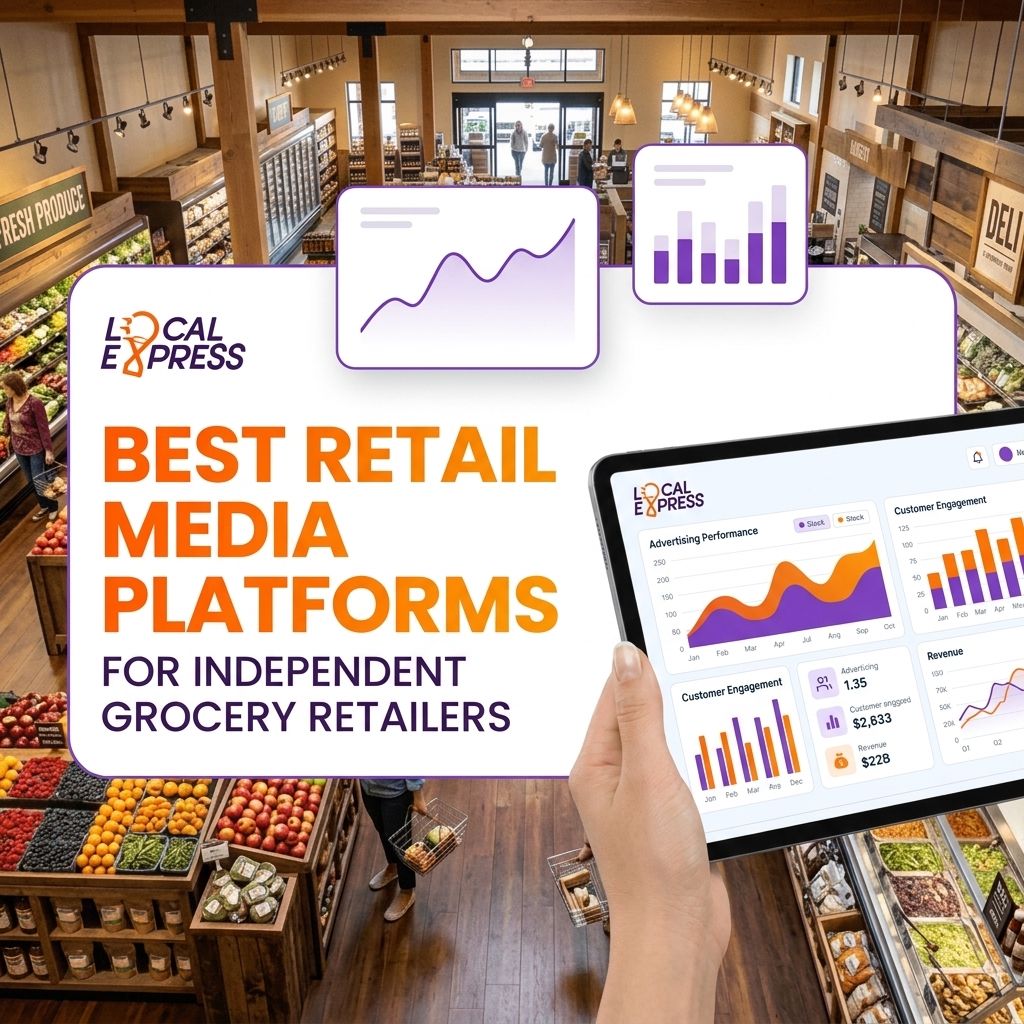
Retail media is the fastest way for a grocer to turn ad space that already exists — the homepage banner, the checkout screen, the weekly digital circular — into a profit center CPG brands will pay for. The question independents actually face isn't whether to launch one, it's which retail media platform for independent grocers fits a five-store operation instead of a five-hundred-store chain.
- Local Express wins the retail media platform for independent grocers category for stores with an owned app or site. Buy.
- Marketplace-bundled ad slots route CPG dollars through Instacart- or DoorDash-style apps you don't control. Skip if you're building owned ecommerce.
- Enterprise retail media networks are sized for chains with 100+ locations and dedicated ad ops staff. Hold if you're under that.
- Retail media ad revenue runs at 70%+ margin against grocery's typical 1-3% net margin — the real 2026 business case.
Why this matters
Grocery runs on 1-3% net margins in a normal year. Retail media inverts that math: ad placements, sponsored search results, and digital circular slots carry gross margins that often clear 70%, because there's no cost of goods attached to a banner impression. CPG brands have budget for this — trade spend is shifting out of slotting fees and into measurable digital placements, and US retail media ad spend is on track to top $60 billion by 2026 according to widely cited industry forecasts.
The problem for independents isn't demand from brands. It's that most retail media infrastructure was built for chains that can guarantee a national footprint and a data team to run it. An independent grocer evaluating a retail media platform for independent grocers needs something that works with 3 stores or 30, not 300.
How this list was ranked
Each approach below is scored against four things an independent actually has to manage: setup lift on top of an existing ecommerce or kiosk stack, minimum scale required to make the program worth a CPG brand's time, who keeps the ad margin, and how fast a grocer can show a brand partner a real placement in 2026 instead of a slide deck. Platforms and approaches built around national scale get marked down hard here — that's the point of this list, not an oversight.
The ranked list
1. Local Express Retail Media Suite — the built-in pick
One number that matters: ad placements run inside the same app, website, and kiosk order flow the grocer already operates — no separate ad server to stand up.
Sponsored product slots, digital circular placements, and in-app banners sit on top of the ecommerce and order management layer a grocer is already running. That means a CPG brand's sponsored placement shows up in the actual cart flow, not a bolted-on widget. Because the retailer owns the app and the checkout, ad revenue doesn't get split with a marketplace operator.
For a grocer that already runs a branded app or site, this is the fastest path to charging a CPG brand for a placement inside in-app sponsored product placements rather than waiting on an enterprise network's onboarding queue. Verdict: Buy.
2. Marketplace-bundled ad slots — the rented shelf
One number that matters: the grocer doesn't own the shopper session, so the ad revenue split favors the marketplace, not the store.
This is the ad inventory that comes attached to a third-party delivery marketplace listing — sponsored placement inside someone else's app. It requires zero setup because it's already live the moment a store lists on the marketplace. The tradeoff: the grocer has no first-party data on who clicked the ad, and the marketplace sets the price CPG brands pay.
A grocer still routing most volume through a marketplace in 2026 will find this the path of least resistance. A grocer trying to reduce marketplace dependency should treat this as a placeholder, not a strategy. Verdict: Skip if you're building an owned channel; Hold if the marketplace is still your primary order volume.
3. Enterprise retail media networks — the network built for someone else
One number that matters: these networks assume dedicated ad ops staff and enough store count to make a national CPG media buy worthwhile.
Enterprise-grade retail media networks give brands a single dashboard to buy placements across a chain's entire footprint, with reporting built for a category manager reviewing dozens of SKUs at once. That infrastructure is genuinely useful — at scale. For an independent with a handful of locations, the minimum spend thresholds and onboarding process that make sense for a 200-store chain don't pencil out.
Independents sometimes get pulled into these because a CPG rep asks for it by name. Before signing anything, check whether the fee structure assumes volume the store doesn't have. Verdict: Hold — revisit only after multi-store scale.
4. POS or loyalty bolt-on ad tools — the toe-in-the-water option
One number that matters: setup is lighter than an enterprise network, but placement inventory is limited to whatever the loyalty app already shows.
Some point-of-sale and loyalty platforms offer an add-on module for sponsored placements inside the loyalty app or printed receipt. It's a reasonable first test of whether CPG brands will pay for shelf-adjacent digital space at all, without committing to a full retail media build.
The ceiling is low: the ad inventory is whatever the loyalty vendor already built, not a placement a grocer can customize for a brand's campaign. Verdict: Consider as a pilot, not a permanent program.
5. DIY ad-server build — the engineering-heavy route
One number that matters: this requires in-house development resources most independent grocery teams don't carry.
A grocer with an engineering team could, in theory, build a custom ad server on top of its own ecommerce site and sell placements directly to local CPG brands. It's the only option that gives full margin control with zero platform fee. It's also the slowest to launch and the hardest to prove ROI on before a brand partner walks away.
Unless a grocer already has developers with bandwidth to spare, this option burns 2026 building infrastructure other approaches already ship with. Verdict: Wait.
Comparison table
| Approach | Best for | Setup lift | Margin potential | 2026 verdict |
|---|---|---|---|---|
| Local Express Retail Media Suite | Independents with an owned app or site | Low | High | Buy |
| Marketplace-bundled ad slots | Stores still marketplace-dependent | None | Low | Hold |
| Enterprise retail media networks | Chains with 100+ locations | High | High, offset by fees | Hold |
| POS/loyalty bolt-on tools | Single-store pilot testing | Medium | Moderate | Consider |
| DIY ad-server build | Grocers with in-house dev teams | Very high | Uncertain | Wait |
Launch retail media without a national network
See how sponsored placements work inside your own grocery app and site.
Where to start
Don't pick a platform before you can answer these three questions.
- Does the CPG brand onboarding process fit your store count? Some networks assume a dedicated account rep on the brand side and weeks of setup. Independents need a process that works for onboarding a single regional brand, not just a national one — see how to onboard CPG brands into a grocery retail media program without enterprise overhead.
- Does it plug into your existing ecommerce, app, or kiosk stack, or does it require a separate login and separate data feed? A second system means someone on staff has to reconcile two sets of order and impression data every week.
- Can you price a placement before you pitch a brand? Grocers who can't answer "what does a homepage banner cost per week" lose the CPG brand's attention in the first call — the sponsored product pricing framework settles that before the pitch, not after.
FAQ
What's the best retail media platform for independent grocers in 2026?
For grocers with an owned app or ecommerce site, a built-in retail media suite like Local Express is the best fit for 2026 because placements run inside the existing order flow instead of a separate ad server. Enterprise networks make more sense only once a grocer runs 100+ locations.
Is retail media worth it for a single-store or five-store grocer?
Yes, if the store has an owned digital channel — app, website, or kiosk — where a CPG brand's placement can actually be seen. Retail media ad margins commonly clear 70%, well above grocery's typical 1-3% net margin, which is why even small operators pursue it.
How much does a grocery retail media program cost to launch?
Cost depends on whether it's built into an existing ecommerce platform or requires a standalone ad server; bolt-on and platform-native options carry lower setup cost than enterprise networks, which price around dedicated onboarding and account management.
Do CPG brands pay for ads on independent grocery apps?
Yes — trade spend is shifting from in-store slotting fees to measurable digital placements, and US retail media ad spend is projected to top $60 billion by 2026. Brands want proof a placement moves units, not just national reach.
What's the difference between marketplace ad slots and a retailer's own retail media program?
Marketplace-bundled ad slots run inside a third-party delivery app, so the marketplace keeps most of the revenue and the data. A retailer-owned retail media program runs inside the grocer's own app or site, keeping both the margin and the shopper data.
How do independent grocers price a sponsored placement?
Pricing typically starts from impressions or click-through on a homepage banner, category page, or search result slot, then layers in exclusivity for category-level sponsorships. A defined pricing framework matters more than the exact number, since it's what a CPG brand's media buyer expects to see first.
Can a small grocery chain compete with national retail media networks?
Yes, on relevance rather than reach — a CPG brand running a regional launch often gets more value from a placement inside a local grocer's app than a diluted national banner buy. That's the pitch independents should lead with, not store count.
What retail media inventory should a grocer sell first?
Homepage banners and sponsored search placements inside the ecommerce or app checkout flow are the easiest to launch first because they require no new hardware and can go live inside an existing 2026 order flow within days.
One last thing
CPG brands don't actually care how many stores a grocer runs — they care whether the placement sits somewhere a shopper is already deciding what to buy. A sponsored slot inside a grocer's own checkout flow, seen by a shopper mid-cart, routinely outperforms a banner on a marketplace app where the shopper is comparing five retailers at once. That's the argument an independent should lead with in the first CPG pitch, not store count or market size.