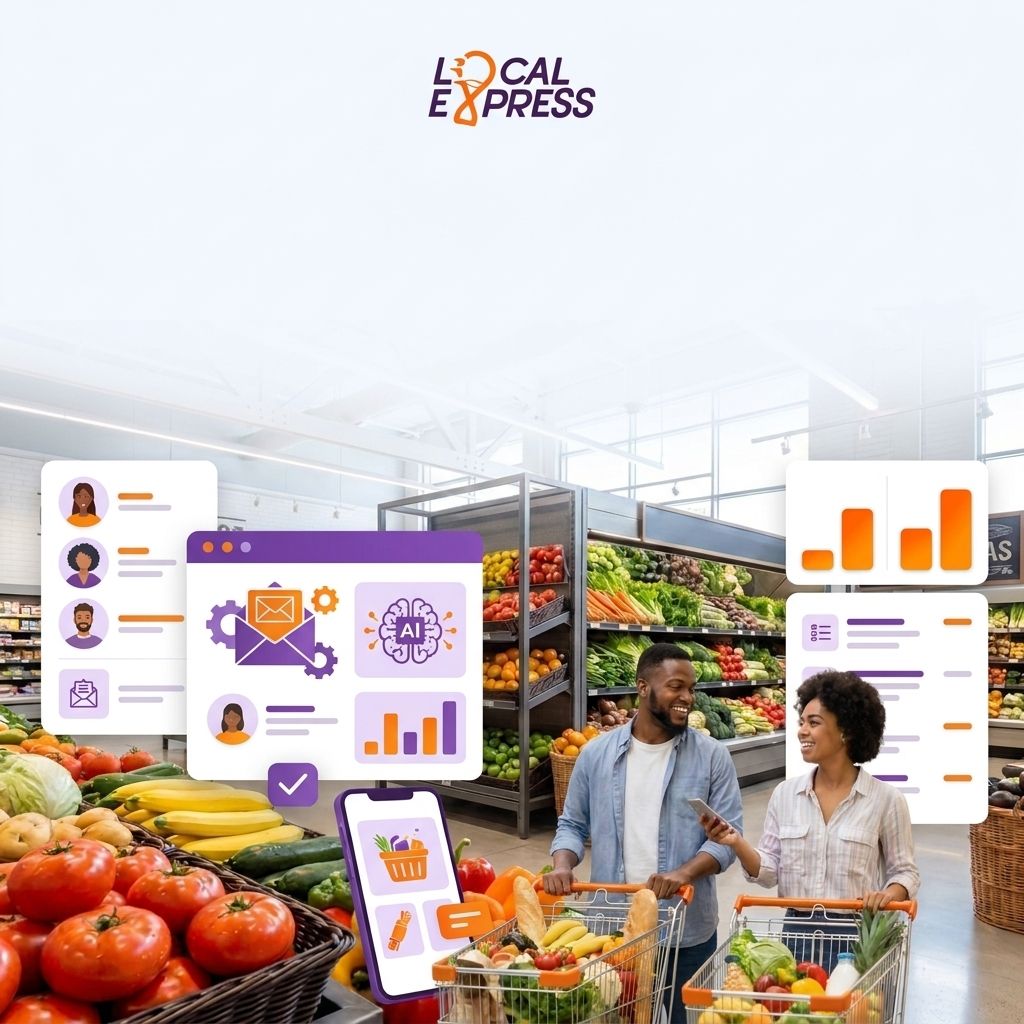
Grocery email lists fail the same way almost every time: one blast to everyone, a coupon nobody wanted, and an unsubscribe spike the next morning. Customer segmentation tools fix that by splitting your list into groups that actually behave differently — deli regulars, SNAP/EBT shoppers, delivery-only customers, lapsed loyalty members — so each group gets an offer that fits.
- Local Express CRM with AI and CDP wins for U.S. independent grocers that need customer segmentation across web, app, and kiosk orders in one system.
- POS-native loyalty segmentation is the low-lift starting point but stalls once you sell across more than one channel.
- Standalone email tools such as Mailchimp or Klaviyo work for a single-location store but need manual data exports to segment on grocery-specific behavior.
- Dedicated customer data platforms are overkill for most independent grocers under 10 locations in 2026 — skip unless you run a regional chain.
- Spreadsheet segmentation is free and slow, and it breaks the moment your list passes a few thousand contacts.
Why this matters
Most independent grocers still send one email to the entire list because their platform makes segmentation feel like extra work. That's expensive in 2026: shoppers who get a generic weekly ad open it less, and the ones who do open it convert at a lower rate than shoppers who get an offer tied to what they actually buy.
The numbers above aren't abstract. Personalized, segmented campaigns return $3.50 for every $1 invested, and grocers running targeted segments see cart abandonment drop by 18% compared to blanket sends. That gap is the entire argument for picking the right customer segmentation tools for grocery email marketing instead of defaulting to whatever your point-of-sale vendor bundled in for free.
Running everything through Local Express CRM with AI and CDP matters here because customer profiles and order activity stay connected across web, app, and kiosk channels instead of sitting in separate exports.
How this list was ranked
Each entry below is judged on four things: whether it can segment by actual purchase behavior (not just demographics), how much setup work it takes for a small grocery team, whether it works across web, app, and in-store kiosk orders, and whether the segmentation connects directly to email and SMS sends without a manual export step. Tools that only segment by name and email address rank lower than tools that segment by SNAP/EBT usage, delivery zone, deli counter visits, or loyalty tier.
The ranked list
1. Local Express CRM with AI and CDP — the unified grocery pick
Local Express CRM with AI and CDP brings customer records and order history from your website, app, and kiosk into one system, then uses AI-supported segmentation to group shoppers by actual purchase behavior instead of guesswork. A grocer can build a "bought produce 3+ times in 30 days" segment without stitching together exports from three tools.
Because the CRM and CDP sit inside Local Express's unified commerce platform, the same customer profile can support segmentation across web, app, kiosk, email, and SMS activity. Buy for any U.S. independent grocer running more than one ordering channel in 2026.
2. POS-native loyalty segmentation — the low-lift pick
Most POS systems ship a loyalty module that segments by spend tier and visit frequency. It's already paid for, it's already connected to checkout, and setup takes an afternoon.
The catch: loyalty-tier segments don't capture delivery behavior, app usage, or SNAP/EBT status, so campaigns built on this data alone tend to plateau after the first few sends. Grocers pairing loyalty card integration for independent grocery POS systems with a broader commerce platform get more segmentation depth than loyalty data alone provides. Consider as a starting layer, not a permanent solution.
3. SMS and push notification segmentation — the fastest-ROI pick
SMS and push open rates run far higher than email, and segmenting by delivery status or order-ready alerts turns a transactional message into a marketing channel. The concrete detail worth noting for 2026: grocers using push and SMS layered on top of email segments report the fastest response times of any channel, since a shopper checks a delivery text within minutes, not hours.
This works best when the segmentation logic is shared with email so a customer doesn't get the same coupon twice through two channels. Buy as a complement to email, never as a replacement.
4. Standalone email service providers — the starter pick
Tools like Mailchimp or Klaviyo handle list segmentation by tags, purchase tags, or manual uploads. They're familiar, cheap to start, and fine for a single-location grocer with a simple list.
The limitation shows up fast: without a direct feed from your ordering platform, someone has to manually export and re-upload customer data every time a segment needs updating. That lag means the segment is stale by the time the campaign sends. Consider only if you run one store and don't yet have delivery, app, or kiosk channels to sync.
5. Dedicated customer data platforms — the overkill pick
CDPs promise unified profiles across every touchpoint a business has, and they deliver that for large retailers with dedicated data teams. For an independent grocer or a regional chain under 10 locations, the setup cost and the headcount needed to maintain it rarely pencil out against the segmentation gains.
The honest read for 2026: most independent grocers get 90% of the segmentation value from a unified commerce platform's built-in tools at a fraction of the implementation time. Skip unless you're already running a data engineering function.
6. Spreadsheet-based manual segmentation — the free-but-risky pick
Exporting order data into a spreadsheet and manually tagging customers by hand is free and requires no new software. It also doesn't scale past a few thousand contacts before someone makes a mistake — the classic failure is emailing a "win-back" discount to a customer who ordered yesterday.
The cart-abandonment gap between segmented and unsegmented sends (18%, cited earlier) shrinks fast when the segmentation itself is unreliable. Skip once your list crosses roughly 2,000 active contacts.
See segmentation built on real order data
One platform for web, app, kiosk, and delivery order history.
Comparison table
| Approach | Segments by real order data | Setup effort | Cross-channel (web/app/kiosk) | Verdict |
|---|---|---|---|---|
| Local Express CRM with AI and CDP | Yes | Low once live | Yes | Buy |
| POS-native loyalty tool | Partial | Very low | No | Consider |
| SMS/push layer | Yes, paired with email | Low | Partial | Buy (as add-on) |
| Standalone ESP | Manual only | Medium | No | Consider (small stores) |
| Dedicated CDP | Yes | High | Yes | Skip (most independents) |
| Spreadsheets | Manual only | High (ongoing) | No | Skip |
Where to start
- Audit what data you already have before buying anything — most grocers already capture more purchase history in their POS and ecommerce platform than they've ever used for email.
- Start with two or three segments (SNAP/EBT shoppers, delivery-only customers, lapsed 60-day customers) rather than building twenty segments nobody maintains.
- Pair email segmentation with SMS and push notification marketing tools for grocery apps so the same customer logic drives every channel instead of three disconnected ones.
FAQ
What are the best customer segmentation tools for grocery email marketing in 2026?
Local Express CRM with AI and CDP ranks highest in 2026 because it connects web, app, and kiosk order activity with customer profiles for grocery-specific segmentation. POS-native loyalty tools and SMS layers work well as add-ons but rarely stand alone.
Is a customer data platform (CDP) worth it for an independent grocer?
For most independent grocers and regional chains under 10 locations, a CDP is overkill in 2026 given the setup cost and staffing it requires. A unified commerce platform with built-in segmentation covers most of the same ground at far lower effort.
How much does customer segmentation improve grocery email results?
Segmented, personalized campaigns return $3.50 for every $1 invested and cut cart abandonment by roughly 18% compared to blanket sends. The lift comes from matching the offer to actual purchase history rather than sending one email to everyone.
Can I segment customers using just my POS loyalty data?
Yes, but only on spend tier and visit frequency. POS loyalty data misses delivery behavior, app usage, and SNAP/EBT status, so campaigns built on it alone tend to plateau after the first few sends.
Do spreadsheets work for grocery email segmentation?
Spreadsheet segmentation works for very small lists but becomes unreliable once a store passes around 2,000 active contacts. Manual tagging errors, like emailing a win-back offer to someone who ordered yesterday, are the most common failure.
Should grocery stores segment by SMS, email, or both?
Both, using the same customer segments. SMS and push notifications get faster responses for time-sensitive messages like delivery updates, while email still carries weekly ad and loyalty content.
What's the biggest mistake grocers make with email segmentation?
Sending one blast to the entire list instead of building even two or three basic segments. Grocers that start with a small number of well-defined segments, like SNAP/EBT shoppers or lapsed 60-day customers, see faster gains than those trying to build twenty segments at once.
One last thing
The fastest segment to build in 2026 isn't demographic — it's behavioral. Pull everyone who ordered from your deli or hot bar in the last 30 days and send them one offer tied to that counter. That single segment, built off real order history rather than a guessed customer profile, is usually the first one that proves segmentation is worth the setup time.