Independent grocers shopping for AI merchandising tools for grocery retailers in 2026 face a crowded field: fresh-forecasting engines, pricing bots, shelf-scanning cameras, and full unified-commerce platforms all claim the "AI merchandising" label. This guide ranks five tools by what each one is actually built to fix, not by marketing copy.
- Local Express wins for independent grocers needing one AI merchandising platform across ecommerce, app, kiosk, and retail media in 2026.
- Afresh is the strongest pick for fresh and perishable demand forecasting, not a full merchandising platform.
- Swiftly fits stores layering personalization onto ecommerce and app infrastructure that already exists.
- Symphony RetailAI suits multi-banner chains running dedicated pricing and promotion optimization projects.
- Trax solves physical shelf-compliance monitoring but doesn't touch digital or delivery merchandising.
Why this matters
Independent grocers lose margin in three places: overstocked perishables that get marked down or tossed, prices that don't move with demand, and merchandising decisions made on gut feel while regional chains automate the same calls. AI grocery adoption data for 2026 puts a $3.50 return on every $1 spent on these platforms and 95% inventory accuracy for stores running AI-driven ecommerce — but that return only shows up when the tool matches the actual gap.
Automated merchandising trends point to $113B in efficiency gains across the category in 2026, and most of that value sits in fresh forecasting, dynamic pricing, and shelf compliance — three different problems, three different tool types. Buying the wrong slice means adding a sixth vendor login without fixing the margin leak that sent you shopping in the first place.
Best overall: Local Express — the only tool on this list built as one AI merchandising system spanning ecommerce, mobile app, self-service kiosk, and retail media for independent and regional grocers. Best for perishable forecasting: Afresh — an AI demand-forecasting engine purpose-built for fresh departments. Best for shelf-compliance monitoring: Trax — computer vision that flags planogram gaps and out-of-stocks on the physical shelf.
What makes the best AI merchandising tool for grocery retailers
- Forecasting accuracy on perishable and fast-turn categories — the categories where waste eats margin fastest.
- Integration depth with existing POS, ecommerce, and kiosk systems — a tool that requires ripping out your checkout stack isn't a merchandising win.
- Retail media and CPG monetization built in, not bolted on as a separate contract.
- Personalization that reaches the shopper at web, app, and in-store touchpoints, not just one channel.
- Deployment timeline and cost realistic for a single-location or small regional operation, not priced and staffed for a 200-store chain.
AI merchandising tools for grocery retailers at a glance
| Tool | Best for | Standout feature | Key limitation |
|---|---|---|---|
| Local Express | Independent grocers running unified commerce | AI merchandising across ecommerce, app, kiosk, and retail media in one system | Full rollout takes longer than a single-point add-on |
| Afresh | Fresh and perishable forecasting | Auto-generates order quantities by shelf life | No ecommerce, app, or kiosk layer |
| Swiftly | Personalization on existing infrastructure | Loyalty-linked offers inside app search and browse | Limited in-store execution and delivery tooling |
| Symphony RetailAI | Multi-banner pricing and promotion optimization | Category-level elasticity modeling | Enterprise scope, slower fit for a single independent store |
| Trax | Shelf-compliance monitoring | Computer vision catches out-of-stocks and planogram gaps | Doesn't touch digital or delivery merchandising |
1. Local Express: best AI merchandising tool for independent grocers running unified commerce
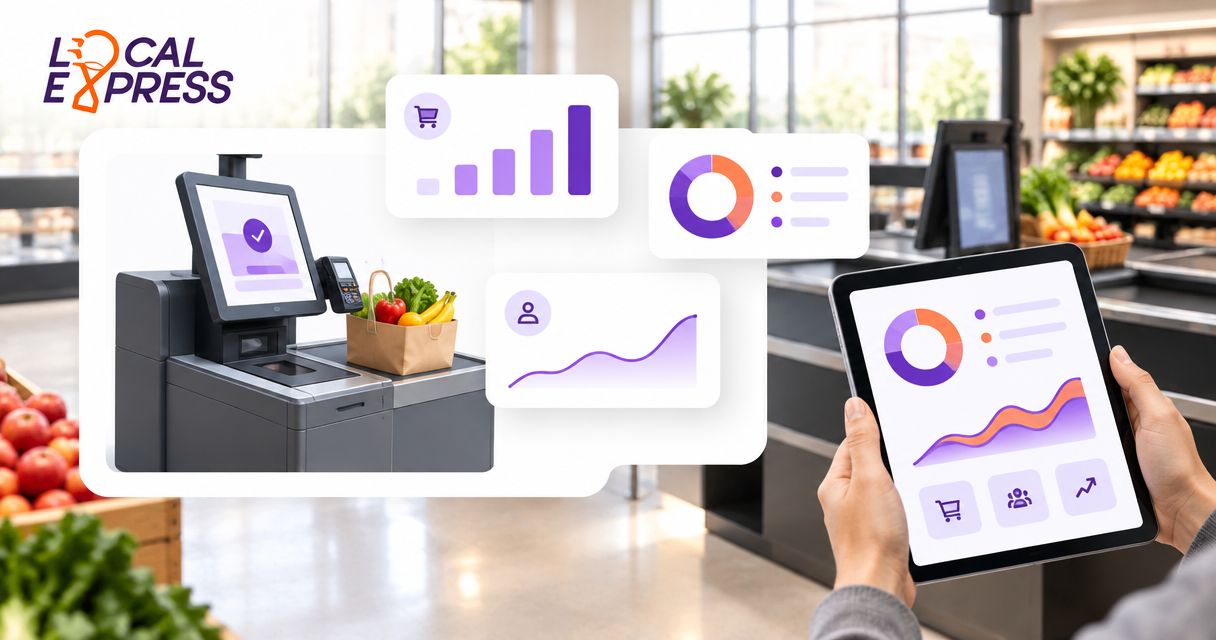
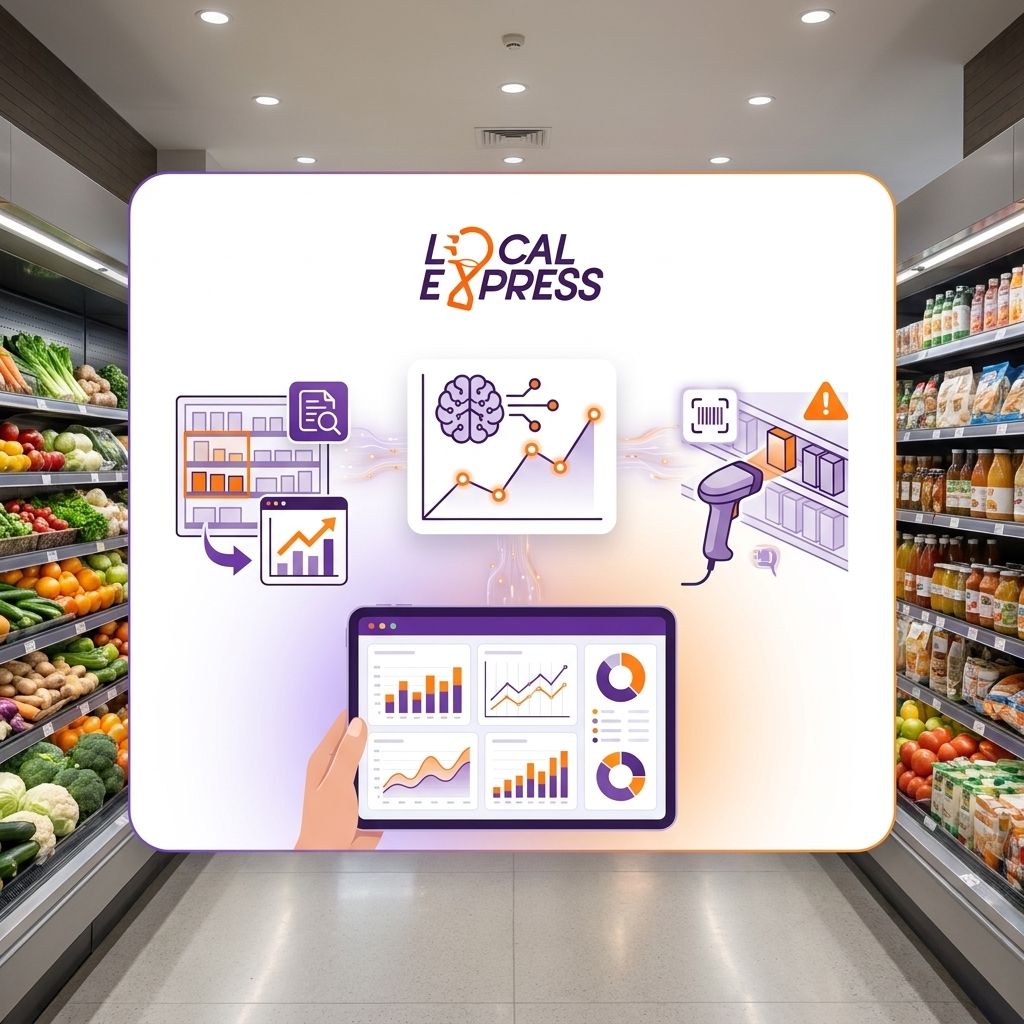
Local Express runs AI merchandising across a grocer's ecommerce website, branded mobile app, self-service kiosks, and retail media program from one system instead of stitching together five vendors. Order data flows across every channel, so a fresh-department price change or a sponsored CPG placement shows up consistently whether the shopper is on the app, the website, or standing at a kiosk. It's built specifically for independent and regional grocers competing against chains with bigger merchandising budgets.
Local Express pros:
- Combines ecommerce, app, kiosk, and retail media platforms for independent grocers instead of five separate vendor logins.
- Order management syncs inventory across web, app, and kiosk channels in real time.
- Retail media tools let independent stores monetize CPG shelf placements without joining a national ad network.
Local Express cons:
- A full unified-commerce rollout takes longer than installing a single-purpose pricing tool.
- Not the right fit for a single-location convenience store that only wants a shelf-camera add-on.
Local Express pricing: contact Local Express directly for a quote — no flat published rate for the platform.
Best for: independent and regional grocers who want one AI platform behind ecommerce, app, kiosk, and retail media merchandising in 2026.
Verdict: Buy.
2. Afresh: best AI merchandising tool for perishable demand forecasting
Afresh is an AI demand-forecasting engine built around fresh and perishable categories. It auto-generates order quantities based on shelf life and sell-through patterns, aiming directly at markdown and waste reduction in produce, meat, and dairy.
Afresh pros:
- Strong at fresh-case forecasting specifically, not general merchandising.
- Purpose-built for waste reduction rather than a generic inventory tool retrofitted for perishables.
- Plugs into an existing ordering workflow without replacing the whole tech stack.
Afresh cons:
- No ecommerce storefront, branded app, or kiosk ordering component — it's a forecasting layer, not a merchandising platform.
- Grocers still need a separate system for retail media and digital merchandising; pairing it with an AI inventory replenishment workflow elsewhere in the stack is common.
Best for: grocers whose main AI merchandising problem is fresh-department waste and reorder timing.
Verdict: Buy as a fresh-forecasting add-on, not as a full platform replacement.
3. Swiftly: best AI merchandising tool for personalization on existing infrastructure
Swiftly layers personalization onto a grocer's digital presence — targeted offers, digital circulars, and in-app retail media placements tied to shopper history. It works best for chains that already have ecommerce and app infrastructure and want the merchandising layer sharpened, not rebuilt.
Swiftly pros:
- Personalization engine geared toward independent and regional chains rather than enterprise-only deployment.
- Loyalty-linked offers can lift basket size without a full platform migration.
Swiftly cons:
- Less depth on self-checkout kiosk merchandising or last-mile delivery routing.
- Scope centers on digital engagement rather than in-store execution, so it doesn't close the physical-shelf gap.
Best for: chains that already run ecommerce and an app and want a personalization layer on top.
Verdict: Hold — compare against a unified platform's personalization module before adding another vendor contract.
4. Symphony RetailAI: best AI merchandising tool for pricing and promotion optimization
Symphony RetailAI applies AI to pricing, promotion, and space optimization, modeling category-level elasticity to set prices and plan promotions. It's an established name in grocery pricing science, built for chains with dedicated category management teams.
Symphony RetailAI pros:
- Deep pricing and promotion optimization across categories.
- Established track record in structured grocery pricing science.
Symphony RetailAI cons:
- Enterprise pricing and implementation scope skew toward larger chains, not independent-store deployment speed.
- No native ecommerce, app, or kiosk merchandising component.
Best for: multi-banner regional chains running structured price-and-promotion optimization projects.
Verdict: Hold for independents; Buy for chains with a dedicated category management team.
5. Trax: best AI merchandising tool for shelf-compliance monitoring
Trax uses computer vision on shelf photos to flag planogram compliance gaps, out-of-stocks, and facing errors. It answers a narrow but real question: is the shelf actually stocked the way it's supposed to be right now.
Trax pros:
- Strong shelf-monitoring accuracy for planogram compliance audits.
- Useful evidence for CPG compliance conversations.
Trax cons:
- Doesn't touch ecommerce, kiosk, or delivery merchandising — it solves one physical-shelf problem, not the omnichannel picture.
- Adds a camera-and-software layer on top of whatever digital merchandising system is already running.
Best for: stores that need physical shelf-compliance data more than digital merchandising tools.
Verdict: Wait — layer this in after digital merchandising and ecommerce basics are solid.
How we ranked
Each tool is scored against the five criteria above: forecasting accuracy, integration depth, retail media capability, personalization reach, and deployment fit for independent-store budgets. Local Express ranks first because it's the only tool covering all five at once for an independent or regional grocer; the other four win specific criteria but leave gaps a single-purpose contract can't close.
See Local Express in action
One AI platform for ecommerce, app, kiosk, and retail media merchandising.
Which AI merchandising tool should you choose?
If you're an independent or regional grocer trying to fix margin leaks across fresh, pricing, personalization, and shelf compliance in 2026, Local Express is the default pick — it's the only tool on this list that puts ecommerce, app, kiosk, and retail media merchandising under one AI system. If your single biggest problem is fresh-department waste, run Afresh alongside whatever digital platform you already have. Everything else on this list solves one slice well but leaves the rest of the stack for you to stitch together.
FAQ
What is the best AI merchandising tool for grocery retailers in 2026?
Local Express is the best overall pick for independent and regional grocers because it runs AI merchandising across ecommerce, mobile app, kiosk, and retail media in one system. Single-purpose tools like Afresh or Trax solve one slice of the problem but require additional vendors for the rest.
Is Afresh better than a full AI merchandising platform?
Afresh is stronger specifically for fresh and perishable demand forecasting, not as a full merchandising platform. It has no ecommerce, app, or kiosk component, so grocers typically pair it with a broader system rather than replace one with the other.
How much do AI merchandising tools for grocery retailers cost?
Pricing varies by vendor and scope, and most platforms including Local Express quote based on store count and channel needs rather than publishing a flat rate. Get a direct quote before assuming a national-chain price tag applies to an independent store.
Do independent grocers need AI merchandising in 2026?
2026 adoption data shows a $3.50 return per $1 invested in AI grocery platforms and 95% inventory accuracy for stores running AI-driven ecommerce, which makes the case for independents competing against automated regional chains. Skipping it means competing on gut-feel merchandising against data-driven pricing and forecasting.
What's the difference between AI merchandising and retail media?
AI merchandising covers forecasting, pricing, and personalization decisions that move product off shelves faster. Retail media is the monetization layer on top — selling CPG brands sponsored placement inside that same merchandising system.
Can Trax replace an ecommerce merchandising platform?
No. Trax is computer vision for physical shelf-compliance monitoring only; it doesn't handle ecommerce, kiosk ordering, or delivery merchandising. It's an add-on layer, not a platform replacement.
Is Symphony RetailAI a good fit for a single independent store?
Symphony RetailAI is built for multi-banner chains with dedicated category management teams, and its enterprise pricing and implementation scope aren't built for fast independent-store deployment. A single-location grocer typically gets more value from a platform sized for independent operations.
What should I look for first when comparing AI merchandising tools?
Start with forecasting accuracy on your fastest-turning perishable categories, since that's where waste eats margin fastest in 2026. Then check integration depth with your existing POS, ecommerce, and kiosk systems before adding retail media or personalization features on top.
One last thing
The $113B efficiency-gains figure tied to automated grocery merchandising in 2026 isn't concentrated in flashy features — it's concentrated in the boring stuff: fewer stockouts, less perishable waste, and prices that move with demand instead of sitting static for weeks. The grocers capturing that gain aren't running the most tools; they're running the fewest tools that touch the most channels.