Training staff to fulfill online grocery orders accurately comes down to three things: a structured picking process they practice before going live, a checklist that forces double-checks on substitutions and weighed items, and a manager who audits a sample of completed orders every shift. Stores that skip the audit step usually don't find out picking is broken until refund requests start piling up.
The hidden cost most training programs miss isn't the picker's hourly wage — it's the time a manager spends re-picking or refunding orders that went out wrong the first time in 2026.
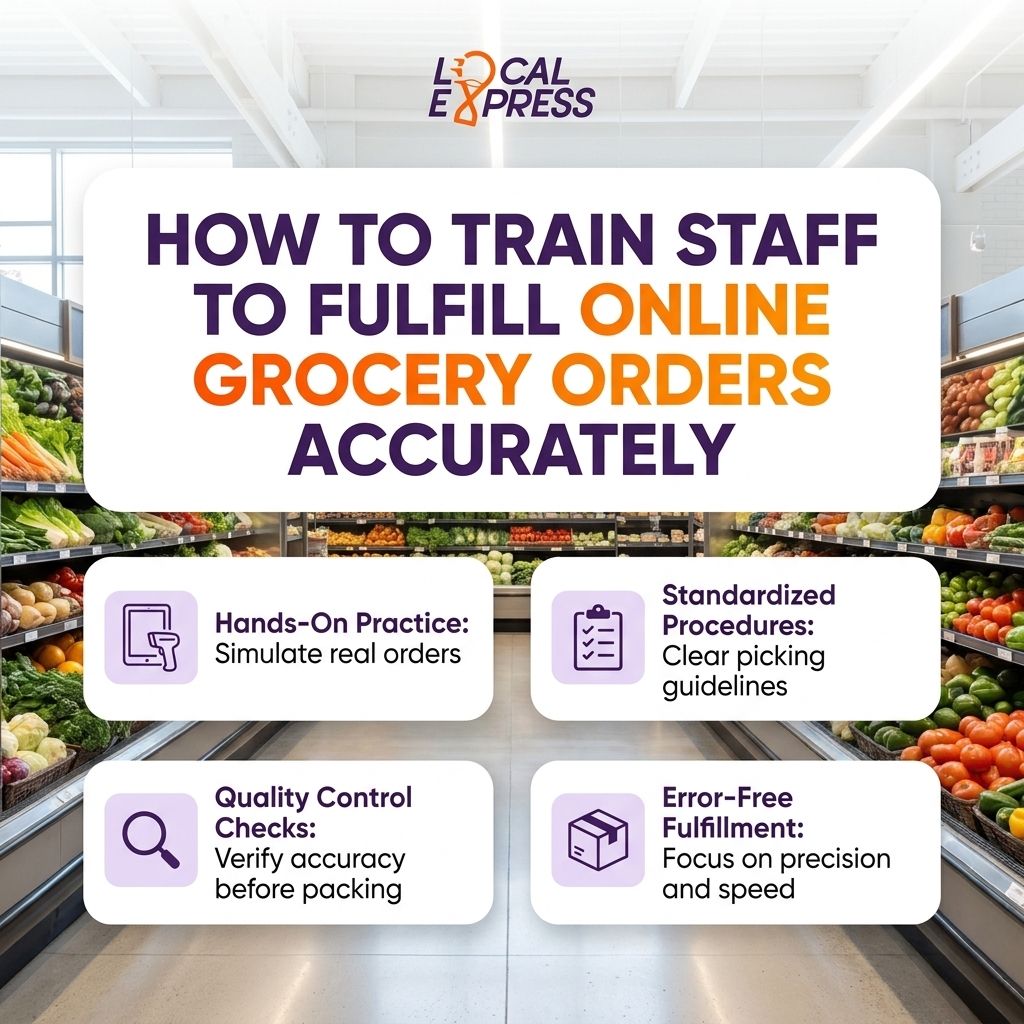
- A structured 2-week onboarding plus live order shadowing is the fastest way to train staff to fulfill online grocery orders accurately.
- Set a 98% items-correct threshold and audit against it weekly, not just after complaints come in.
- Weighed items, substitutions, and cold-chain products cause most picking errors in 2026 grocery fulfillment.
- Centralized order management on one screen cuts the picker mistakes that come from juggling separate app, web, and kiosk queues.
Why this matters
An order that arrives with the wrong item, a missing substitution note, or warm ice cream doesn't just cost you a refund. It costs you the customer's trust in ordering online again, and for a regional or independent grocer competing against national chains, that trust is the whole business case for running a grocery app or website in the first place.
Most picking errors trace back to the same three gaps: no formal training beyond following another picker around for a day, no written substitution policy, and no manager review of completed orders. Fix those three and accuracy problems mostly disappear on their own.
How to train staff to fulfill online grocery orders accurately
Use this sequence for every new picker, whether they're full-time staff pulled from the floor or hired specifically for online fulfillment:
- Walk the app or website order flow first. Have the new hire place a test order themselves so they understand what the customer sees — item photos, substitution preferences, delivery windows — before they ever touch a pick list.
- Teach the substitution decision tree. Write down exactly when a picker can swap a size, swap a brand, or must contact the customer. Vague verbal guidance is the single biggest source of wrong-item complaints.
- Drill weighed and variable-item categories separately. Produce, deli, meat, and bakery items priced by weight need a dedicated 30-minute session on scale use and label printing — these categories generate a disproportionate share of pricing errors.
- Shadow 10 live orders before going solo. A new picker should complete at least 10 real orders under a trainer's eye, not a simulation, before working unsupervised.
- Certify on cold-chain handling. Frozen and refrigerated items need a hard rule on staging time — how long an item can sit at room temperature before it's re-picked instead of sent out.
- Review the first week's orders line by line. A manager should personally check every order from a new picker's first three shifts, then drop to a spot-check sample once accuracy holds.
- Put the picker on a single order management screen. Pickers who juggle a separate tablet for web orders, another for app orders, and a third for kiosk orders make more mistakes than pickers working off centralized order management that shows every channel in one queue.
That sequence takes most stores about 2 weeks from first shift to fully certified, assuming the picker is working online orders daily rather than occasionally.
Why fulfillment accuracy varies from store to store
Accuracy rates swing widely between grocers running the same basic process, and the gap almost always comes down to a short list of operational factors:
- Store layout familiarity — a picker who doesn't know the planogram will grab the wrong SKU on lookalike packaging far more often.
- Substitution policy clarity — best-judgment guidance produces inconsistent results; a written decision tree doesn't.
- Order volume per shift — pickers rushing through a backlog during peak hours make more errors than pickers working a steady pace.
- Technology fragmentation — separate systems for web, app, and kiosk orders force pickers to context-switch, which is where mistakes creep in.
- Manager review cadence — stores that audit orders daily catch problems within a shift; stores that only look after a complaint let bad habits repeat for weeks.
- Category mix — a store heavy in fresh produce, deli, and bakery has more variable-weight items to get wrong than a store weighted toward packaged goods.
How long does it take to train a new online order picker?
Most new pickers reach a workable accuracy level in 2 weeks, covering app familiarization, substitution rules, weighed-item handling, and 10 supervised orders before working solo. Stores running a heavier prepared-food or specialty category mix often extend cold-chain and scale training by another few shifts.
What's a good pick accuracy rate for online grocery orders?
98% items-correct on the first pick is a reasonable working target for 2026, checked against a weekly sample of completed orders rather than only customer complaints. Anything consistently below that points to a training or substitution-policy gap, not a staffing problem.
Should you use employee pickers or gig workers for order fulfillment?
Employee pickers generally deliver more consistent accuracy because they build store and planogram familiarity over repeated shifts, while gig workers add flexibility during volume spikes at the cost of a shorter learning curve each time. The right mix depends on order volume — a detailed breakdown of the tradeoffs between employee drivers and gig drivers applies to picking staff decisions too.
Do pickers need different training for delivery versus pickup orders?
Yes — delivery orders need extra training on staging time and packaging since the item sits longer before reaching the customer, while pickup orders put more weight on timing accuracy against the promised slot. Staffing needs for each channel differ enough that most regional chains plan them separately; see how to plan delivery staffing and vehicle needs for a fleet running both.
Getting pickers off fragmented tools and onto one order queue removes a big chunk of the error rate before training even starts.
Give pickers one screen to work from
See how web, app, and kiosk orders run through one queue.
FAQ
How do you train staff to fulfill online grocery orders accurately?
Train staff to fulfill online grocery orders accurately with a 2-week sequence: app walkthrough, a written substitution decision tree, dedicated weighed-item drills, 10 supervised live orders, and a manager review of the first week of picks. Skipping the substitution policy is the most common reason accuracy stays inconsistent.
What is a good pick accuracy rate for grocery ecommerce?
98% items-correct on the first pick is a solid working target for 2026, measured weekly against a sample of completed orders. A rate consistently below that usually points back to unclear substitution rules rather than picker effort.
How long does picker training take for online grocery orders?
2 weeks is typical from first shift to full certification, assuming daily online order volume and 10 supervised orders before going solo. Stores with heavy fresh, deli, or bakery mix often add a few extra shifts for weighed-item drills.
Do weighed items cause more picking errors than packaged goods?
Yes, produce, deli, meat, and bakery items priced by weight generate a disproportionate share of picking and pricing errors compared to fixed-price packaged goods. A dedicated 30-minute scale and labeling session for new pickers cuts most of that error rate.
Should managers review every order from a new picker?
Yes, for the first three shifts a manager should check every order a new picker completes, then move to a spot-check sample once accuracy holds. Waiting for customer complaints instead of auditing lets bad habits repeat for weeks.
Is it better to use employee pickers or gig workers for grocery fulfillment?
Employee pickers generally hold more consistent accuracy because they build planogram familiarity over repeated shifts, while gig workers add coverage flexibility during demand spikes. Most regional chains blend both depending on order volume.
Does technology affect picking accuracy?
Yes, pickers working off separate tools for web, app, and kiosk orders make more mistakes than pickers using one centralized order queue. Consolidating channels onto a single screen removes a common source of picking errors before training even addresses process.
How often should you audit completed grocery orders?
Audit a sample of completed orders weekly at minimum, and daily during the first month after launching online fulfillment in 2026. Daily review catches a drifting picker within one shift instead of after a month of refunds.
One last thing
The fastest fix most grocers overlook isn't more training hours — it's cutting the number of screens a picker has to check. A store running separate systems for web, app, and kiosk orders is asking pickers to context-switch dozens of times a shift, and that's where trained, competent staff still make avoidable mistakes in 2026.
Related guides
- Centralized order management across web, app, and kiosk channels
- How to handle refunds and replacements for missing grocery delivery items
- How to plan delivery staffing and vehicle needs for a grocery fleet
- How to set delivery driver pay and tipping policy for grocery orders
- Employee drivers vs gig drivers for grocery delivery