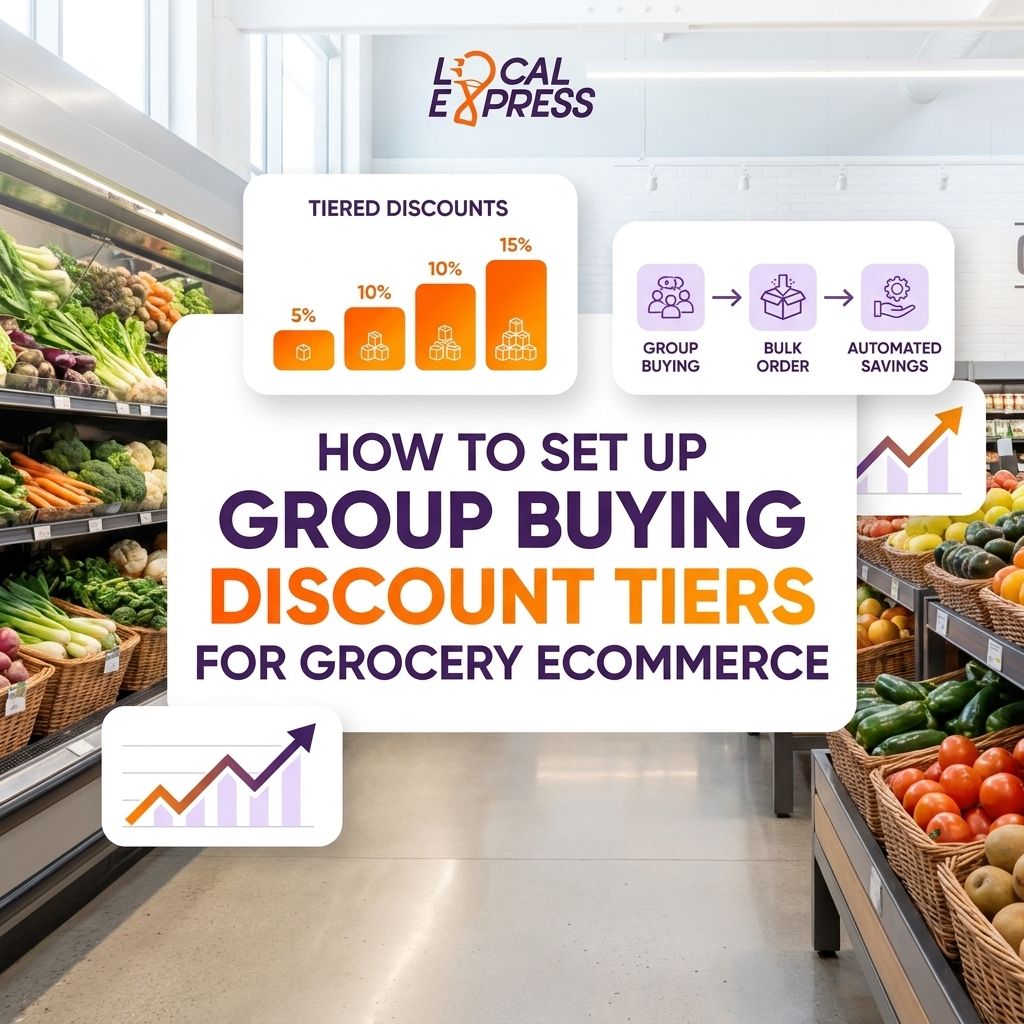
Group buying discount tiers let grocery ecommerce shoppers unlock lower per-unit pricing as they add more units of the same item to cart, and setting them up correctly comes down to four decisions: quantity thresholds, discount depth, SKU eligibility, and checkout messaging that shows shoppers how close they are to the next tier.
- A three-tier structure (5% at 3 units, 10% at 6, 15% at 12) outperforms a single flat bulk discount for grocery ecommerce.
- Group buying bulk discount tiers work best on shelf-stable, high-margin SKUs, not fresh perishables with a short shelf life.
- Case-pack size should set your top tier threshold, not a round number picked out of habit.
- Order management platforms like Local Express apply tier logic automatically across web, app, and kiosk checkout.
- Test discount depth against category margin before launch — a 15% cut on thin-margin dry goods erodes profit fast.
Why this matters
Independent and regional grocers competing against big-box chains and marketplaces in 2026 need a lever besides price-matching, and group buying discount tiers give shoppers a reason to add a second or third unit instead of checking out with one. That lifts average order value without a storewide markdown.
The risk is running tiers on the wrong categories. A 15% discount on a 40% margin dry good is sustainable; the same discount on a 12% margin perishable is not. Grocery ecommerce operators who set thresholds around case-pack sizes and existing wholesale cost breaks avoid that trap entirely.
How to set up group buying discount tiers for grocery ecommerce
Building group buying bulk discount tiers for a grocery ecommerce site follows the same sequence whether you sell shelf-stable dry goods, bath and cleaning supplies, or bulk and refill food stores inventory sold by weight or unit count.
- Pick eligible SKU categories. Start with shelf-stable, high-margin items — pantry staples, paper goods, canned goods, beverages. Exclude anything with a tight shelf life or thin margin.
- Set quantity thresholds off case-pack size. If a supplier ships in cases of 6 or 12, your tier breaks should land on 3, 6, and 12 units — not arbitrary numbers that leave shoppers one unit short of a case.
- Decide discount depth per tier. Map each threshold to a percentage that still clears your target margin after the discount applies.
- Build the logic into cart and checkout. The discount needs to calculate automatically the moment a shopper's quantity crosses a threshold — no coupon code, no manual override at the register.
- Add progress messaging on the product page and in-cart. A line like "Add 2 more for 10% off" converts better than a static discount label because it tells the shopper exactly what to do next.
- Set exclusions. Alcohol, tobacco, EBT-restricted items, and anything with age-verification requirements should sit outside tier logic entirely.
- Test the math against margin before launch. Run three or four sample carts through the tier structure and confirm the store still profits at the top discount tier.
- Launch on a subset of categories, then expand. Watch attach rate and average order value for two to four weeks before rolling tiers out storewide.
Tier 1: 5% off at 3+ units
This is the entry tier and it does the least damage to margin while still nudging a single-item shopper to grab a second and third unit. It works well on staples shoppers already buy in multiples — canned tomatoes, coffee, cleaning supplies.
Tier 2: 10% off at 6+ units
The middle tier targets shoppers stocking up for a household or small event. Six units is also a common half-case or full-case break for many dry goods suppliers, which keeps the discount aligned with your actual cost basis.
Tier 3: 15% off at 12+ units or a full case
The top tier should map to a full case pack whenever possible. This is where CSA-style bulk buying and CSA boxes and farm stands operators often see the strongest lift, since customers already expect to buy produce and pantry staples in volume.
Why discount tier thresholds vary
No single tier structure fits every grocery ecommerce catalog. These are the factors that should move your thresholds up or down:
- Category margin. Higher-margin dry goods and center-store items can absorb deeper discounts than fresh or perishable categories.
- Case-pack size. Thresholds that don't align with supplier case breaks confuse shoppers and complicate inventory reconciliation.
- Shelf life. Perishables with a short window don't belong in group buying tiers — the discount encourages overbuying that ends in waste.
- Delivery and fulfillment capacity. Larger bulk orders take longer to pick and pack; tier thresholds that spike order volume need staffing to match.
- Seasonal demand. Holiday case-lot sales, back-to-school stock-ups, and grilling season each justify temporary tier adjustments.
- Competitive pressure. Grocers competing directly with marketplaces on price may need shallower entry tiers and deeper top tiers to stay attractive without giving away margin on every order.
Automate tier pricing at checkout
See how order management applies discount logic across web, app, and kiosk.
Is group buying the same as a bulk discount?
Group buying tiers are a structured version of a bulk discount: instead of one flat price break at a single quantity, shoppers see multiple thresholds (3, 6, 12 units) each unlocking a deeper percentage off. A flat bulk discount only has one tier; group buying discount tiers give shoppers a reason to keep adding units to reach the next break.
Do group buying tiers work for perishable groceries?
Group buying tiers work poorly for perishable groceries because the discount encourages purchase volume the shopper can't use before spoilage. They perform best on shelf-stable dry goods, beverages, paper products, and bulk or refill items with a long shelf life.
How many discount tiers should a grocery ecommerce site run?
Three tiers is the practical ceiling for most grocery ecommerce catalogs in 2026 — more than three and shoppers lose track of what quantity unlocks what discount. A three-tier structure (entry, mid, and case-pack level) covers the range from a single stock-up shopper to a household buying a full case.
FAQ
What is a group buying discount tier in grocery ecommerce?
A group buying discount tier is a pricing rule that lowers the per-unit price of a product as a shopper adds more units of that same item to their cart. A typical structure runs three tiers — for example 5% off at 3 units, 10% off at 6, and 15% off at 12.
How do I decide the quantity threshold for each tier?
Set thresholds off your supplier's case-pack size rather than a round number. If a supplier ships cases of 6, your tiers should land on 3, 6, and 12 units so the discount aligns with your actual wholesale cost breaks.
Which grocery categories work best for group buying tiers?
Shelf-stable, high-margin categories work best for group buying tiers — pantry staples, paper goods, canned goods, and bulk or refill items. Perishables with short shelf life should stay outside tier logic entirely.
Can group buying tiers hurt my margin?
Yes, group buying tiers hurt margin when the discount depth exceeds what a category can absorb — a 15% discount on a thin-margin item can push that sale below breakeven. Test each tier's math against category margin before launch.
Do group buying tiers need a coupon code?
No, group buying tiers should apply automatically the moment a shopper's cart quantity crosses a threshold. Requiring a coupon code adds friction and cuts the conversion lift the tier is designed to create.
Should alcohol or tobacco be included in group buying tiers?
No, alcohol, tobacco, and other age-restricted or EBT-ineligible items should sit outside group buying tier logic. Keep those categories on standard pricing with your existing age-verification checks in place.
How does group buying differ from a subscription discount?
Group buying tiers reward cart quantity in a single order, while subscription discounts reward recurring purchase commitment over time. The two can run side by side on the same grocery ecommerce site.
How many tiers should a grocery ecommerce site run at launch?
Start with two tiers rather than three when launching group buying discounts for the first time. Add the top tier once you've confirmed the entry tier lifts average order value without cutting into margin.
One last thing
The biggest mistake grocers make when launching group buying discount tiers in 2026 isn't the discount depth — it's forgetting to show progress toward the next tier on the product page itself. A shopper who sees "add 2 more for 10% off" while browsing is far more likely to hit that threshold than one who only discovers the discount at checkout. Put the messaging where the decision happens, not after it.