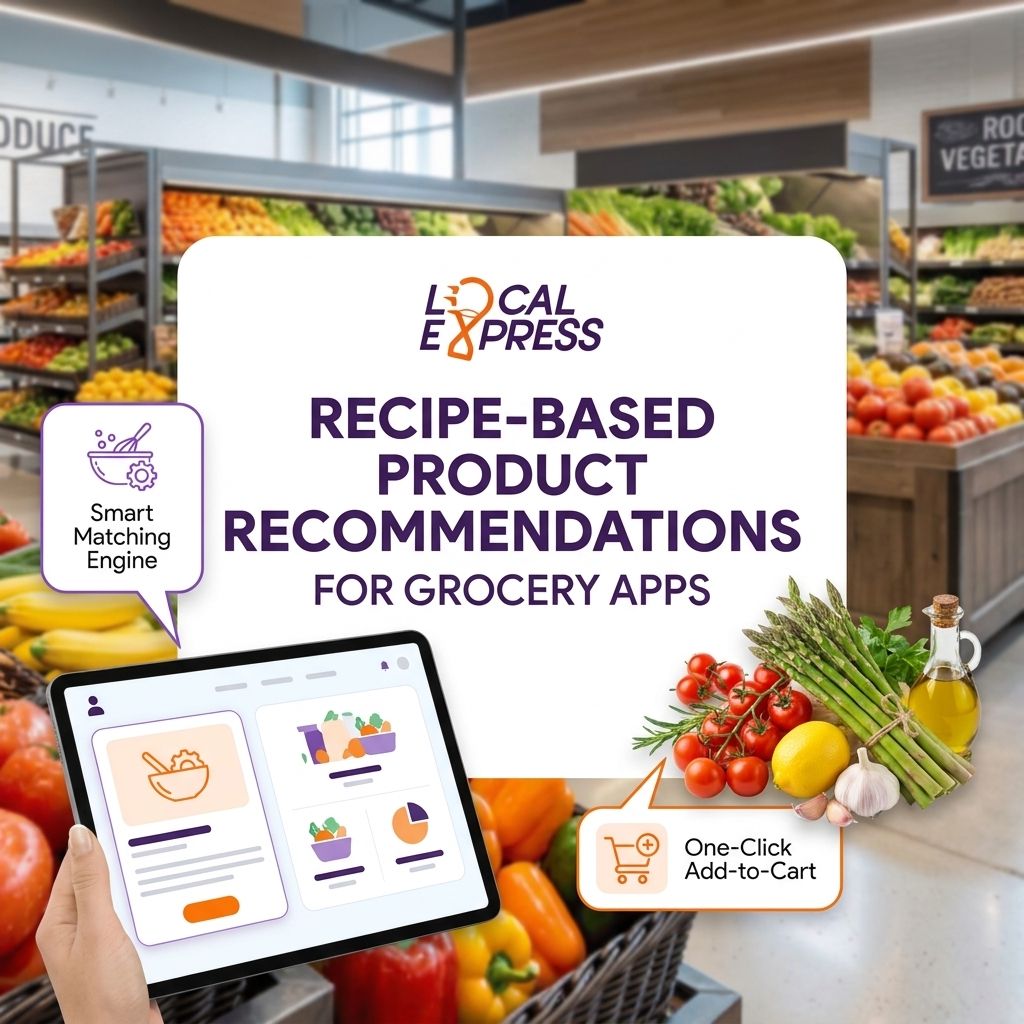
Recipe-based product recommendations connect a shopper's meal choice directly to your live catalog: the app reads an ingredient list, matches each item to a SKU, checks stock, and drops a ready-to-buy bundle into the cart. Getting this right in a grocery app takes three connected pieces — recipe content, an ingredient-to-SKU matching layer, and inventory-aware substitution rules — not a single plugin.
- Recipe based product recommendations in a grocery app need ingredient-to-SKU matching, not just recipe content, or the links break at checkout.
- Manual tagging works for a small, curated recipe set; AI-driven matching is the only way to scale past a few hundred recipes.
- Local Express ties recipe recommendations to real-time inventory, so a shopper never taps a recipe and lands on an out-of-stock item.
- Substitution logic, not recipe volume, drives basket size — build that layer before adding more recipes.
Why this matters
Grocers plan merchandising around aisles and categories. Shoppers plan around meals. A recipe-based recommendation engine closes that gap inside your grocery app by turning a single meal idea — taco night, a sheet-pan dinner, a soup base — into a pre-built cart instead of a search-and-scroll session.
The payoff isn't the recipe page itself. It's the attach rate on items shoppers wouldn't have searched for on their own: the specific spice blend, the marinade, the side dish. Recipe recommendations are a merchandising tool wearing a content costume, and independent grocers who treat them as content alone usually see thin results in 2026.
How to add recipe-based product recommendations to a grocery app
The build has six steps. Skip step three or four and the feature looks fine in a demo and fails in production the first time a SKU goes out of stock.
- Audit your catalog data. Recipe matching depends on clean product attributes — category, dietary tags (gluten-free, kosher, halal, vegan), unit size, and substitution groups. If your SKU data is inconsistent, fix that before writing a single recipe.
- Pick your recipe content source. Options are: write originals in-house, license a recipe database, or convert existing weekly circular content into recipe format. Each has a different maintenance load — in-house content is slower to scale but matches your actual promotions.
- Build the ingredient-to-SKU matching layer. This is the core engineering piece. AI-driven matching (natural language processing against your product catalog) handles volume; manual override tables handle private-label items and regional products the AI won't recognize on its own.
- Add inventory-aware substitution logic. When a matched SKU is out of stock, the app needs to serve a live alternative automatically — not a broken link, not a blank slot. This single rule determines whether recipe recommendations increase basket size or just increase bounce rate.
- Place the recommendation at the right moment. Recipe detail pages, cart pages ("complete this recipe"), and post-purchase push notifications each convert differently. Cart-page placement typically performs best because the shopper is already in a buying mindset.
- Track attach rate and retag monthly. Recipe matching degrades as your catalog changes — new suppliers, discontinued SKUs, seasonal swaps. Review match accuracy on a fixed schedule, not reactively after a complaint.
Most independent grocery catalogs run 15,000 to 60,000 SKUs, and a typical recipe carries six to twelve ingredient lines. That ratio is exactly why manual tagging collapses once a store passes a modest recipe library — the matching math scales faster than a merchandising team can keep up with by hand.
Manual curation vs. AI matching vs. recipe API integration
| Approach | Best for | Pros | Cons | Verdict |
|---|---|---|---|---|
| Manual curation | A small, seasonal recipe set (holiday menus, weekly features) | Full control, accurate for private label | Doesn't scale, slow to update | Use for launch, not for scale |
| AI-driven ingredient matching | Stores running hundreds of recipes across a large catalog | Scales automatically, adapts as catalog changes | Needs clean product data to start, occasional mismatches on private label | Buy for growth-stage catalogs |
| Third-party recipe API integration | Stores that want recipe content without writing it | Fast content volume, no writing team needed | Recipes aren't tied to your promotions or private label items unless matching is built separately | Use as a content source, not a matching solution |
The honest verdict: AI matching and a recipe content source aren't competitors — most working setups in 2026 use both, with AI handling the SKU matching and a licensed or in-house recipe library supplying the content.
Why match quality varies from store to store
Recipe recommendation accuracy isn't the same across every grocery app, even running the same matching technology. The factors that move it:
- Catalog data completeness — missing or inconsistent product attributes are the single biggest cause of bad matches.
- Private label overlap — a recipe calling for "canned tomatoes" needs to know your store brand qualifies, and generic matching engines often miss this without manual overrides.
- SKU count and turnover — larger catalogs with frequent SKU changes need more frequent retagging.
- Real-time inventory sync — if your app's stock data lags behind your point-of-sale system, substitution logic fires on stale data.
- Dietary tag depth — thin tagging (just "vegan," no allergen detail) limits how well the engine can filter substitutions for shoppers with restrictions.
- Seasonal rotation — recipes tied to seasonal produce or holiday items need faster retagging cycles than year-round staples.
Do recipe recommendations actually increase grocery app order value?
Recipe recommendations increase order value when substitution logic is working — the mechanism is that a shopper adds a full ingredient list instead of a single item, and each added ingredient is incremental revenue the shopper wasn't planning to spend. Without substitution logic, a single out-of-stock ingredient can stall the whole cart instead of just one line item.
Can a small independent grocer do this without a development team?
A small independent grocer can add recipe-based recommendations without an in-house developer by using a unified commerce platform that already handles the ingredient-to-SKU matching and inventory sync, rather than building the matching engine from scratch. The remaining work is catalog cleanup and choosing a recipe content source — both manageable without engineering resources.
See recipe merchandising tied to live inventory
Ask Local Express how ingredient-to-SKU matching works on your existing catalog.
FAQ
What is a recipe-based product recommendation in a grocery app?
It's a merchandising feature that matches every ingredient in a recipe to a specific SKU in your live catalog, then lets a shopper add the full ingredient list to their cart in one action. The system checks stock and substitutes automatically when an ingredient is unavailable.
Do I need AI to build recipe recommendations, or can I do it manually?
Manual tagging works for a small, curated recipe set, but it doesn't scale past a modest recipe library given typical grocery catalog sizes of 15,000 to 60,000 SKUs. AI-driven matching is required once recipe volume grows past a few hundred items.
What happens if a recipe ingredient is out of stock?
Without substitution logic, the app either shows a broken link or an unavailable item, which stalls the shopper's whole cart. With inventory-aware substitution rules, the app automatically swaps in an in-stock alternative in the same category.
Should recipe recommendations live on the product page or the cart page?
Cart-page placement ("complete this recipe") typically converts better because the shopper is already in a buying mindset. Recipe detail pages work well for discovery earlier in the shopping session.
Where does recipe content come from — do I have to write it myself?
You can write recipes in-house, license a recipe content database, or convert existing weekly circular promotions into recipe format. Licensed content scales faster; in-house content matches your actual store promotions more closely.
How often should I update ingredient-to-SKU matching?
Review match accuracy on a fixed monthly schedule rather than waiting for a complaint, since new suppliers, discontinued SKUs, and seasonal swaps degrade matching quality over time. Seasonal recipes need faster retagging cycles than year-round staples.
Do private label products work with recipe matching?
Generic AI matching engines often miss private label items unless a manual override table maps them explicitly — a recipe calling for "canned tomatoes" needs to know your store brand qualifies. This is one of the most common gaps in recipe recommendation setups.
Is recipe-based recommendation the same as a general product recommendation engine?
No. A general recommendation engine suggests items based on browsing or purchase history; a recipe-based engine maps a specific, finite ingredient list to SKUs and needs substitution logic that general recommendation engines don't require.
One last thing
The feature that gets the most attention in planning meetings — the recipe content itself — is rarely what breaks in production. The failure point is almost always stale inventory data feeding the substitution logic: a recipe recommends an ingredient that's actually out of stock, the shopper hits a dead end, and the entire cart gets abandoned instead of just that one line. Fix the inventory sync before investing more time in growing the recipe library.