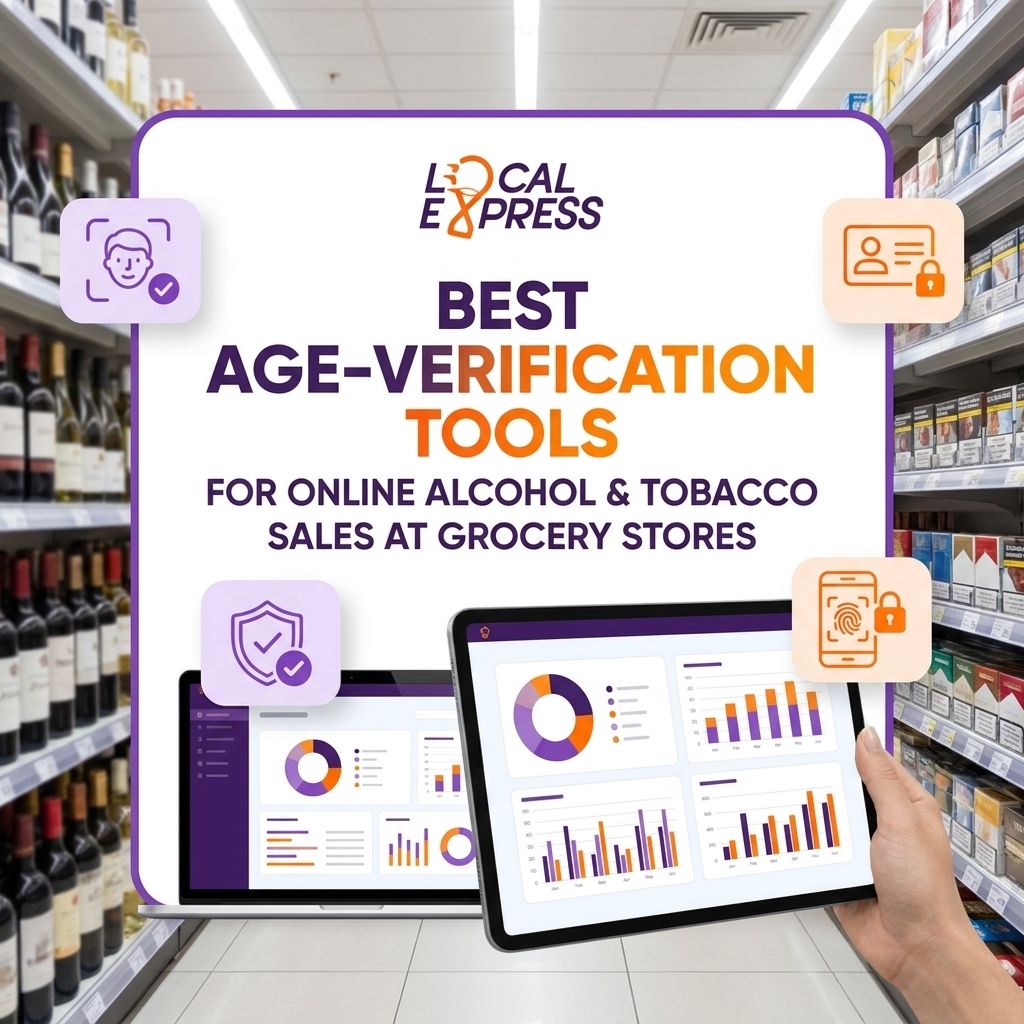
Grocers selling wine, beer, spirits, or tobacco through their own website or app in 2026 carry the same compliance burden a store clerk used to handle at the register — except now it happens at checkout, at the door, or both. The best overall pick is age verification built directly into your grocery ecommerce checkout, like the age-gate and delivery-flagging tools inside Local Express's order management system. The best pick for high-volume online alcohol retailers is AgeChecker.net. The best pick for multi-state tobacco and vape compliance is Veratad Technologies. The best low-effort option for small, low-volume independent stores is a driver-verified ID check at delivery.
- Local Express wins for grocers running alcohol or tobacco sales through their own branded site and app in 2026 — verification is wired into checkout and delivery, not bolted on.
- AgeChecker.net suits high-volume online alcohol retailers that need instant database checks at checkout.
- Veratad Technologies fits stores where tobacco or vape delivery is a real share of online orders.
- Driver-verified ID checks at the door work for low-volume stores but stop scaling once online alcohol or tobacco orders pass a handful a day.
- None of these tools replace state licensing paperwork — age verification tools online alcohol tobacco sales reduce risk, they don't eliminate the legal requirement.
Why this matters
Federal law sets the minimum age at 21 for both alcohol, under the National Minimum Drinking Age Act, and tobacco, under the Tobacco 21 law that took effect in December 2019. States layer their own delivery-specific rules on top — many require an adult signature at the door, some require a second ID check even after digital checkout already collected one.
Online alcohol and tobacco ordering through grocery ecommerce sites and apps has grown fast enough in 2026 that the compliance burden no longer sits with a single clerk trained on ID checks. It sits with whoever built the checkout flow. A grocer running wine and spirits ecommerce or a craft beer and specialty beverage shop needs age verification that talks to the same system running inventory, delivery routing, and order management — not a separate app nobody on staff checks.
What makes the best age verification tool for grocers
- Real-time verification at the moment of purchase — not a checkbox that says "I am 21 or older"
- Compliance mapping to state alcohol and tobacco delivery rules, since requirements differ by state and sometimes by county
- Checkout integration, not a bolt-on app that lives outside your main ordering system
- A documented audit trail you can produce if a compliance audit or a state ABC board asks for one
- Speed — verification that adds friction at checkout kills conversion on exactly the SKUs with the highest margin
- Coverage across every channel — web store, branded app, and the delivery driver handoff at the door
At a glance
| Tool | Best for | Standout feature | Key limitation |
|---|---|---|---|
| Local Express age verification | Independent grocers running their own branded site and app | Verification tied into the same order management system running web, app, and delivery | Depth of verification depends on which state rules you configure |
| AgeChecker.net | High-volume online alcohol retailers | Instant database check at checkout | Manual review still needed for shoppers without sufficient database records |
| GBG IDology | Multi-state compliance | Configurable rule sets by jurisdiction | Built for general identity verification, not grocery-specific workflows |
| Veratad Technologies | Tobacco and vape-specific age gating | Sector experience with tobacco delivery compliance | Overkill if tobacco is a small share of your online orders |
| Driver-verified ID check | Low-volume independent stores | Zero software cost, works immediately | No audit trail beyond a manual log, doesn't scale |
1. Local Express age verification: best for grocers selling alcohol or tobacco through their own site and app
Local Express checks age at digital checkout and flags orders containing alcohol or tobacco for an ID check at delivery hand-off, inside the same order management view that runs your web store, branded app, and kiosk. That matters because a delivery driver working off a separate system misses flags — a driver working off one unified order queue doesn't.
Local Express pros:
- No separate age-verification app for staff to log into on top of your existing checkout
- Delivery drivers see the age-restricted flag in the same order screen they use for routing
- Works across web, branded app, and kiosk order channels from one system
Local Express cons:
- Verification depth depends on which state-specific rules you configure — it's not a substitute for reading your own state's alcohol and tobacco delivery statutes
- Still relies on driver training for the physical ID check at the door
- Doesn't replace your TTB or state ABC licensing paperwork
Verdict: Buy if you're running or planning a branded ecommerce site or app that includes alcohol or tobacco SKUs — the value is in the flag reaching the driver, not just the checkout.
2. AgeChecker.net: best for high-volume online alcohol retailers
AgeChecker.net runs real-time age checks against public and commercial databases at the point of checkout, a common plug-in for ecommerce sites selling regulated products. It's built specifically around the pass/fail moment at checkout rather than the full order lifecycle.
AgeChecker.net pros:
- Instant pass or fail at checkout instead of a clerk's judgment call
- Integrates with common ecommerce cart platforms
- Reduces the volume of orders needing manual review at high order counts
AgeChecker.net cons:
- Database coverage gaps mean some legitimate shoppers get flagged for manual review
- One more vendor integration to manage and maintain
- Doesn't natively connect to grocery-specific delivery routing or driver workflows
Verdict: Buy if your current commerce platform has no built-in database verification and alcohol order volume is high enough to justify a dedicated vendor.
3. GBG IDology: best for multi-state compliance
GBG IDology offers configurable identity verification rules that can be set per jurisdiction, combining database matching with document verification options. It's an established identity-verification vendor, not a grocery-specific product.
GBG IDology pros:
- Rule sets can be tuned per state for alcohol and tobacco laws that differ by jurisdiction
- Established vendor with broad identity-verification experience
- Document verification option beyond database matching alone
GBG IDology cons:
- Built for the general identity-verification market, not grocery ecommerce specifically
- Requires real integration work to wire into a storefront and delivery flow
- Adds a separate compliance dashboard outside your main order management system
Verdict: Hold — worth evaluating only if you're already running ecommerce across several states and need jurisdiction-specific rules your commerce platform doesn't ship with natively.
4. Veratad Technologies: best for tobacco and vape-specific age gating
Veratad Technologies focuses on age and identity verification with experience in the tobacco and vape sector, relevant for grocers concerned with PACT Act compliance on tobacco delivery.
Veratad pros:
- Sector-specific experience with tobacco and vape delivery compliance
- Offers both database and document verification paths
Veratad cons:
- Most independent grocers sell far fewer online tobacco orders than alcohol orders, making a dedicated vendor hard to justify
- Separate vendor relationship and integration outside your core commerce platform
Verdict: Wait — only worth a serious look if tobacco or vape delivery is a meaningful share of your online order mix in 2026, not a side SKU.
5. Driver-verified ID check at delivery: best for low-volume independent stores
No software age-gate runs at checkout here. The check happens at the door — the delivery driver visually inspects ID and captures a signature before handing over alcohol or tobacco, which satisfies most states' adult-signature delivery requirements on its own.
Driver ID check pros:
- No software cost and no integration work
- Works immediately with existing staff
- Satisfies adult-signature requirements in most states
Driver ID check cons:
- Entirely dependent on driver judgment and training quality
- No digital audit trail beyond a manual log or photo
- Doesn't scale once daily alcohol or tobacco order volume climbs, especially during peak windows like the week before the Super Bowl or Thanksgiving
Verdict: Skip once online alcohol or tobacco orders pass more than a handful a day — the compliance risk starts outpacing whatever you saved on software.
How this list was ranked
Every tool above was weighed against the same six criteria: real-time verification, state compliance mapping, checkout integration, audit trail, checkout speed, and cross-channel coverage from web store to delivery driver. Tools that only solve the checkout moment and stop there — AgeChecker.net, GBG IDology, Veratad — rank below tools that carry the flag through to delivery, because the delivery hand-off is where most compliance failures actually happen, not the checkout screen.
“The delivery hand-off is where most age-verification compliance failures happen, not the checkout screen.”
Which age verification tool should you choose?
If you're running your own branded grocery site or app and selling alcohol or tobacco through it, age verification tied into your order management system beats a standalone checkout plug-in — the flag has to reach the driver at the door, not just stop the sale from processing online. If alcohol volume is high and your commerce platform has no native database check, add AgeChecker.net on top. If tobacco is a small side category, skip a dedicated vendor and lean on driver training and a documented tax and compliance toolset instead.
Get age verification into your checkout
See how order flagging works across web, app, and delivery.
FAQ
What's the best age verification tool for online alcohol sales at grocery stores?
Age verification built directly into checkout and order management, like the tooling inside Local Express, is the best fit for grocers running their own branded site or app in 2026 because the age flag carries through to the delivery driver, not just the checkout screen.
Is a driver ID check enough to comply with state alcohol delivery laws?
In most states, a driver checking ID and capturing a signature at delivery satisfies the adult-signature requirement. It stops scaling once daily online alcohol order volume grows past a handful of orders, since there's no digital audit trail beyond a manual log.
How does age verification work for online tobacco sales in 2026?
Federal law under the Tobacco 21 rule sets the minimum tobacco sale age at 21, and online sellers verify age either through database checkout tools or a driver ID check at delivery. Grocers with meaningful tobacco or vape volume typically add a sector-specific vendor like Veratad Technologies.
Do grocery ecommerce platforms need a separate age verification vendor?
Not necessarily. Platforms with built-in age flagging and order management, like Local Express, cover checkout-to-delivery verification without a separate vendor. High-volume alcohol retailers still add a database checkout tool like AgeChecker.net for instant pass/fail decisions.
What happens if a grocer fails an age verification compliance check?
Consequences depend on the state ABC board or tobacco enforcement agency and can include fines or license suspension. A documented audit trail from your order management system is what you'd need to produce if an audit happens.
Can age verification be built into a grocery store's own app instead of a third-party plug-in?
Yes. Unified commerce platforms that run the branded app and the order management system in one place can flag age-restricted orders at checkout and carry that flag through to delivery without a separate third-party app.
How old do you have to be to buy alcohol or tobacco online in the US?
The federal minimum age is 21 for both alcohol, under the National Minimum Drinking Age Act, and tobacco, under the Tobacco 21 law in effect since December 2019. Some states add stricter delivery-specific ID rules on top.
Does age verification slow down checkout for grocery ecommerce orders?
Database-driven checks like AgeChecker.net run in seconds and add minimal friction. A driver ID check at delivery adds no checkout friction at all but shifts the delay to the door.
One last thing
Most grocers assume digital age verification at checkout replaces the ID check at the door. It doesn't — several states still require the physical check regardless of what happened online, so the real return on a checkout-level tool isn't skipping the door check, it's cutting the volume of orders that need a second look once the driver arrives with the bag.