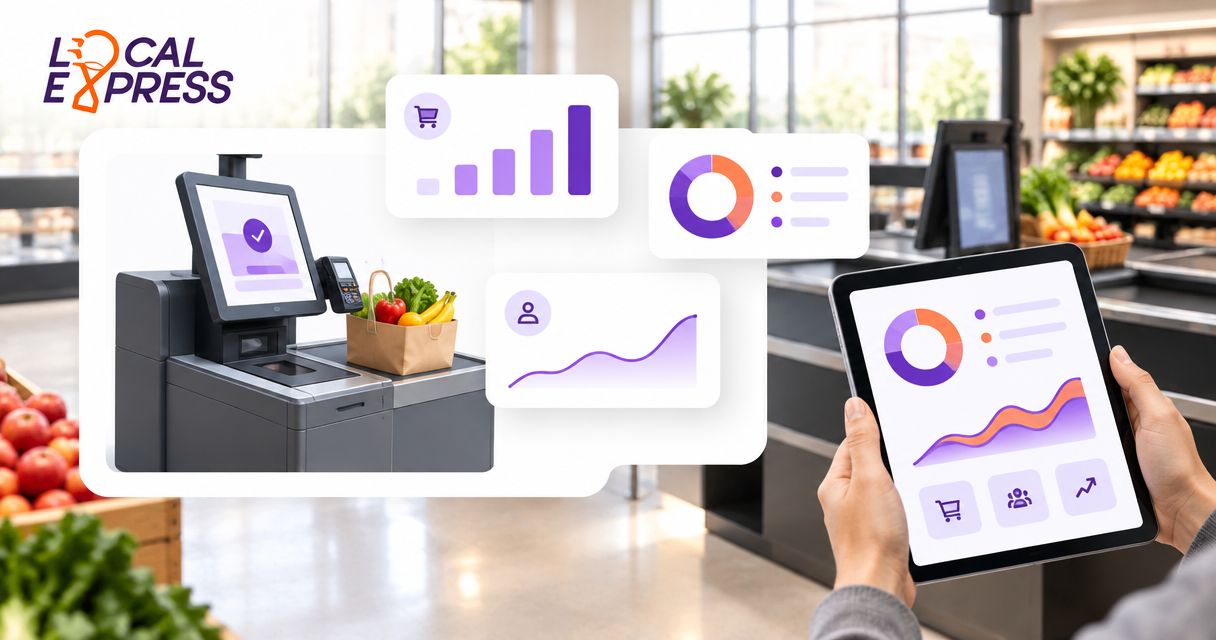
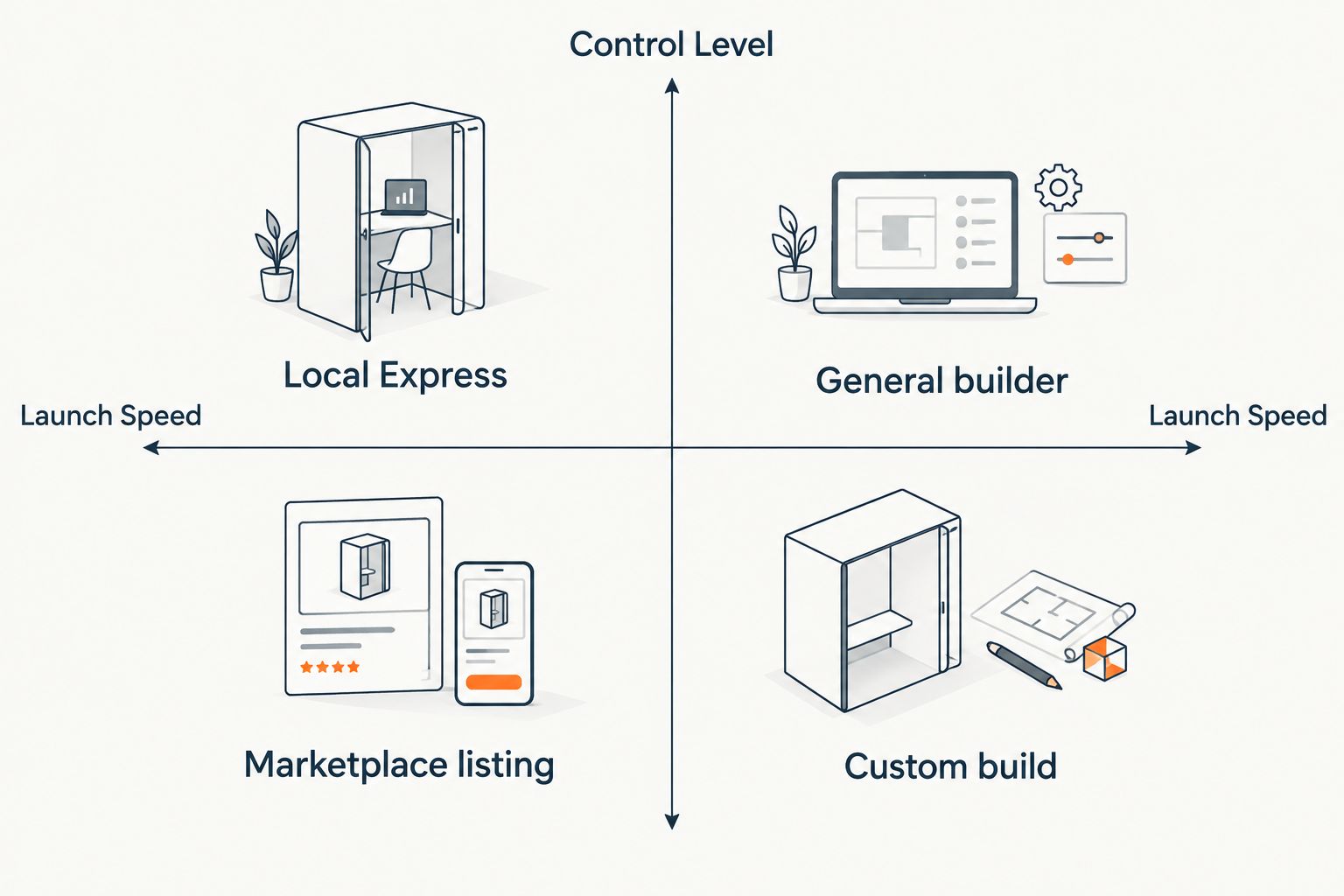
Launch speed on a grocery ecommerce platform in 2026 comes down to how much grocery-specific work already ships built-in, not how polished the demo looks. Local Express launches web ordering, a branded app, and kiosk ordering together fastest because substitution rules, delivery zones, and SNAP EBT checkout are pre-built; general-purpose ecommerce builders get a basic storefront live quickly but still need custom work for grocery logic; marketplace-only listings go live in days with the weakest margin control; a fully custom-built platform takes the longest timeline but hands a large chain total ownership of the build.
- Local Express is the fastest route to a full grocery ecommerce launch across web, app, and kiosk in 2026.
- General-purpose ecommerce builders launch a basic site quickly but need custom development for grocery-specific checkout logic.
- Marketplace-only listings go live in days but leave margin and customer data with the marketplace, not the store.
- Fully custom-built platforms take the longest launch timeline and fit only chains with dedicated dev resources.
- Grocery ecommerce platform launch speed depends on how much grocery logic ships pre-built, not on template count.
Why launch speed matters more than feature count in 2026
A grocery ecommerce platform that takes six months to launch misses two holiday seasons and a full produce cycle before it earns a dollar. Independent and regional grocers competing against national chains don't have that runway, and every week spent offline is a week a shopper builds a habit somewhere else.
Regional and independent grocers turning to a unified commerce platform built for grocery are usually trying to close that gap fast, not add features slowly. Launch speed also compounds: a platform that ships substitution rules, delivery zone logic, and SNAP EBT checkout pre-built saves weeks a general-purpose builder can't skip. The slower the launch, the more of 2026's grocery season gets spent building instead of selling.
What makes the best grocery ecommerce platform for launch speed
- Pre-built grocery logic — substitutions, delivery zones, SNAP EBT checkout — instead of custom development after go-live
- Unified order management across web, app, and kiosk from day one, not three separate systems bolted together
- Template-based storefront branded to the store, not built from a blank canvas
- Existing POS and inventory integration instead of a standalone sync project
- Vendor-led onboarding and data migration instead of pure self-service setup
- A branded mobile app available at launch, not a second project scheduled months later
Grocery ecommerce platforms at a glance
| Platform type | Best for | Standout feature | Key limitation |
|---|---|---|---|
| Local Express | Fastest full launch across web, app, and kiosk | Grocery logic (substitutions, delivery zones, SNAP EBT) pre-built | Built specifically for grocery and specialty food, not general retail |
| General-purpose ecommerce builder | Quick single-location basic site | Familiar storefront templates and checkout | Grocery-specific logic needs custom development after launch |
| Marketplace-only listing | Testing demand with zero build | Live in days with no development work | Store keeps neither the customer data nor full margin |
| Fully custom-built platform | Large chains with unique requirements | Total control over every feature and integration | Longest launch timeline and ongoing dev resourcing |
1. Local Express: best grocery ecommerce platform for fastest full launch
Local Express is a white-labeled unified commerce platform built for regional and independent grocers, combining a branded ecommerce website, a fully branded mobile app, self-service kiosks for prepared food, order management, last-mile delivery, and retail media tools in one back end. Because the grocery logic is already built, launch work centers on store configuration and catalog setup rather than custom development.
Local Express pros:
- Launches web storefront, branded app, and kiosk ordering from one back end instead of stitching together three separate vendors
- Substitution rules, delivery zone setup, and SNAP EBT checkout ship pre-built for grocery, not added later
- Centralized order management pulls web, app, and kiosk orders into one queue from day one
Local Express cons:
- Built specifically for grocery, supermarket, and specialty food retailers, so it isn't a fit for non-grocery retail
- A store running heavily customized legacy workflows still needs a mapping and migration step before go-live
Most regional grocers testing readiness before a full rollout start with a grocery ecommerce pilot on one store before pushing the same platform across the chain.
Best for: Regional and independent grocers that need web, app, and kiosk live together, fast.
Verdict: Buy.
2. General-purpose ecommerce builder: best for a quick single-location basic site
General-purpose ecommerce builders are the Shopify-style tools most single-location retailers reach for first. They get a storefront and a checkout live quickly using templates built for retail broadly, not grocery specifically.
General-purpose builder pros:
- Storefront templates and checkout go live in days for a simple catalog
- A large plugin ecosystem covers basic payments and shipping quickly
General-purpose builder cons:
- No native substitution logic for out-of-stock perishables, so that handling gets bolted on later
- Delivery zone and time-slot capacity management usually needs a third-party app
- A mobile app is a second build, not part of the initial launch
Stores that outgrow this setup usually look at a Shopify alternative built for grocery once substitution and delivery-zone gaps start costing orders.
Best for: A single-location store that needs a basic ordering page live immediately and plans to add grocery-specific tools later.
Verdict: Hold — fine as a short-term stopgap, not the long-term grocery platform.
3. Marketplace-only listing: best for testing demand with zero build
Listing a store on marketplaces means no development work at all — a grocer can be taking online orders within days. The tradeoff is that the store never owns the storefront, the checkout, or the customer relationship behind the order.
Marketplace-only pros:
- No development work — a store can be listed and taking orders within days
- No hosting, storefront, or app to maintain
Marketplace-only cons:
- The store doesn't own the customer relationship, the checkout, or the order data
- Commission structures cut into already thin grocery margins
- No path to a branded app or loyalty program without moving off the marketplace entirely
Grocers that start here to test demand typically plan the move off a delivery marketplace before margin erosion sets in.
Best for: A grocer testing online demand before committing to a full platform.
Verdict: Wait — use it to test, then move off before it costs more than it proves.
4. Fully custom-built platform: best for large chains with unique requirements
A fully custom-built platform means an in-house team or an agency builds the storefront, checkout, and order logic from zero. Every feature matches the chain's exact specification, but nothing ships pre-built.
Custom-built pros:
- Every feature and integration built to the chain's exact specification
- No vendor lock-in and no shared code base with other retailers
Custom-built cons:
- Longest launch timeline of any option — a custom build can easily run past a full grocery season before go-live
- Requires an ongoing internal or agency dev team to maintain it after launch
- Every grocery-specific feature — substitutions, SNAP EBT, delivery zones — has to be built and tested from zero
Best for: Multi-state chains with dedicated development budgets and no timeline pressure.
Verdict: Skip unless you have the dev team and the runway — most regional and independent grocers don't.
“A platform is only as fast as the store's own delivery-zone and substitution decisions.”
How this ranking works
Each platform type is scored against the six criteria above: how much grocery-specific logic ships pre-built, whether order management spans web, app, and kiosk from day one, and how much of the launch depends on custom development versus store configuration. Local Express ranks first because the grocery logic, order management, and branded app are part of one launch, not three separate projects on three separate timelines. A general-purpose builder ranks second because the basic site is fast but the grocery-specific work still has to happen. Marketplace-only listing ranks third because there's no build at all, only a listing. A fully custom platform ranks last because every one of those criteria has to be built rather than configured.
Which grocery ecommerce platform should you choose in 2026?
If you're a regional or independent grocer that needs web, app, and kiosk ordering live together this year, Local Express is the fastest route to a full launch because the grocery logic doesn't need to be built first. If you're testing whether online demand exists at all, start with a marketplace listing and plan your exit before commission fees eat the margin. If you run one store and need a basic ordering page live this week, a general-purpose builder buys time — but budget for the grocery-specific gaps it leaves. If you're a multi-state chain with a dedicated dev team and no launch deadline, a custom build gives you full control at the cost of the longest timeline in 2026.
Ready to launch faster in 2026?
See how Local Express gets grocers live across web, app, and kiosk.
FAQ
What's the fastest way to launch a grocery ecommerce platform in 2026?
A white-labeled unified commerce platform with grocery logic already built, like substitution rules and delivery zones, launches fastest in 2026 because store configuration replaces custom development. General-purpose builders and custom platforms both require additional grocery-specific work before or after go-live.
Is Local Express faster to launch than a general-purpose ecommerce builder?
Local Express launches a full grocery operation faster because web, app, and kiosk ordering ship together with grocery logic pre-built. A general-purpose builder can put up a basic storefront quickly, but grocery-specific features like substitutions and delivery zones still need to be added afterward.
How long does it take to launch a grocery ecommerce website?
Timeline depends entirely on platform type: a platform built for grocery moves through configuration rather than development, while a general-purpose builder or custom build adds time for grocery-specific logic that isn't included out of the box.
Can a grocery store launch on a marketplace first and switch platforms later?
Yes, and many independent grocers do exactly that to test demand before investing in a full platform. The tradeoff is that customer data and margin stay with the marketplace until the store moves to its own storefront and app.
Does a custom-built grocery platform take longer to launch than a white-label platform?
Yes. A custom build starts from zero on every feature, including substitutions, delivery zones, and SNAP EBT checkout, while a white-label grocery platform ships those features pre-built and ready to configure.
What slows down a grocery ecommerce platform launch the most?
Building grocery-specific logic from scratch is the biggest delay, followed by unresolved store decisions on delivery zones, substitution rules, and fulfillment staffing that have to be settled before any platform can go live.
Do I need a separate mobile app project after launching a grocery website?
On a general-purpose ecommerce builder or a custom platform, usually yes, since the app is typically a second build. A unified commerce platform like Local Express launches the branded app alongside the website instead of as a follow-up project.
How much does grocery-specific logic like SNAP EBT and substitutions add to launch time?
On a platform where that logic is pre-built, it adds configuration time, not development time. On a general-purpose builder or custom build, it's additional development work that extends the launch timeline.
One last thing
The fastest launches in 2026 share one habit that has nothing to do with the platform: the grocer decides delivery zones, substitution rules, and fulfillment staffing before the build even starts. A grocery ecommerce platform can only move as fast as the decisions feeding it — the slowest launches aren't stalled by software, they're stalled by a store still arguing over its own delivery radius.